Cercando un posto nei gruppi di amici
Lo studente S. è un alunno di quinta elementare. È stato recentemente diagnosticato con Disturbo dello Spettro Autistico, il che aiuta a comprendere meglio il suo comportamento e le sue esigenze nell'ambiente scolastico.
Leggi o ascolta la sua storia qui, oppure scarica il riassunto e l'analisi in PDF.
S.’s case highlights the challenges faced by children with autism in mainstream schools regarding social relationships and acceptance.
It is a prime example of the need for targeted interventions for social integration, classroom awareness, and support at the cognitive, social, and emotional levels.
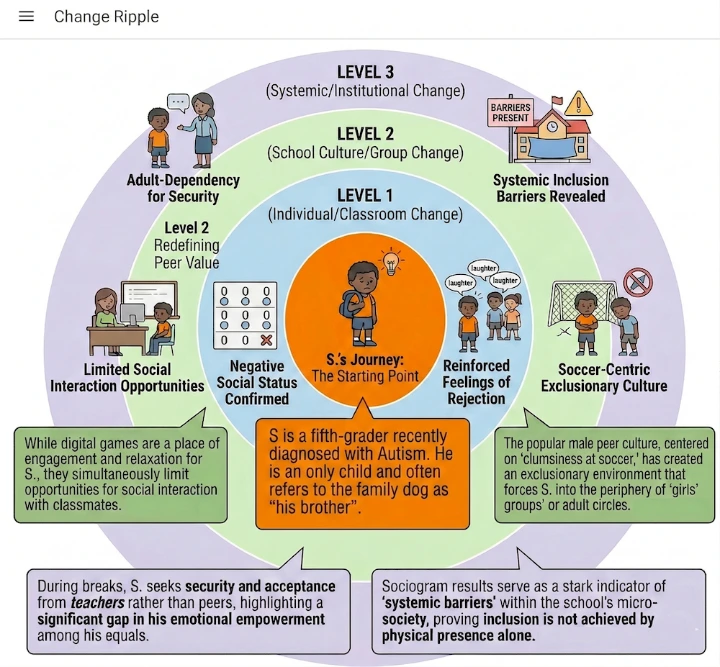
During breaks, S. usually remains alone, choosing to talk to teachers for security or joining the girls’ group rather than participating in group games with male peers.
Digital games and screens provide him a place of engagement and relaxation, but they also limit his opportunities for direct social interaction with his classmates.
In class, S. often interrupts to tell imaginary stories related to his inner world. His classmates often react with laughter or sarcastic comments, reinforcing his feelings of rejection.
A classroom sociogram revealed that he was not chosen by any of his classmates, highlighting a profound lack of stable friendships and significant social isolation.
In the school setting, S. faces significant difficulties in social integration. He is often the target of ridicule for his physical appearance or perceived clumsiness at popular games like soccer.
An only child, he shows a strong emotional connection to the family dog, whom he often refers to as "his brother."
S. is a fifth-grade student recently diagnosed with Autism Spectrum Disorder. This diagnosis has provided a better understanding of his specific behaviors and needs within the school environment.
Reporting from the 1st Primary School of Vrilissia, this story documents the period from September 2025 to January 2026.
Looking for a place
in friend groups
S.’s case highlights the challenges faced by children with autism in mainstream schools regarding social relationships and acceptance.
It is a prime example of the need for targeted interventions for social integration, classroom awareness, and support at the cognitive, social, and emotional levels.
During breaks, S. usually remains alone, choosing to talk to teachers for security or joining the girls’ group rather than participating in group games with male peers.
Digital games and screens provide him a place of engagement and relaxation, but they also limit his opportunities for direct social interaction with his classmates.
In class, S. often interrupts to tell imaginary stories related to his inner world. His classmates often react with laughter or sarcastic comments, reinforcing his feelings of rejection.
A classroom sociogram revealed that he was not chosen by any of his classmates, highlighting a profound lack of stable friendships and significant social isolation.
In the school setting, S. faces significant difficulties in social integration. He is often the target of ridicule for his physical appearance or perceived clumsiness at popular games like soccer.
An only child, he shows a strong emotional connection to the family dog, whom he often refers to as "his brother."
S. is a fifth-grade student recently diagnosed with Autism Spectrum Disorder. This diagnosis has provided a better understanding of his specific behaviors and needs within the school environment.
Reporting from the 1st Primary School of Vrilissia, this story documents the period from September 2025 to January 2026.
Looking for a place
in friend groups
Reading on Mobile?
For the best reading experience or high-quality printing, you can download the full narrative below.
DOWNLOAD PDF STORY 3Reading on Mobile?
For the best reading experience or high-quality printing, you can download the full narrative below.
DOWNLOAD PDF STORY 3Story 3: "Looking for a place in friend groups"
Student 'S' recently transitioned from unexplained behavior to a formal diagnosis of Autism Spectrum Disorder. This shift serves as the most impactful change, moving the school’s approach from "managing behavior" to recognizing a need for targeted interventions. Currently, S. faces confirmed social isolation, seeking security from adults while his peers respond to his internal narratives with laughter or sarcasm.
Story 3: "Looking for a place in friend groups"
Student 'S' recently transitioned from unexplained behavior to a formal diagnosis of Autism Spectrum Disorder. This shift serves as the most impactful change, moving the school’s approach from "managing behavior" to recognizing a need for targeted interventions. Currently, S. faces confirmed social isolation, seeking security from adults while his peers respond to his internal narratives with laughter or sarcasm.
Cambiamento a catena