
Looking for a place in friend groups
S. is a fifth-grade elementary school student. He was recently diagnosed with Autism Spectrum Disorder, which helped to better understand his behavior and needs in the school environment. He is an only child and often refers to the family dog as “his brother”, showing a strong emotional connection with him.
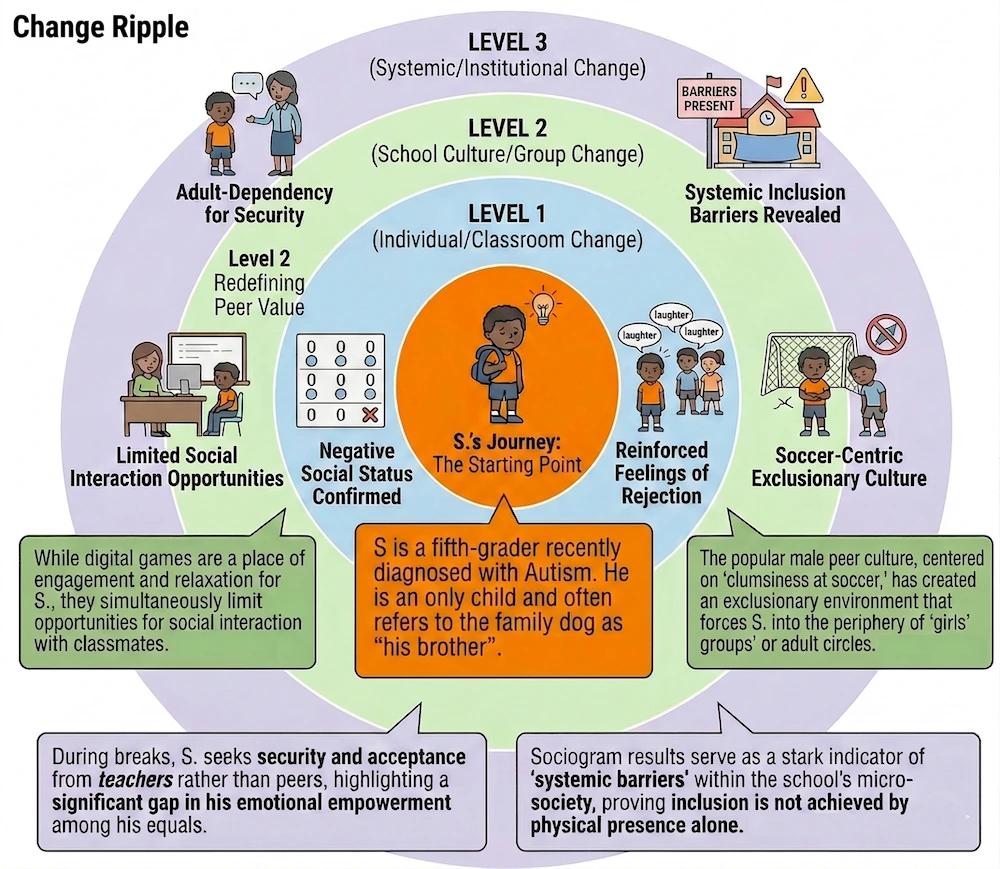
In the school setting, S. faces significant difficulties in his social integration. The sociogram conducted in the classroom showed that he was not chosen by any of his classmates, highlighting his social isolation and lack of stable friendships. During the course of everyday school life, he is often the target of ridicule, both for his physical appearance and for his clumsiness at soccer, a game that is particularly popular among his peers.
During class, S. often interrupts to tell his own imaginary stories, which seem to be related to his inner world and personal interests. His classmates react with laughter or sarcastic comments, which reinforces his feeling of rejection and further hinders his social adjustment. During breaks, S. usually remains alone. He does not participate in group games and chooses to spend his time talking to teachers, seeking security and acceptance from adults rather than his peers, or he joins the girls’ group.
One of S.s’ main interests is his involvement with electronic media. Digital games and screens are a place of engagement, control, and relaxation for him, but at the same time they limit opportunities for social interaction with his classmates.
S.s’ case highlights the challenges faced by children with autism in mainstream schools, particularly in terms of social relationships, acceptance by the group, and managing different modes of expression. It is a prime example of the need for targeted interventions for social integration, classroom awareness, and student support at the cognitive, social, and emotional levels.
Significant Change
This analysis follows the Most Significant Change (MSC) methodology, a participatory form of monitoring and evaluation focused on identifying impactful shifts within social and educational programs.
1. Domains of Change
Social-Emotional Well-being, Inclusive School Culture, and Peer Relationships.
2. Observable Changes
- 1. Diagnosis: Shift from unexplained behavior to a formal diagnosis of Autism Spectrum Disorder.
- 2. Social Status: Confirmed isolation via sociogram (zero peer choices).
- 3. Behavioral Interaction: Seeking "security and acceptance" from teachers or joining female groups instead of popular male peer groups.
- 4. Peer Reaction: Classmates responding to S.'s internal narratives with "laughter or sarcastic comments."
3. Candidate Most Significant Change
The formalization of the ASD diagnosis, which serves as the most impactful shift by moving the school's approach from "managing behavior" to recognizing a need for "targeted interventions".
4. Stakeholder Mapping
Student (S.), S.'s family (including his emotional connection to his dog), Classroom Teachers (Author), Classmates (including both the "soccer" group and the "girls' group")
Reflection Prism
Pedagogically, this story illustrates the "significant change" required to shift from a medical diagnosis to an active educational theory of inclusion. S.’s interruptions are not mere behavioral flaws but a "different mode of expression" that requires other strategies (i.e a Universal Design for Learning UDL) approach. His interest in electronic media presents a clear opportunity for teacher capacity building; instead of allowing digital games to be an "isolated place," they could be bridged into the classroom as a collaborative tool to showcase his strengths. This would move S. from a "limited or symbolic" presence to one of meaningful academic participation.
S.’s mental well-being is currently characterized by a struggle for emotional resilience in a climate of "ridicule" and "rejection." His "imaginary stories" function as a psychological sanctuary—a place of control and relaxation that shields him from a reality where he feels physically and socially "clumsy." The fact that he views his dog as a "brother" suggests a profound lack of sense of belonging among humans, leading him to seek parity with a non-judgmental companion. While his diagnosis offers clarity, his current reliance on adults for security highlights a significant gap in his emotional empowerment among peers.
The sociogram results serve as a stark sociological indicator of the "systemic barriers" S. faces within the school’s micro-society. The popular male peer culture, centered on "clumsiness at soccer," has created an exclusionary environment that forces S. into the periphery of "girls' groups" or adult circles. This dynamic proves that inclusion is not achieved by his physical presence alone. To foster community cohesion, the school must move toward "classroom awareness" interventions that dismantle the athletic-performance hierarchy, allowing S. to be valued for his unique cognitive and social contributions rather than being defined by his "isolation."