
Not just presence, but participation
Student F. is a fourth-grade student. From the moment you meet her, you understand the effort she makes every day to meet the demands of school.
F. has mobility difficulties. She wears braces on her legs often needs physical support to move around safely. She cannot walk long distances on her own and relies heavily on the adult next to her.
She has a twin sister who attends another class at the same school. Her sister has learning difficulties and has been diagnosed with ADHD, but does not have mobility problems. The two sisters have a good relationship with each other, there is love and connection, but the difference in their difficulties creates comparisons.
When F. joined elementary school, in first grade, the atmosphere was encouraging. Many of her classmates were eager to help her, to accompany her during recess, to keep her company. The presence of a parallel support teacher was helpful, and F. felt that she belonged to the group.
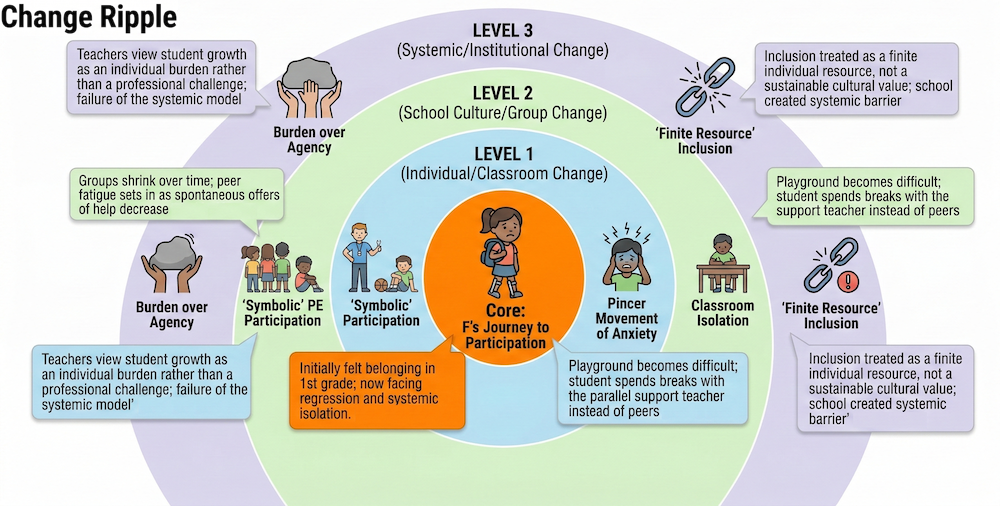
In the following school years, however, things changed. As the children grew older, the groups began to shrink. Her classmates seemed to “get tired” of her. Spontaneous offers of help became fewer and fewer, and F. began to spend more and more breaks in the classroom or with her parallel support teacher. Not because she didn’t want to go outside, but because the playground became a difficult place, full of movement, running, and games in which she could not participate equally.
Physical education class is one of the most demanding moments of her school life. The activities are often not adapted to her abilities, resulting in her participation being limited or symbolic. Similar difficulties arise on school trips, especially when they involve travel and a lot of walking. F. tries to keep up, but often falls behind, both literally and figuratively. Some teachers express hesitation or refusal to accompany her, stating that she has “grown up” and that it is now physically more difficult to support her, as she leans on them too much. These statements, although practical, reveal the lack of adequate support from the school and the shifting of responsibility to the individual rather than the system.
In the family environment, F.’s parents have high expectations. They pressure her to be an excellent student, devoting many hours to reading, revision, and extra lessons at home. For them, academic success seems to be the way to “compensate” for her difficulties. For F., however, this pressure often translates into fatigue, anxiety, and fear of failure. F. is growing up in an environment where physical limitations, social isolation, and high expectations coexist. Her story is not just the story of a child with motor difficulties, but a case study that highlights the importance of meaningful inclusion, empathy, and collective responsibility on the part of the school, family, and society.
This analysis follows the Most Significant Change (MSC) methodology, a participatory form of monitoring and evaluation focused on identifying impactful shifts within social and educational programs. Unlike traditional indicator-based monitoring, MSC allows us to capture the "messy," unexpected, or indirect consequences of an intervention—including those that highlight systemic failures or "lessons learned".
Significant Change
This analysis follows the Most Significant Change (MSC) methodology, a participatory form of monitoring and evaluation focused on identifying impactful shifts within social and educational programs.
1. Domains of Change
Social-Emotional Well-being, Systemic Inclusion/Policy, and Teacher Agency.
2. Observable Changes
- 1. Social: Peer support shifted from "eager to help" in 1st grade to classmates getting "tired" and groups "shrinking" by 4th grade.
- 2. Physical/Recess: Moved from being part of the group to spending breaks "in the classroom or with her parallel support teacher."
- 3. Pedagogical: Participation in PE and trips moved from being inclusive to "limited or symbolic."
- 4. Staffing: Teachers transitioned from encouraging support to "hesitation or refusal" to physically assist her.
- 5. Psychological: Student now experiences "fatigue, anxiety, and fear of failure" due to high academic pressure.
3. Candidate Most Significant Change
The shift from active social belonging to systemic isolation as the school environment failed to adapt to the student's increasing physical and social needs over time.
4. Stakeholder Mapping
F (student), Twin sister, Classmates, Parallel Support Teacher, Classroom Teachers, PE Teacher, Parents.
Reflection Prism
From a pedagogical perspective, F.'s experience represents the "inclusion trap"—where a student has physical presence but lacks meaningful participation. The "symbolic" participation in PE and trips points to a lack of Universal Design for Learning (UDL) and a deficit in teacher capacity to adapt curricula. Most concerning is the teachers' shift in agency, where they view the student’s physical growth as an individual burden rather than a professional challenge. This reflects a pedagogical failure to move from a "charity" or "medical" model of support to an educational theory of full accessibility.
This story documents a distressing regression in social-emotional well-being. While the student initially felt a sense of belonging, the narrative highlights the psychological toll of "peer fatigue" and systemic withdrawal. The shift from a supportive group to isolation with an adult helper can foster learned helplessness and a reduction in motivation. Furthermore, the student is caught in a "pincer movement" of anxiety: she is physically excluded at school while facing "high expectations" at home to compensate for her disability. The resulting "fear of failure" suggests that the current inclusive model is failing to protect her emotional resilience.
Sociologically, this narrative is a case study in how group dynamics can erode if not intentionally maintained. The "shrinking groups" and classmates "getting tired" are not just natural social evolutions; they are symptoms of a school culture that lacks collective responsibility. By allowing the parallel support teacher to become the student's sole social outlet, the school has created a systemic barrier that reinforces her status as "other." Inclusion is being treated as a finite resource provided by individuals, rather than a sustainable cultural value that addresses the shifting needs of a growing child.