
When Diversity Becomes Strength
Student P. is a second-grade student from Africa who lives in a single-parent foster family. He attended our school for the first time last school year as a first-grade student.
P. is a second-grade student from Africa who lives in a single-parent foster family. He attended our school for the first time last school year as a first-grade student.
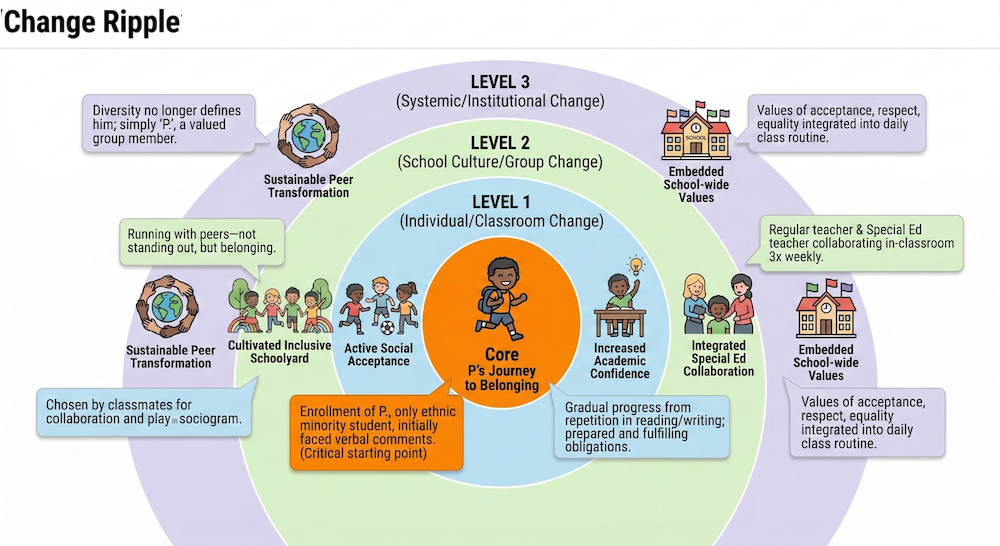
During the enrollment process, isolated incidents of verbal comments from older students related to the color of his skin were recorded.
The first-grade teacher was fully informed about the student's social and family background. In the classroom, the teacher placed particular emphasis on cultivating values such as acceptance, respect for diversity, and equality. These actions were integrated into the daily routine and functioning of the class.
At the learning level, systematic repetition was applied in reading and writing, with the aim of strengthening the student's basic skills . The support was provided in collaboration with the special education teacher, who provided in-school support three times a week, within the classroom. This collaboration contributed significantly to the gradual progress and strengthening of his self-confidence.
It is worth noting that P.is the only student with a different ethnic background at the school. This factor was taken into account in the design of the educational interventions, with the aim of ensuring his smooth social integration and emotional empowerment.
During this school year, as a second-grade student, P. appears to be fully integrated into the school environment. He actively participates in the learning process, comes to school prepared, and consistently fulfills his obligations. According to the results of a sociogram conducted in the class, he is chosen by his classmates for collaboration and play, which shows that he is accepted and has developed friendly relationships. He may remain the only student in the school with a different ethnic background, but today that does not define him. He is simply P.: a child with a smile, with determination, with friends, with a place in the group. And perhaps the most beautiful image is the one that shows him in the schoolyard, running with the other children—not standing out, but belonging.
Significant Change
This analysis follows the Most Significant Change (MSC) methodology, a participatory form of monitoring and evaluation focused on identifying impactful shifts within social and educational programs.
1. Domains of Change
Social-Emotional Well-being, Academic Achievement, and Inclusive School Culture.
2. Observable Changes
- Shift from receiving "isolated incidents of verbal comments" to being "chosen by classmates for collaboration and play."
- Progression from requiring "systematic repetition" to "consistently fulfilling obligations."
- Change from "standing out" as a newcomer to "belonging" in the schoolyard.
3. Candidate Most Significant Change
The transition from the student's background "defining him" to his acceptance as a peer, evidenced by the sociogram results where he is an active choice for collaboration.
4. Stakeholder Mapping
Student (P.), Foster parent, First-grade teacher, Second-grade teacher (Author), Special Education teacher, older students, and classmates.
Reflection Prism
From a pedagogical standpoint, the "Significant Change" highlights the efficacy of collaborative teaching models. The integration of the special education teacher for "in-school support" within the regular classroom represents a shift from "extraction-based" intervention to embedded inclusive practice. This strategy prevented the student from being further marginalized. The teacher's use of "systematic repetition" serves as a practical application of Mastery Learning theory, ensuring basic skills were solidified before moving to complex tasks. This increased teacher capacity to manage a diverse classroom without compromising individual student progress.
The narrative illustrates a profound shift in the student's emotional resilience and sense of belonging. Initially, the student faced social isolation through "verbal comments," which often undermines a child's self-concept. However, the systematic support from teachers provided a "scaffold" for his self-confidence. The psychological "Significant Change" here isn't just the absence of bullying, but the presence of active motivation. By the second grade, the student moves from a state of vulnerability to one of determination, suggesting that the school environment has successfully fostered a "secure base" for his mental well-being.
The sociological impact is best measured through the sociogram, which indicates a shift in group dynamics. In many school settings, being the "only" student of a different background creates a "visibility trap". The teacher addressed this systemic barrier not by ignoring the difference, but by cultivating a "culture of equality" in the daily routine. The change here is the normalization of diversity: the student is no longer "the outsider" but a "friend" and "collaborator." This fosters community cohesion, proving that intentional social engineering within a classroom can dismantle external prejudices and foster genuine inclusion.