
J's Story
J. is a ninth-grade student who benefits from additional support measures due to learning difficulties that have accompanied him throughout his educational journey.
Academic tasks have often required differentiated approaches, individualized support, and greater effort to achieve the expected outcomes. In addition, J. grew up in a family environment marked by instability, a circumstance that sometimes affected his self-confidence and his perception of his place within the school community.
Despite these challenges, J. has always demonstrated a remarkable willingness to participate in school life. Teachers frequently describe him as a student who is available, cooperative, and eager to contribute whenever he is given the opportunity. Although academic achievement was not always the area in which he excelled, J. consistently revealed qualities such as perseverance, responsibility, and a genuine desire to be involved.
The most significant change in J.'s school experience emerged through his participation in extracurricular activities, particularly the School Radio and the Multimedia Club. These projects provided a different context for learning, one in which practical skills, creativity, teamwork, and commitment were highly valued.
Under the guidance of his mentor, an Information and Communication Technologies (ICT) teacher, J. began to take on increasingly important responsibilities. He became involved in recording and editing audio content, supporting multimedia productions, preparing materials for school events, and assisting with technical tasks. These experiences allowed him to demonstrate competences that were not always visible in traditional classroom settings.
Reflecting on J.'s journey, his mentor, P., stated:
"From the very beginning, J. showed an enormous willingness to learn and participate. Even when he was unsure of his abilities, he never refused a challenge. Over time, he became one of the students I could trust most when a task needed to be completed. What impressed me most was not his technical development, but the confidence he gained in himself."
From the Margins to the Core
As J. became more involved in these projects, other teachers also began to notice changes in his behaviour, motivation, and interactions with others.
Mrs. T., one of his teachers, observed:
"In the classroom, J. often struggled to demonstrate what he knew. However, when we started to see the work he was producing in the Multimedia Club, it became clear that he possessed skills and talents that were not being captured through traditional forms of assessment. His participation helped us to look beyond his difficulties and recognize his strengths."
Mr. B., another of his teachers, highlighted the impact on J.'s self-esteem:
"The difference was visible. J. became more confident, more willing to express his ideas, and more proud of his achievements. The recognition he received from teachers and peers had a profound effect on how he viewed himself."
Participation in the School Radio also created opportunities for J. to develop social relationships and gain visibility within the school community. His work became known to classmates, teachers, and other members of the school, allowing him to be recognized for his contribution rather than being defined by his learning difficulties.
L. and C., the school psychologist and social mediator pointed out:
”When he first arrived at our school, he kept to himself and found it difficult to connect with others. Through his outstanding contribution to the School Radio and Multimedia Club, he discovered his voice, gained confidence, and learned to value his own story. The recognition he received transformed not only his self-esteem but also the way he engaged with the world around him. Today, he is a sociable, confident, and inspiring young man whose journey has touched us deeply. He is, without doubt, an exceptional human being.”
A., one of his classmates, reflected:
"I didn't know J. could do all those things. When I listened to the radio programmes and saw the multimedia projects, I realized how much work he was doing. He became someone we could count on."
J. himself described the importance of these experiences:
"I liked being part of the Radio and the Multimedia Club because people trusted me. I felt that what I did was important. I learned many things and I was happy when others liked my work."
These experiences contributed not only to the development of technical and digital competencies but also to J. 's sense of belonging, autonomy, and personal value. Through meaningful participation, he discovered contexts in which he could succeed and make a positive contribution to the school community.
From a Most Significant Change perspective, the most important transformation was not simply the acquisition of new skills. The most significant change was the shift in how J. saw himself and how others perceived him. Through opportunities that valued his interests and abilities, he moved from being viewed primarily through the lens of his learning difficulties to being recognized as a capable, committed, and valued member of the school community.
J. 's story reminds us that inclusive education is not only about providing support for difficulties. It is about creating opportunities for every student to reveal their strengths, develop their potential, and experience success. His journey demonstrates how trusting relationships, meaningful participation, and recognition of individual talents can transform educational experiences and promote genuine inclusion.
This story highlights a broader lesson for schools: when educational communities focus on students' capacities rather than their limitations, they create conditions for empowerment, belonging, and personal growth. J. 's experience shows that every student has talents worth discovering, and that inclusion becomes truly meaningful when those talents are given space to flourish.
Significant Change
This analysis follows the Most Significant Change (MSC) methodology, a participatory form of monitoring and evaluation focused on identifying impactful shifts within social and educational programs.
1. Domains of Change
InclusiveEducation, StudentParticipation, Self-Esteem and Confidence, Social Inclusion, Digital Competence, and School Belonging
2. Observable Changes
- Participation: Shift from limited visibility in traditional academic contexts to active engagement in extracurricular projects.
- Recognition of Strengths: Teachers and peers began to recognize J.'s abilities in multimedia production, radio broadcasting, and technical support.
- Self-Confidence: Increased willingness to take initiative, share ideas, and Changes assume responsibilities.
- Social Inclusion: Improved interactions with peers and stronger sense of belonging within the school community.
- Autonomy and Responsibility: Demonstrated reliability and commitment in carrying out tasks assigned through the School Radio and Multimedia Club.
3. Candidate Most Significant Change
The most significant change was J. 's transformation from a student primarily identified through his learning difficulties to a valued and recognized contributor within the school community, whose strengths and talents became visible through meaningful participation in extracurricular activities.
4. Stakeholder Mapping
J. (student), Family, ICT Teacher/Mentor, Subject Teachers, School Radio Team, Multimedia Club Members, Classmates, and Educational Support Staff
This change was considered the most significant because it represents a profound transformation in how J. was perceived by himself, by his peers, and by the educational community. For many years, his learning difficulties tended to define the way others understood his school experience. Educational discussions frequently focused on the challenges he faced, the support measures he required, and the barriers that limited his academic performance.
The extracurricular projects, particularly the School Radio and the Multimedia Club, created a different context in which J.'s abilities could emerge and be recognized. These environments shifted the focus from what he found difficult to what he was capable of achieving. Through meaningful participation, he demonstrated responsibility, commitment, creativity, and technical competence, qualities that had previously received little visibility within traditional classroom settings.
The significance of this change lies not only in the development of new skills but also in the transformation of J.'s identity as a learner and as a member of the school community. As his contributions became visible, teachers and classmates began to recognize him through a strengths-based perspective rather than a deficit-based one. This recognition fostered greater self-confidence, increased motivation, and a stronger sense of belonging.
The role of the ICT teacher as a mentor was particularly important in this process. By providing guidance, trust, and opportunities for responsibility, the mentor created conditions in which J. could experience success and develop autonomy. This supportive relationship became a catalyst for personal growth and encouraged him to engage more actively in school life.
The change also had a broader impact on the school community. J.'s experience challenged assumptions about what students with learning difficulties can achieve when provided with
meaningful opportunities to participate. It highlighted the importance of inclusive practices that recognize diverse talents and create multiple pathways for success.
From an inclusion perspective, the most significant aspect of this story is that J. moved from being a student primarily supported because of his difficulties to becoming a student valued for his contributions. His journey demonstrates that inclusion is most effective when it enables students not only to access learning but also to actively participate, contribute, and be recognized as capable members of the community.
This story offers an important lesson for schools: when educational environments focus on students' strengths, interests, and potential, they create opportunities for empowerment, social participation, and personal fulfilment. J.'s experience illustrates how inclusive educational practices can reveal hidden talents, strengthen self-esteem, and promote genuine belonging for all learners.
This change was considered the most significant because it represents a profound transformation in how J. was perceived by himself, by his peers, and by the educational community. For many years, his learning difficulties tended to define the way others understood his school experience. Educational discussions frequently focused on the challenges he faced, the support measures he required, and the barriers that limited his academic performance.
The extracurricular projects, particularly the School Radio and the Multimedia Club, created a different context in which J.'s abilities could emerge and be recognized. These environments shifted the focus from what he found difficult to what he was capable of achieving. Through meaningful participation, he demonstrated responsibility, commitment, creativity, and technical competence, qualities that had previously received little visibility within traditional classroom settings.
The significance of this change lies not only in the development of new skills but also in the transformation of J.'s identity as a learner and as a member of the school community. As his contributions became visible, teachers and classmates began to recognize him through a strengths-based perspective rather than a deficit-based one. This recognition fostered greater self-confidence, increased motivation, and a stronger sense of belonging.
The role of the ICT teacher as a mentor was particularly important in this process. By providing guidance, trust, and opportunities for responsibility, the mentor created conditions in which J. could experience success and develop autonomy. This supportive relationship became a catalyst for personal growth and encouraged him to engage more actively in school life.
The change also had a broader impact on the school community. J.'s experience challenged assumptions about what students with learning difficulties can achieve when provided with
meaningful opportunities to participate. It highlighted the importance of inclusive practices that recognize diverse talents and create multiple pathways for success.
From an inclusion perspective, the most significant aspect of this story is that J. moved from being a student primarily supported because of his difficulties to becoming a student valued for his contributions. His journey demonstrates that inclusion is most effective when it enables students not only to access learning but also to actively participate, contribute, and be recognized as capable members of the community.
This story offers an important lesson for schools: when educational environments focus on students' strengths, interests, and potential, they create opportunities for empowerment, social participation, and personal fulfilment. J.'s experience illustrates how inclusive educational practices can reveal hidden talents, strengthen self-esteem, and promote genuine belonging for all learners.
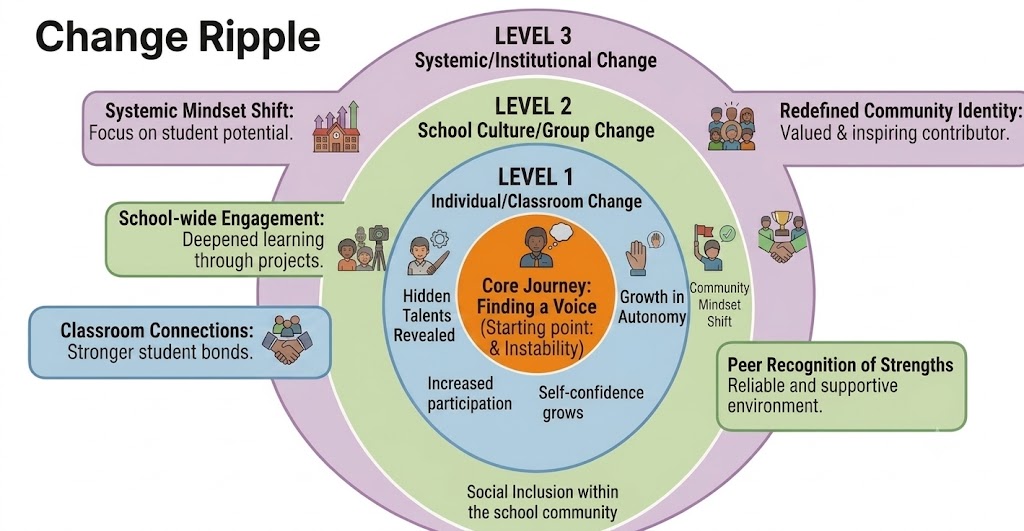
Reflection Prism
From a pedagogical perspective, J.'s experience demonstrates the importance of creating multiple pathways for participation and success within inclusive education. Traditional classroom assessment did not always provide opportunities for J. to demonstrate his strengths. However, extracurricular learning environments enabled him to engage through practical, collaborative, and technology-based activities that matched his interests and abilities.
The role of the ICT teacher as a mentor was particularly significant. Rather than focusing solely on J.'s learning difficulties, the mentor adopted a strengths-based approach, identifying potential, providing responsibilities, and fostering autonomy. This reflects inclusive pedagogical practice at its best: creating learning opportunities that recognize diverse talents and allow students to contribute meaningfully to the school community.
J.'s story highlights that inclusion is not only about access to learning but also about ensuring that every student has opportunities to experience success, competence, and recognition.
From a psychological perspective, J. 's story illustrates the transformative impact of recognition and self-efficacy on student development. For many years, his learning difficulties and challenging family circumstances may have contributed to a fragile academic self-concept and limited confidence in his own abilities. Participation in the School Radio and Multimedia Club provided opportunities for successful experiences that strengthened his sense of competence and personal value.
The most significant psychological shift was the development of self-confidence through authentic achievement. By completing meaningful tasks, receiving positive feedback, and experiencing trust from adults, J. gradually moved from a position of dependency towards greater autonomy. The recognition he received from teachers and peers contributed to a stronger sense of belonging and helped him develop a more positive perception of himself as a capable learner and contributor.
Sociologically, J.'s journey demonstrates the importance of participation as a mechanism for social inclusion. Through the School Radio and Multimedia Club, he occupied valued social roles that increased his visibility and recognition within the school community. His contributions allowed peers and teachers to engage with him through his strengths rather than through the lens of his learning difficulties.
The extracurricular projects functioned as inclusive social spaces where collaboration, shared goals, and collective achievement fostered positive relationships. These experiences contributed to a stronger sense of belonging and challenged deficit-based perceptions that can sometimes limit opportunities for students requiring additional support.
More broadly, J.'s story illustrates how inclusive school cultures are built when communities recognize and celebrate diverse forms of achievement. His experience demonstrates that social inclusion is strengthened when students are given authentic opportunities to participate, contribute, and be valued for what they can do rather than defined by the challenges they face.