
S's Story: An Interrupted Journey
S. is an eight-year-old migrant pupil from Bangladesh. He joined our school, a Primary School with Nursery and Key Stage 1 provision, in January 2026 and was enrolled in one of the Year 3 classes. The greatest challenge during his integration was the language barrier, together with the extreme shyness and insecurity that accompanied him. Verbal communication was severely limited, placing his adaptation and inclusion at school at risk. S. neither understood nor spoke Portuguese or English.
Extreme shyness and insecurity
On S.'s first day at school, the School Cluster's Linguistic and Cultural Mediator, together with the class teacher, welcomed both S. and his father, who spoke some English, although with difficulty.
During this initial meeting, S.'s father was informed about the Portuguese education system, the school's rules and procedures and a sociolinguistic profile was completed. Based on this information, the Multidisciplinary Team for Inclusive Education (EMAEI) defined a range of educational measures aimed at promoting equity, equal opportunities and S.'s successful integration, in collaboration with his parents and the professionals involved (the class teacher, the Portuguese as a Non-Native Language teacher and the learning support teacher).
The EMAEI immediately selected the subjects S. would attend, including Portuguese as a Non-Native Language, Arts Education and Physical Education. The team also planned educational activities to be delivered by the Linguistic and Cultural Mediator, the learning support teacher assigned to the school and the support staff, with the aim of fostering language immersion, interpersonal relationships and the pupil's inclusion within the school community.
According to the Linguistic and Cultural Mediator, who worked closely with S.: "At first, S. would hide behind his cap. He avoided eye contact and reacted with confusion to attempts at communication. Over time, I adapted my strategies to communicate with him more effectively. I prepared cards showing emotions and feelings, which helped him understand me better and feel more comfortable around me. During break times, I organised mime games with the help of both migrant and Portuguese children. These activities worked very well, not only for S., but also for the other pupils, who gradually began to see him as one of their own, accepting his differences and communication difficulties. S. started to participate more in games and enjoy himself. For me, this was the most significant change I observed throughout my intervention."
R., the Portuguese as a Non-Native Language teacher responsible for teaching a group of fifteen pupils from different nationalities, also noted: "During the first month, it was very difficult to explain to S. what was expected in each lesson and each activity. However, S. learns very quickly and, through repeated exposure to essential illustrated vocabulary, which the Mediator and I prepared together, he began naming school objects in Portuguese (pencil, rubber, notebook), colours, foods, school facilities, and much more."
The challenge was equally significant in the mainstream classroom. The class already consisted of twenty-two pupils, including five children from foreign nationalities (India, Nepal, and Bangladesh), in addition to S., who had just arrived.
All the pupils were delighted to welcome a new classmate. However, when the teacher introduced him and they heard the pronunciation of his name for the first time, which sounded similar to the name of a portuguese beverage, a few inappropriate jokes were made. Although S. did not understand them, the teacher could not allow the situation to pass unnoticed. She seized the opportunity and organised a rhyming game using each pupil's name. The activity quickly became enjoyable and filled the classroom with laughter.
One pupil, N., also from Bangladesh and enrolled at the school since 2023, spontaneously translated everything that was happening for S. S. smiled at the teacher, indicating that he had understood her intention. From that day onwards, he naturally gravitated towards N.
Recognising the immediate connection between the two boys, the teacher saw a valuable opportunity for S.'s inclusion and entrusted N. with the role of "buddy". N. supported S. in the classroom, during break times, and in the dining hall, translating instructions from teachers and support staff into Portuguese and Bengali, as well as helping communicate S.'s own needs and wishes.
For S., that classmate became his safe haven within the class and throughout the school.
According to the class teacher: "The use of videos, images, and visual cues, the continuous adaptation and simplification of tasks (circling, underlining, matching), close collaboration with the Portuguese as a Non-Native Language teacher, the learning support teacher, the Linguistic and Cultural Mediator and the translation of activities by his buddy sitting next to him all began to bear fruit over time. The most significant change I observed in S. was that, more recently, he started taking the initiative to raise his hand and participate in lessons in practical ways, asking to come to the board and complete Mathematics exercises. Although he was not officially attending Mathematics lessons, he showed great curiosity and a strong desire to learn. He wanted to do what everyone else was doing."
Over time, during break times, S. began seeking out other children to play with independently, without relying on his buddy, N. At this stage, some misunderstandings and conflicts emerged, as S. occasionally displayed aggressive behaviour during games and play.
N. explained to the other children that this was how some children played in Bangladesh and, at the teacher's request, explained to S. in Bengali that in Portugal children are expected to respect one another during games and behave kindly.
It was not an easy journey for S., but through collaboration between the Linguistic and Cultural Mediator, support staff and his family, he gradually understood what needed to change in order to be accepted and included by his new friends.
According to one of his classmates: "At first, S. pushed and hit people when we played tag. I didn't like playing with him because I was afraid he might hurt me. Now he is much more careful and a lot more fun. Mrs V. showed him how we play."
According to Mrs V., one of the school's support staff, the most significant change she observed was: "The way S. started approaching other children on his own initiative and the care he began showing towards them so that he would not hurt them."
Food also proved to be a challenge to S.'s inclusion. Due to his religion and cultural background, he initially showed considerable resistance to the food provided at school.
According to Mrs C., the support assistant who supervised him during lunch: "The most difficult aspect of S.'s inclusion was lunchtime. He did not want to eat and rejected our food without even tasting it. I knew he could not eat pork, but he refused almost everything. He would not eat soup, did not like potatoes, and would not eat fruit, no matter how much I encouraged him. Then one day, N., his buddy, saw how worried I was and persuaded him to try the food. From that day onwards, he started eating a little better, and I felt much more reassured."
What had initially been a concern also became an opportunity. The class was encouraged, including S., to bring alternative snacks from home once a week to share with classmates during break time. Some tasting experiences were highly successful, while others were less so. Nevertheless, the impact on S., the class, and the wider school community was extremely positive, opening horizons to new cultures and traditions.
Whenever a school welcomes a pupil from another country, the entire educational community is enriched by the differences that pupil brings. Everyone makes an effort to adapt and everyone has an opportunity to give their very best in supporting inclusion.
In S.'s case, his journey of inclusion was only just beginning and was already bearing fruit, but it was interrupted. He will now have to begin again.
For the team that worked with S.-teachers, mediator, support staff and the EMAEI team, the feeling was bittersweet. Everyone gave their best and invested considerable effort in welcoming and including S., who left us after only four months.
All records and information regarding the measures implemented to support his inclusion accompanied his individual file to his new school, enabling the staff there to understand both what had been done and the progress he had made. However, nothing conveys this better than telling his story: a story that we hope will ultimately have a happy ending.
Significant Change
1. Domains of Change
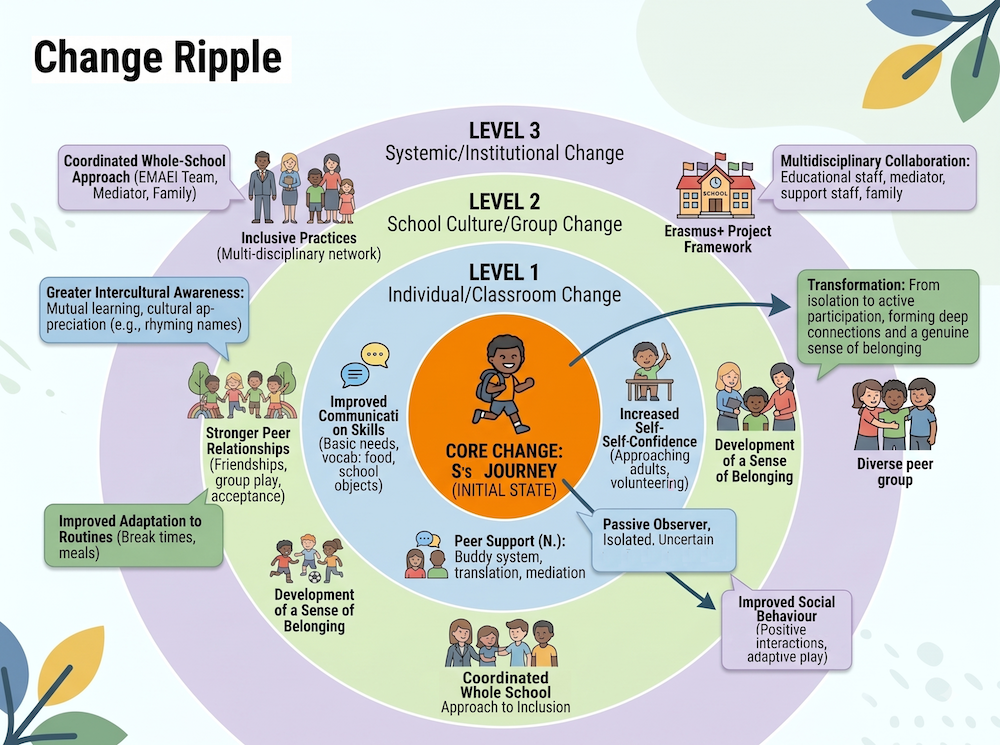
The story reflects change across several interconnected domains, including inclusive education, migrant integration, school belonging, emotional well-being, language acquisition, social inclusion and intercultural understanding. It also highlights increased student participation, the positive impact of peer mentoring, social and emotional development, family engagement and the contribution of a whole-school approach to inclusion.
2. Observable Changes
- Increased Participation in School Life
- S. progressed from a passive observer to an active participant in classroom activities, increasingly engaging in lessons and volunteering to contribute.
- Development of a Sense of Belonging
- S. moved from isolation and uncertainty to becoming a recognised and accepted member of the class and school community.
- Improved Communication Skills
- Through language immersion and targeted support, S. acquired essential Portuguese vocabulary that enabled him to communicate basic needs, interact with peers and participate more confidently in school activities.
- Stronger Peer Relationships
- The relationship with his peer mentor, N., became a bridge to wider social integration, leading to friendships and increased participation in play and group activities.
- Increased Self-Confidence
- S. gradually became more confident in approaching adults and peers, participating in lessons and navigating school routines independently.
- Improved Social Behaviour and Emotional Regulation
- With support and mediation, S. learned to adapt his play behaviours to the expectations of his new environment and developed more positive interactions with peers.
- Greater Intercultural Awareness within the School Community
- The inclusion process fostered mutual learning among pupils and staff, encouraging respect for cultural diversity and promoting intercultural understanding.
- Improved Adaptation to School Routines
- Challenges related to food, communication and social interaction gradually diminished as S. became more familiar with school expectations and routines.
3. Candidate Most Significant Change
- The most significant change was S.’s transformation from a withdrawn and isolated child, unable to communicate and uncertain of his place within the school, into a confident pupil who actively participated in school life, formed meaningful relationships with peers and developed a genuine sense of belonging within the school community.
- This transformation was achieved through a coordinated whole-school approach involving educational staff, family members and peer support, demonstrating that successful inclusion begins when children feel accepted, valued and connected to others.
4. Stakeholder Mapping
The key stakeholders involved in S.’s inclusion journey included S. himself and his family, alongside a multidisciplinary network of educational professionals comprising the class teacher, the Portuguese as a Non-Native Language teacher, the Learning Support Teacher, the Linguistic and Cultural Mediator, the EMAEI team and support staff. The process was further strengthened by the contribution of S.’s peer mentor, N., his classmates and the wider school community, all of whom played an important role in supporting his adaptation, participation and sense of belonging.
From a Most Significant Change perspective, the most remarkable transformation in S.'s journey was not simply his acquisition of a new language, but his transition from a child who arrived withdrawn, isolated, and unable to communicate with those around him, into a confident pupil who actively engaged in school life, formed meaningful relationships with his peers and developed a genuine sense of belonging within the school community.
This change is considered particularly significant because it demonstrates that inclusion involves much more than language acquisition. While learning Portuguese was an important part of S.'s journey, the most meaningful outcome was the development of trust, confidence and social connections. As S. began to feel accepted and valued by his classmates and the adults around him, he became increasingly willing to participate, communicate, learn and engage with others.
Several factors contributed to this change. These included the coordinated work of the Multidisciplinary Team for Inclusive Education (EMAEI), the support provided by the Linguistic and Cultural Mediator, the Portuguese as a Non-Native Language teacher, the class teacher, support staff and S.'s family. Equally important was the role played by his peer mentor, N., whose support helped bridge linguistic and cultural barriers during the first months of adaptation.
Although S.'s journey at our school was unexpectedly interrupted by his family's relocation, the progress he made in just four months demonstrated the positive impact that a whole-school approach to inclusion can have on a newly arrived migrant pupil. His story also highlighted the capacity of children, families and educational professionals to learn from one another and to build meaningful relationships across linguistic and cultural differences.
For all those involved, S.'s story remains a powerful reminder that successful inclusion begins when a child feels that they belong.
This story demonstrates that belonging is one of the most powerful drivers of inclusion.
While language support remains essential, meaningful inclusion occurs when children feel accepted, valued and connected to others. Relationships often become the bridge through which learning, participation and wellbeing develop.
The experience also highlights the value of peer mentoring, intercultural mediation and multidisciplinary collaboration in supporting newly arrived migrant pupils.
Schools should adopt whole-school approaches that combine language support with social, emotional and relational dimensions of inclusion.
Structured peer mentoring programmes, intercultural mediation, collaborative teaching practices and family engagement can significantly enhance the adaptation of newly arrived migrant pupils.
The experience also demonstrates the importance of coordinated multidisciplinary responses. When teachers, support staff, mediators, leadership teams and families work together, schools are better positioned to create environments where every child feels recognised, respected and valued.
Ultimately, this story reminds us that successful inclusion begins when a child feels that they belong.
Change Ripple
Review the significant changes in this 'Change Ripple' infographic. Click image to enlarge
Reflection Prism
From a pedagogical perspective, the story demonstrates the importance of inclusive teaching practices that respond to individual needs while promoting participation. Through visual supports, adapted learning activities, differentiated instruction and close collaboration between professionals, barriers to learning were progressively reduced. The educational response focused not only on language acquisition but also on ensuring that S. could actively engage in classroom life. His decision to raise his hand, volunteer for activities and show curiosity about subjects beyond those formally assigned to him illustrated the impact of these inclusive pedagogical approaches.
From a psychological perspective, the most significant transformation was the development of confidence and emotional security. When S. first arrived, he appeared withdrawn, avoided eye contact and struggled to communicate with those around him. The absence of a shared language, combined with the uncertainty of a new environment, limited his participation and social interaction. Over time, however, supportive relationships with adults and peers enabled him to feel safer and more confident. His growing willingness to engage in lessons, approach classmates and participate in school activities reflected a profound increase in self-confidence and emotional well-being.
From a sociological perspective, the story highlights how inclusion is fundamentally a relational process. At the beginning of his journey, S. occupied a peripheral position within the school community due to linguistic and cultural barriers. As relationships developed, he gradually became part of friendship groups, playground activities and classroom interactions. The change was not only individual; it also involved the class and wider school community learning how to welcome, understand and support someone whose experiences differed from their own. Inclusion emerged through participation, interaction and mutual recognition.
An intercultural perspective provides an additional layer of understanding. S.’s journey was not simply a process of adapting to a new school; it was a process of navigating between cultures. Challenges related to communication, play behaviours, food preferences and social expectations required mutual adaptation from both S. and the school community. The role of intercultural mediation was particularly important in helping bridge cultural differences and transform potential misunderstandings into opportunities for dialogue and learning. The experience encouraged greater cultural awareness among pupils and staff and demonstrated that diversity can be a source of enrichment for the entire community.
The story also highlights the importance of peer support (peer support perspective). While many adults contributed to S.’s inclusion, the role played by N. was exceptional. As a fellow pupil from Bangladesh, N. became far more than a translator. He acted as a cultural bridge, a trusted companion and a source of emotional security. His support enabled S. to understand routines, communicate his needs and build confidence in unfamiliar situations. The relationship between the two boys demonstrates the powerful role that peer mentoring can play in fostering inclusion, belonging and resilience among newly arrived migrant pupils.
From a family perspective, the story highlights the importance of trust, collaboration and shared commitment in supporting the inclusion of newly arrived migrant pupils. Throughout S.’s journey, his family maintained a positive relationship with the school and worked alongside educational professionals to support his adaptation to a new linguistic, cultural and educational environment. The father’s emotional farewell reflected not only gratitude for the support provided but also recognition of the school as a welcoming and caring community during a period of significant transition and uncertainty. This perspective reminds us that successful inclusion extends beyond the pupil and is strengthened when families feel respected, involved and supported throughout the process.
From a leadership and organisational perspective, the positive changes observed were made possible through a coordinated whole-school approach. Teachers, support staff, the Linguistic and Cultural Mediator, EMAEI, school leadership and the family worked collaboratively to create a network of support around the pupil. The consistency of this response ensured that inclusion was not viewed as the responsibility of a single professional but as a shared commitment across the school community. This collaborative culture enabled timely responses to challenges and created the conditions necessary for meaningful and sustainable change.
Taken together, these perspectives suggest that the most significant change in S.’s story was not simply the acquisition of a new language or the successful adaptation to school routines. Rather, it was his transformation from a child who arrived feeling isolated, uncertain and disconnected into a pupil who felt recognised, valued and genuinely part of a community.
The story demonstrates that belonging is both the outcome and the foundation of inclusion. Once S. experienced acceptance, trust and meaningful relationships, he became increasingly able to participate, communicate, learn and contribute. His journey reminds us that successful inclusion is achieved not through a single intervention but through the combined efforts of individuals, relationships and systems working together to ensure that every child feels that they belong.