
Start writing here...
Mark's Story: A Storyof Inclusion
The story concerns Mark, a 9-year-old student of Ethiopian nationality attending the fourth grade of primary school.
The story concerns Mark, a 9-year-old student of Ethiopian nationality attending the fourth grade of primary school. His inclusion journey is guided by the Institute's motto: "It takes a whole village to raise a child," a principle that well represents the educational vision shared by the school community.
The school context is strongly oriented towards promoting inclusion. Management constantly sensitizes teaching and non-teaching staff to the importance of guaranteeing personalized learning paths as a fundamental right for every student. This educational action is supported by National Documents and current legislation.
For Mark, at the end of the second grade, the ASL RM1 recognized the application of Law 104, art. 3 paragraph 1, allowing for the activation of a more structured and targeted path.
The Institute's inclusive culture is detailed in its main planning documents:
PAI 2024–2025: Reiterates that difference is an existential condition of the human being and a right to be welcomed.
PTOF 2024–2025: Promotes the enhancement of diversity and the removal of learning obstacles related to disabilities and migratory backgrounds.
RAV 2025–2028: Provides for the creation of innovative, flexible, and technological learning environments functional for personalized teaching.
The school considers cultural diversity—with students of multiple nationalities present in Mark's class—as a resource and an asset in everyone's growth path.
During the 2022–2023 school year, in first grade, the class stopped at a villa for recreation during a theater field trip. When it was time to leave, Mark refused to get off the swing, explaining he had never been on one before and had never been to a playground. This episode powerfully represented his history of experiential and social deprivation.
- Family Background: Mark is Ethiopian and belongs to a class of 21 children that has been welcoming from the start. He is the third of six children; two adolescent brothers still live in Ethiopia with their maternal grandmother. In Italy, the family consists of the mother, father, and younger siblings.
- Previous Schooling: He came from a municipal preschool where he was unable to follow a path suited to his needs. At the start of primary school, he appeared unschooled, with barely intelligible language, clear socialization difficulties, poor personal autonomy, and sudden, unmotivated crying fits.
- Social Context: His parents Parents report some difficulties or discomfort that occurred during preschool.. The father expressed deep disappointment that the need for evaluation was only communicated in April of the final year. The family lived in deep socio-economic hardship: the father worked in a subway cleaning cooperative, while the mother was unemployed and caring for the younger children.
Strengths Initial Critical Issues
Tenderness and sweetness Lack of previous schooling
Willingness to learn Intelligibility of language
Joy of life Socialisation difficulties
Strong empathy with teachers Poor personal autonomy
Inclusive Methodologies and Strategies
The school employed several strategies to support Mark:
- Group work and peer tutoring.
- Experiential learning.
- Positive reinforcement and sharing progress.
- Use of technology (LIM, PC).
- Prompting and Fading techniques.
- Psychomotor activities and use of the school garden as a relational space.
- Seating: Mark's desk was placed in the central island to favour interaction and
- visibility.
Daily Routines and Workshops
Mark was involved in structured routines:
- Morning Greetings: Initially teacher-led, then student-led, often with songs or mimed alphabets.
- Canteen Time: Assignments of responsibility like clearing tables.
- Organization: Independent management of school materials.
- Music Workshops: Used an analog method with simple symbols (dots and
- crosses) instead of traditional notation, allowing full participation. This included body percussion and simple instruments like tambourines and maracas.
- Manual Activities: Manipulative and graphic-pictorial activities helped develop fine motor skills and self-expression.
The school worked in parallel to support the family:
- Employment: Through a collaboration with a cooperative at the hospital, Mark's mother began working. She eventually secured a permanent contract, which, combined with family allowances and disability benefits for Mark and his younger brother, stabilized their income.
- After-School Support: The Institute collaborates with local parishes and retired teacher volunteers for assisted study paths.
- Administrative Support: The school assists the family with residence permit renewals and documentation for exemptions (transport, canteen, medical visits).
- Social Services: Services monitor the family and assist with the search for a larger home to facilitate family reunification with the siblings in Ethiopia.
-
Systemic Barriers and Facilitators
- Barriers: Poor preschool experience, socio-economic hardship,
- language/cultural barriers, and late evaluation.
- Facilitators: Inclusive strategies based on UDL (Universal Design for Learning), flexible classroom organization, strong coordination between school figures and local entities, and a multicultural, welcoming class group.
-
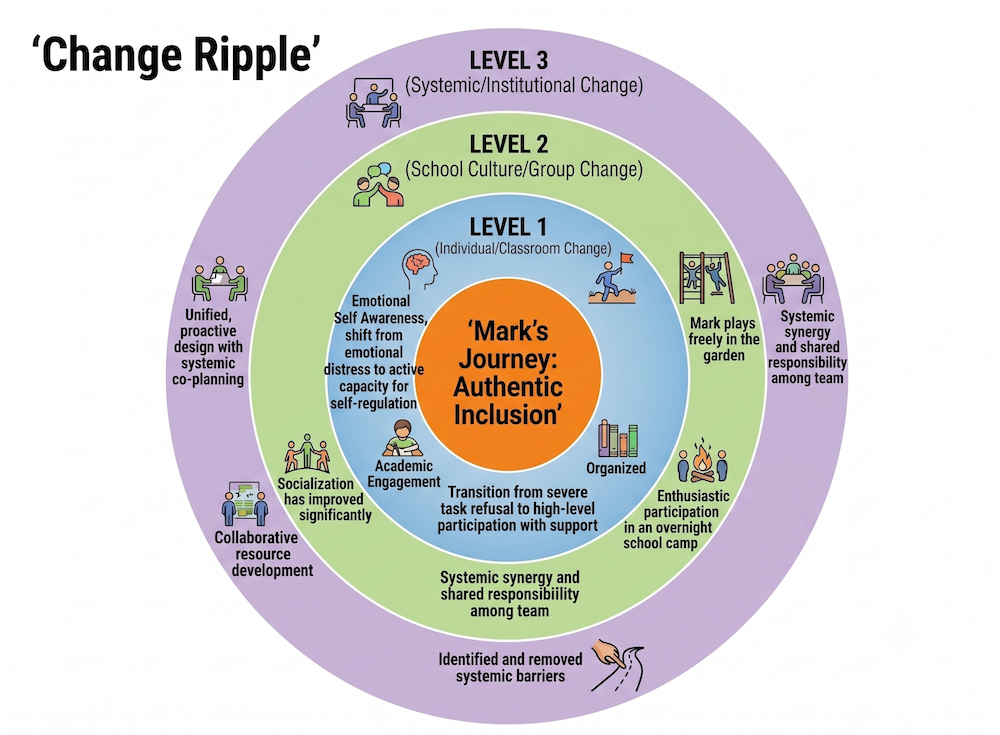
Currently in fourth grade, Mark is a polite child who respects rules and manages his materials independently. His attention span and socialization have improved significantly. A major milestone was his enthusiastic participation in an overnight school camp.
Seeing Mark play freely in the garden and express his thoughts in comprehensible sentences marks his inclusion as an authentic success for the school. The phrase "It takes a whole village to raise a child" has become a daily reality for him.
The teaching team—composed of four regular teachers, two support teachers, and two OEPAC—learned that inclusion is the result of synergy and responsibility. It requires identifying and removing barriers, recognizing diversity as a resource, and practicing equity: "giving more to those who have less".
Table of Inclusion Experience Results
|
Learning Environment |
Creation of an inclusive, welcoming, and motivating environment; increased active participation; value of peer learning. |
|
Organizational and Methodological |
Shared planning among teachers; adoption of active/cooperative methodologies; application of PDP and PEI. |
|
Network and Professional Resources |
Enhanced continuous training for teachers/OEPAC; empowerment of Instrumental Functions; continuous territorial support network. |
This analysis follows the Most Significant Change (MSC) methodology, a participatory form of monitoring and evaluation focused on identifying impactful shifts within social and educational programs.
1. Predefined Domains of Change
Primary Domain: Social-Emotional Well-being & Behavioural Self-Regulation.
Secondary Domains: Inclusive Curricular Adaptation, Peer Collaboration, and Teacher
Agency (Collaborative Action Research).
2. Observable Changes
Emotional Self-Awareness: Shift from profound emotional distress, acute task avoidance, and a sense of isolation to an active capacity to identify triggers, self-soothe, and openly communicate emotional states.
Academic Engagement: Transition from severe task refusal and complete disengagement during traditional literacy and numeracy sessions to high-level participation supported by concrete manipulatives, visual task boards, and multi- sensory storytelling.
Social Integration: Evolution from peer alienation and explosive, protective overreactions during collaborative group work to sustained, prosocial peer interactions utilizing structured roles within cooperative learning groups.
Pedagogical Practices: Shift from an isolated, reactive approach by individual teachers managing behavioral crises to a unified, proactive design characterized by shared visual scheduling, collaborative resource development, and systemic co-planning.
3. Candidate Most Significant Change (MSC)
The Shift: Mark’s transformation from experiencing debilitating emotional volatility and near-total academic disengagement to developing a robust, self-directed toolkit for emotional regulation and active collaborative learning. This fundamentally redefined his identity from a "disruptive student" to a valued, participating member of the classroom community.
4. Stakeholder Mapping
Student: Mark.
School Educators: Curricular Class Teachers, Specialized Support Teacher, and the dedicated Classroom Assistant.
External Collaborators: Local Multi-Disciplinary Health Team (educational psychologists, speech and language therapists), family members, and the wider school leadership team.