
The students who brought about change
This story recounts how a Hungarian high school adapted to integrate non-Hungarian-speaking students, including refugees, into its newly launched secondary programme. Faced with language barriers, the classmaster and school staff embraced flexible communication—using English, peer translation, and digital tools—while adapting assignments and offering extra Hungarian language instruction. Through collaborative teacher efforts, external support from the Menedék Association, and dedicated scheduling, the students achieved independence in Hungarian, leading to lasting structural changes within the school's curriculum.
Story
Summary: The school embraces diversity as a strength and faces a new challenge as non-Hungarian-speaking students, impacted by nearby conflict, arrive at the school.
School is not a boring routine: no two days are alike, and no two groups are exactly the same. Every day brings a new challenge, for which there are best practices, but every situation is different. Our school's strength has always been its diversity, and the teachers here have treated this as an opportunity rather than a problem.
In recent years, a new challenge has emerged in our school, as in others: children have arrived who do not speak Hungarian. The war in our vicinity has only exacerbated this situation. School staff had to learn new methods to integrate students who cannot speak a common language with their peers into daily life. In elementary school, this was achieved fairly quickly; experience showed that the younger a student was when they arrived at school, the easier it was for them to integrate. Of course, this required a tremendous amount of work on the part of the teachers, and the students' openness also played an important role in this.
Summary: The school launches its first 9th-grade class with students from 10 countries, where the classmaster overcomes language barriers to build trust with three non-Hungarian speakers.
In September 2023, we launched our first high school class. We felt it was important for the school to continue to reflect society, where all students work together, as we must prepare them to learn to live alongside one another and cooperate with one another.
The 9th grade started with 36 students from 10 different countries, including several students with special educational needs or learning difficulties. We began the year with a community-building camp, where the students treated each other with exemplary kindness: after just one hour, it was no longer clear who had previously been classmates or friends; everyone was getting to know everyone else. Within the school walls, however, it was evident that teaching and learning the curriculum in a language the students did not know posed a challenge. Everyone was familiar with the system's rules: every student must meet a uniform set of requirements and do so in Hungarian.
As a classmaster, I felt an even greater responsibility to ensure that the students could hold their own in the classroom and meet the requirements. There were three students who didn't speak the language: Yahia, who came from Egypt and spoke English at a native level; Marina, who came from Kazakhstan and spoke only Russian; and Nikita, who came from Ukraine and spoke Ukrainian and Russian perfectly and also knew English quite well. As a student, I had studied German and only switched to English in high school, so I wasn't confident speaking English. Here, however, I had no choice: if I wanted to talk to the students without translation apps, I had to speak English. Communication with Yahia and Nikita worked out this way, but Marina only knew Russian. The quickest way I could communicate with her was to tell Nikita in English what I wanted to say, and she would translate from English to Russian and vice versa.
Summary: Teachers collaborate to support non-Hungarian students through translation tools, adapted assignments, multilingual instruction, and dedicated Russian-speaking staff support.
After that, we met more and more often outside of class, and a trusting relationship quickly developed between us. They told me about the difficulties they were facing, and I tried to find solutions for them. Fortunately, all of my colleagues prioritised the human aspect and supported the students: everyone allowed the students to use translation programmes, and everyone received assignments in the language they requested. Of course, at first we ran into situations where the solution came back in Russian. We have a colleague who speaks Russian, so he also helped grade the papers, even though he didn't teach the class. We also had another colleague who agreed to be available to all Russian-speaking students at the school if they had any problems, since he also knows Russian. The students turned to him with confidence. Later, we were able to adapt the structure of the assignments for the three students so that they could complete them more easily. More and more of us began teaching in two or three languages; often, we didn't even notice that we were speaking in a foreign language.
Summary: The classmaster pulls students for targeted Hungarian language study, sourcing textbooks and aligning grading to build their academic confidence across subjects.
I consulted with my colleagues, and whenever possible, I took the students out of class—even just one lesson at a time—and we began studying in Hungarian. The saddest part was that the students were capable of performing above average in their own language, so they had to face the fact that even though they were capable of it, their lack of language skills greatly slowed them down and even prevented them from achieving a sense of success. Fortunately, I found a lot of teaching materials for learning Hungarian, so I tried to use as varied methods as possible, even though I am not a language teacher. I couldn't accept that such talented students should face constant failure.
I consulted with my qualified colleague to find out which language textbook he would recommend for learning the language, and I purchased them for the students, which allowed me to prepare for the language classes with greater awareness. My colleague also agreed that I would grade the students' work, so they received grades in Hungarian language and literature based on their performance in the Hungarian as a Foreign Language class. During these sessions, we also discussed what difficulties they were having in other subjects, so we studied history, physics, and everything else together in Hungarian, and organised their tasks. In addition, the students were helped by their classmates, although Nikita was very reserved and preferred to work alone.
Summary: Students gain independence in Hungarian and peer integration, prompting the school to plan a official language preparatory programme for future years.
We have now reached the point where we can converse with the students in Hungarian, while they are also specifically preparing for their Hungarian-language exams. They only use a translator when they need to interpret complex texts (such as historical sources), and they are becoming increasingly confident in handling technical terminology. They can independently compose texts on many topics, both orally and in writing. Nikita is studying advanced mathematics and often finds herself in situations with her native Hungarian-speaking classmates where they need to share their knowledge and experiences with one another, which is helping her open up to her peers.
Of course, we still have a lot of work to do, since as new classes have started in high school, this situation arises in every grade, and we want to ensure that students receive regular support not only to become active members of the class community, but also to hold their own in the Hungarian education system and make further education and career development achievable options for them. And I am very grateful to them for helping me overcome my fear and finally speak a foreign language with confidence (even if grammar and pronunciation aren't my strong suits yet). We also hope to obtain permission to launch a Hungarian language preparatory class, where students' primary task in the first year would be to master the Hungarian language as thoroughly as possible, and then, starting the following year, join a class where they study the high school curriculum alongside their Hungarian-speaking peers, with much greater success.
Significant Change
1. Identify Domains of Change
- Refugee & Non-Native Student Inclusion (Primary)
- Teacher Agency & Professional Confidence
- Systemic/Structural School Adaptation
- Peer Cohesion & Social-Emotional Well-being
2. List Observable Changes
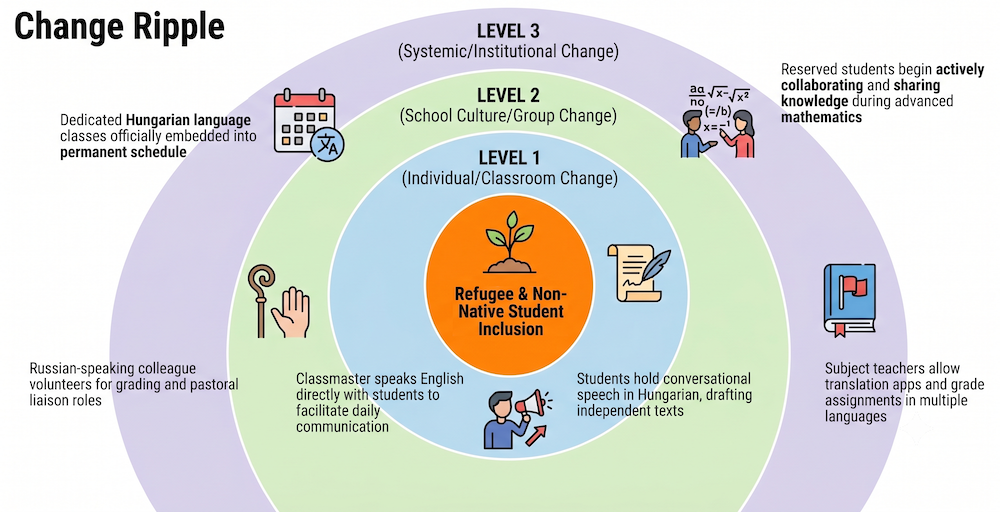
- The classmaster moved from using German and low confidence in English to speaking English directly with students to facilitate daily communication.
- Subject teachers shifted from rigid monolingual instruction to allowing translation apps and grading assignments in Russian or English.
- A non-class Russian-speaking colleague volunteered to grade subject papers and act as a dedicated pastoral liaison for Russian-speaking students.
- Students shifted from entirely relying on translation apps to holding conversational speech in Hungarian, drafting independent texts, and only utilizing digital translation for complex historical or technical sources.
- Nikita, initially noted as highly reserved and working strictly alone, began actively collaborating and sharing knowledge with Hungarian native peers during advanced mathematics.
- The school officially modified its baseline timetable structure to embed dedicated Hungarian language classes into the permanent schedule.
3. Suggest Candidate MSCs
The most impactful shift is the transition from an informal, ad-hoc teacher rescue mission to the formal structural integration of Hungarian as a Foreign Language into the institutional school timetable . This transformed inclusion from an individual teacher's personal burden into a systemic, sustainable school policy.
4. Stakeholder Mapping
Author/classmaster, students, school staff, subject teachers, Russian-speaking teacher, qualified language teacher, external experts and the Menedék Association.
Change Ripple
Review the significant changes in this 'Change Ripple' infographic. Click image to enlarge
Reflection Prism
From a pedagogical standpoint, the story illustrates a dynamic evolution of differentiation strategies, from basic resource modification to practice change. Teachers implicitly rejected a deficit-based paradigm, transitioning from static monolingual tasks to multi-tier language delivery. Mészáros’s collaborative action research approach—consulting specialists, purchasing targeted textbooks, and aligning grading matrices to individual progress—exemplifies high-level teacher agency. Crucially, by embedding specialised language blocks directly into the institutional schedule, the school advanced past individualistic accommodation into sustainable, inclusive instructional design.
This narrative beautifully charts a profound shift in emotional resilience, safety, and identity construction. For non-native students, navigating a curriculum in an unknown tongue initially strips away their sense of agency, forcing high-achieving individuals to internalise a narrative of systemic failure. By structuring human-centric safety nets—such as translation allowances and peer-mediated translation bridges—the school mitigated performance anxiety. The true psychological triumph is visible in Nikita: her transition from protective isolation to active vulnerability in advanced maths showcases how academic validation directly fosters a secure sense of cultural belonging.
This case serves as a powerful microcosm of the Social Model of Disability and Inclusion, highlighting how structural environments must adapt to dismantle barriers rather than demanding assimilation from the individual. The high school classroom consciously mirrored a pluralistic society, actively subverting the systemic rigidity of the uniform Hungarian requirement. By weaving an external non-governmental organisation (The Menedék Association) into the school’s relational fabric, the institution built vital social capital.
Fostering Distributed Leadership and Psychological Safety: School leadership cultivated a culture where teachers felt empowered to innovate and take risks. When classmaster David Mészáros and subject teachers stepped outside standard protocols—allowing translation software, setting multi-language assignments, and adapting assessment matrices—they did so within an environment that prioritised human dignity and academic progress over rigid administrative compliance.
Mobilising Organisational Assets Across Silos: Leadership effectively leveraged existing internal capacity by deploying non-teaching staff resources dynamically. A Russian-speaking colleague who did not teach the specific class was invited to act as a dedicated pastoral liaison and assist with grading. This cross-departmental collaboration maximised staff strengths and ensured wrap-around support without overwhelming individual class teachers.
Embedding Informal Practices into Permanent Structures: The true marker of organisational maturity in this case is the institutionalisation of success. What began as informal, voluntary pull-out sessions in Hungarian was formally integrated into the permanent school timetable. Leadership allocated specific timetable periods and secured qualified language teaching staff, transforming a grassroots teacher effort into a sustainable school policy.
Building Strategic External Partnerships: Recognising the limits of internal resources, school leadership proactively integrated external social capital by partnering with the Menedék Association. This partnership provided specialised NGO support for exam preparation, family administration, and social integration, creating a robust, multi-agency ecosystem around the school.
Driving Visionary Systemic Policy (Preparatory Pathways): Organisational leaders used local classroom learning to advocate for structural policy evolution—specifically proposing a dedicated Hungarian language preparatory year. This forward-looking approach ensures that future cohorts of non-native learners can build linguistic foundations before joining mainstream curricula, establishing a repeatable model for refugee and migrant inclusion.