
A Twenty-Eight Year Journey in Education
My master's degree had barely dried on the paper when, as a newly qualified teacher, I drove from the north to the south. It was a hot August evening in 1998. A huge, glowing sun was setting behind the fields. Twenty-eight years have passed since that moment, and my journey as a teacher and as a person has included all kinds of successes and failures. I work as a crafts teacher in a comprehensive school, teaching textile crafts to pupils in grades 3–9. My pupils are between 9 and 16 years old. In addition to teaching crafts, I also work as part of a team that focuses on preventing bullying. Working with school bullying is challenging and sometimes emotionally demanding; nevertheless, it is rewarding and gives my work an additional sense of meaning.
What are crafts, and why are they studied at school?
Crafts is a compulsory subject for both girls and boys from the first grade through the end of the seventh grade. After that, crafts becomes an optional subject. Officially, the subject is called crafts, and it involves working with both hard and soft materials and carrying out complete craft processes that combine the materials and techniques of textile crafts and technical crafts. Since the classrooms are located in completely different parts of the school building and the groups are fairly large, in practice we teach pupils textile crafts for half the year and technical crafts for the other half. There are 2–3 hours of crafts each week, and every pupil in grades 1–7 studies both types of crafts every school year.
Crafts, together with home economics, which is taught in grades 7–9, is regarded as a general educational subject and as an important way of teaching everyday life skills. Having the same crafts education for girls and boys promotes gender equality in the choice of further studies and careers. In the future, there will be fewer traditional “women’s” and “men’s” professions and household tasks. Craft skills are skills not only of the past but also of the future. In a world facing a climate catastrophe, repairing and recycling materials and products will become increasingly important. Craft skills also strengthen the resilience of communities in dealing with unpredictable situations. Schools should develop creativity, problem-solving skills, design skills, perseverance and responsibility towards the environment.
All forms of manual activity, especially in childhood, are important for the development of motor skills and the brain. One-third of the human brain is involved in controlling the hands. Cooperation between the thinking brain and the working hands is a fundamental skill—in other words, an essential part of human development, particularly in childhood. Simultaneous activation of several areas of the brain strengthens neural networks and supports brain plasticity. Making crafts also calms the body, supports working memory, improves concentration, and increases mental well-being and self-efficacy. Despite all the digitalisation around us, human beings will remain hand-using creatures in the future as well.
Of course, I had noticed the small pupil who stood out from the large group because of her determination. It was obvious that moving around was extremely difficult for her. Despite her difficulties, this little pupil seemed to throw herself wholeheartedly and enthusiastically into every game and activity that interested her.
The pupil had the same class teacher throughout the entire six years of primary school. The teacher is experienced and highly skilled. When she began working with the pupil as she entered our school in first grade, the physiotherapists and occupational therapists had assumed that the pupil would work only with an iPad, because she functioned using only one hand and had poor hand motor skills. Fortunately for the pupil, the experienced teacher questioned the instructions she had been given. Together, the teacher and the pupil’s mother considered that there was an opportunity for development and learning if the right conditions were created. They decided together not to give up immediately, but to try. They agreed to experiment, not to put pressure on the pupil or create expectations, but simply to see what would happen.
A huge amount of fine motor development and new neural connections supporting hand–eye coordination had taken place. Despite digitalisation, handwriting is still an important skill that promotes equality among people. All important documents are still signed with a pen on paper. Thanks to the wise teacher and her mother, the pupil will one day, as an adult, be able to sign her employment contract and mortgage documents with her own unique signature.
I realised this at the bottom of that motivational pit. I decided that we would climb out of it by trusting our intuition and, above all, trying to read the child’s own feelings about the activity.
perseverance.
Significant Change
1. Identify Domains of Change
Based on the narrative provided, this story fits the following domains:
Systemic & Classroom Inclusion: Moving away from exclusionary, separate digital tasks toward full participation in a standard curriculum alongside peers.
Student Motivation & Agency: Shifting from underperformance and a "motivation pit" to taking complete ownership of the learning process.
Teacher Innovation & Professional Growth: Overcoming a lack of prior specialized training by adapting instructional methods based on student- centered intuition rather than strictly clinical guidelines.
2. List Observable Changes
Initial Intervention Refusal: The primary school teacher and mother rejected
the therapists' recommendation to restrict the student entirely to an iPad.
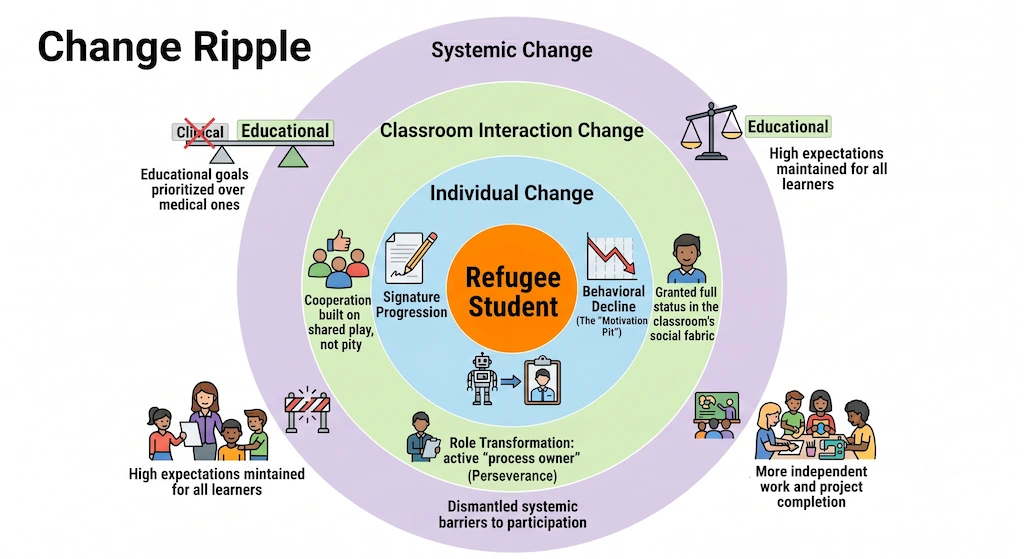
Signature Progression: The student's hand-written signature adapted from covering an entire sheet of paper to a functional, smaller size.
Behavioral Decline (The "Motivation Pit"): When restricted to repetitive, low- complexity motor tasks (needle felting), the student began taking it too easy, letting the assistant take over, and displaying visible frustration.
Role Transformation: The student transitioned from a passive "needle-moving robot" into the active "process owner and supervisor" of complex tasks.
Independent Trialing: Supported by a new assistant, the student began attempting every technical step first before allowing the assistant to step in.
Independent Project Completion: The student successfully designed, measured, cut, and machine-sewed a personalized hoodie.
3. Suggest Candidate MSCs
• The Shift from Task Execution to Process Ownership: The most significant change occurred when the teacher stopped trying to adapt the physical action of crafting for one hand (which led to isolating, unrewarding tasks like endless needle felting) and instead adapted the cognitive and managerial role of the student within the standard project framework. This redefined what "doing" crafts means, transforming the student from a disengaged participant into a collaborative leader.
4. Stakeholder Mapping
Student: A determined pupil with hemiplegia/limited single-hand mobility, whose recognized superpower is perseverance.
Author/Crafts Teacher: Pauliina Impiö, an experienced textile crafts educator and anti-bullying team member.
Primary School Teacher: An experienced, highly professional educator who taught the student for grades 1–6 and established their foundation for learning.
Mother: An active, supportive parent who collaborated with teachers to push past physical limitations.
Assistants: A primary school assistant, followed by a highly effective, encouraging upper-secondary graduate assistant in grade 7.
Clinical Experts: Occupational therapists and physiotherapists who provided functional assessments and recommendations.
Change Ripple
Review the significant changes in this 'Change Ripple' infographic. Click image to enlarge
Reflection Prism
The narrative illustrates a powerful practical application of Vygotsky’s Zone of Proximal Development, mediated beautifully through an instructional assistant. Initially, the teacher fell into a common trap: confusing physical task differentiation with meaningful cognitive engagement. The breakthrough occurred when the pedagogy shifted from modifying outputs to modifying agency. By transforming the student into a "process supervisor," the educator engaged high-order executive functioning—designing, planning, and instructing. This shows that inclusive education thrives when teachers look past clinical limitations and trust instructional intuition to maintain high expectations for all learners.
This story highlights the vital link between authentic belonging, self-efficacy, and emotional resilience. When restricted to repetitive, simplified therapeutic tasks, the student experienced a deep motivational collapse driven by a threat to their autonomy and a feeling of alienation from peers. Shifting the focus to group-aligned goals restored the student's sense of identity and value within the classroom community. By treating "perseverance" as an intrinsic superpower rather than a medical deficit, the educators built long-term emotional resilience, protecting the student from the isolation and vulnerability to bullying that frequently impacts neurodivergent youth.
From a sociological perspective, this narrative documents a successful shift from the medical model of disability to the social model. The clinical advice initially sought to pathologize and isolate the student via a separate, digital-only curriculum. By resisting this and altering the social architecture of the workshop, the school dismantled systemic barriers to participation. Inclusive craftwork became an equalizer, fostering a collaborative culture where peer interactions were built on shared creative play rather than pity or difference. The student was not merely integrated; they were granted full status in the classroom's social fabric.
The narrative underscores a critical human resource insight regarding the strategic deployment of paraprofessionals. Initially, the classroom assistant's presence risked fostering learned helplessness and underperformance. The organizational breakthrough occurred when the assistant's role shifted from a task executor to a facilitator of student agency—requiring the student to attempt physical steps first and step into the role of a process supervisor. For school leaders, this emphasizes that inclusive success relies less on the mere volume of support hours allocated, and far more on deliberately training staff to cultivate cognitive independence, leadership, and true systemic belonging.
Furthermore, a potential operational disconnect is revealed between the school's educational goals and external medical services. Clinical experts prescribed exclusionary, digital-only pathways or isolating, repetitive exercises that triggered a motivational collapse. School leadership must bridge these multi-agency gaps, empowering frontline educators to trust their pedagogical intuition and push back against clinical directives that prioritize physical therapy over peer socialization and student well-being.