
The Boy With The White Face
This story tells the journey of Leo, a student with autism and a history of school refusal and literacy avoidance, as he starts at a vocational upper secondary school. Initially concealing himself behind a painted white face mask, Leo slowly builds trust with his educators, who address his need to understand the "why" behind tasks and provide structured, visual scaffolding for reading and writing.
Story
Summary: A teacher begins at a vocational high school and notices a tall student with white face paint, discovering through handover files his autism diagnosis, past school refusal, and writing avoidance.
It was my first week at a new job, in a type of school that was new to me. Had I prepared myself adequately? What challenges would I be faced with? Previously I had worked in academically oriented, purely theoretical programmes, but this was something different: vocational programmes with a strong focus on the practical. I imagined that the students would be practically inclined with little or even no interest in the theoretical elements that I represented. It would be a challenge, but a challenge I was eager to take on. Later it would turn out that I was both right and wrong in my assumptions. It was a different group of students from what I was used to, but not necessarily in the ways I had expected. I want to emphasise that, both on a group level and an individual level, the similarities are of course infinitely greater than the differences, but some stand out a little, which is of course positive since it forces us to think in new ways and develop our pedagogy, which in the end everyone can benefit from.
I had seen him in the school premises during my first two days; it was impossible to miss him because he stood out from the crowd. The tall boy with his face completely painted white, my initial thoughts went to a classic pantomime artist but with a somewhat punkish aura. In the handover from the lower secondary school there was quite a lot written. He came from previous schooling in IMA: an introductory programme in upper secondary school for students who are not eligible for national programmes and need adapted education to achieve upper secondary eligibility, prepare for working life or another education, with a focus on life skills, compulsory school subjects, and personal development. During the past year he had also received his autism diagnosis. It further stated that he had problems with attendance in lower secondary school and that he refused to write. Relationship and contact with adults were extremely important for him and that one needed to reach him early and form a positive relationship. On the positive side it said that there were no pedagogical difficulties. What a challenge, I thought, how should I approach this boy? Would I understand how he functions, and would we understand each other? Those were thoughts that passed through my mind before my first lesson with the class.
Summary: During a mid-lesson break, the teacher initiates a brief but meaningful conversation with the student, establishing early trust essential for his engagement.
Social Studies 1a1 on Wednesday morning, my first session with the class. There was quite a comfortable, though quiet, atmosphere in the classroom. The students had started a week before me, so perhaps some of the initial uncertainty had settled, but during my discussion prompts I still had to pull the answers out of the students, so they had not yet become completely comfortable. In the middle of the lesson we had a break; most of the students left the classroom, but one boy remained seated. It was him, the one I had seen earlier in the week out in the school's public spaces. He was hard not to notice, taller than most and with his entire face painted white, he stood out in the crowd.
That he sat there alone did not feel surprising, a kind of exclusion that in my ignorance I had almost assumed, but it gave me a good chance to initiate contact with him, so I sat down to talk with him. It was not a long conversation, but it was a good one. It changed my image of the student, who no longer felt so foreign and different, and I believe it was also the first step toward a good relationship that later benefited us both in our continued work. I had read that it was important to reach him early, but afterward I have come to understand exactly how important that actually is. If things go wrong with this student, it can come to a complete stop to the point that it cannot be fixed, so it was important to gain his trust right away.
Summary: The specialized vocational facilities and tight-knit community create a safe environment where students who previously felt different find a sense of belonging.
Physical Barriers
This is a vocational school at upper secondary level with centrally located premises in a mid-sized city. In the facilities there are several kitchens, both training kitchens and large-scale kitchens, as well as two dining halls where students can practise practical tasks but also get real work experience since the dining rooms at certain times are used as a real restaurant with real guests. The premises are fairly fresh and updated, and there are large windows facing north and south that provide good natural light. There is a very limited number of students moving around in these facilities; only those students who attend programmes with some form of kitchen orientation have access to the premises. Therefore, not very many people move around in the facilities and everyone knows each other. Based on this, I would describe the physical work environment as safe and secure for the students who are at the school. The premises themselves therefore do not constitute an obstacle for the student this study is based on; rather, they provide a sense of security that is beneficial for many, including my student.
Social Barriers
Searching for one's identity and wanting to fit in are completely normal feelings for many teenagers. In our school this is even more noticeable; many who come to our programmes have previous school experiences of being a little different, many who have felt that they did not quite fit in. The beautiful thing for many is that they find each other and a sense of safety here, and they also gain a better self-image and self-confidence. It is therefore, in a way, a very diversified student group, and it is clearly part of the school's mission to provide a safe and equal education for students regardless of background, gender identity, or how one identifies. We have different types of students, but many, as mentioned, find a sense of belonging here. My student, whom I will from now on call Leo, has these types of experiences from previous schooling, and it is too early to fully evaluate how he will develop during his entire time with us. However, it is clear that he has already taken big steps toward becoming a more secure, happier person who has found a place where he belongs.
Summary: After understanding the hygiene reasons, Leo removes his makeup for kitchen classes, gradually dropping the protective mask altogether as he feels safer at school.
Pedagogical Barriers
Leo attends a vocational programme focused on restaurant work and baking. At the same time, it is a high school programme that should make it possible to qualify to apply for higher studies at a university or college. The studies therefore consist of a mixture of theoretical teaching and practical teaching.
The teachers in the practical subjects early on expressed concern about Leo regarding his makeup. It would pose a hygiene problem in the kitchen and bakery, and Leo simply had to be without makeup on the days they had practical training. There was concern that this would become a problem, that Leo needed the façade he had painted on himself. Kitchen teacher Ben, who is also one of Leo's mentors, had the conversation with Leo and explained why he was not allowed to wear makeup in the kitchen. Why is very important for Leo; he does not want to do anything if he does not understand why. However, if he understands why, he is adaptable. The conversation was received very well and the outcome was successful; since then the makeup has not been a problem. The effect eventually spread to the days when they only have teaching in theoretical subjects, and now as this is written it is only once in a while that Leo shows up to school wearing his makeup, so the façade that initially felt so important has been torn down. It is mainly on days with schedule-breaking activities that Leo continues to wear makeup; these are days when he needs to meet students outside his own class. From this we can draw the conclusion that Leo quickly found a sense of security in the kitchen and in the context where he normally finds himself at school. In the safe environment there is no need for the external façade.
As previously mentioned, Leo does not actually have learning difficulties, but rather a number of barriers, and one such barrier arises if the teacher does not explain why Leo should do a certain thing or what benefit he has from what they are going through. A pedagogical barrier is therefore the motivation to learn: learning for the sake of learning is not an option, learning because the teacher says they should will not happen, but if you can explain why in a way that Leo understands, then he is willing to work to develop further. Thus, clear leadership is needed where one not only explains how but also what benefit the student has from the knowledge one is trying to convey. It is not the only key, but one of them.
Summary: Teachers implement colour-coded text structures and varied visual/auditory teaching methods to help Leo engage with theoretical content and start writing.
In Leo's case, there is as previously mentioned a neurodiversity in the form of his autism. During his earlier schooling he had a support person who helped him. Instead of developing strategies for writing and reading this person wrote and read for him. Here, the previous school failed to explain why writing and reading skills are important abilities, which meant that Leo did not make an effort to learn them. However, in such a situation it is not enough to have only a why, because it is not only about doing or not doing; clear pedagogical strategies are also needed for how to approach learning. Fortunately, with us Leo has received a Swedish teacher with experience of this type of student with similar difficulties. Swedish teacher Maria has developed a strategy for approaching both reading and writing. It is a strategy that provides a structure for language with visual categories of text. It is logical to think that if you have a longer piece of text, or if you yourself are going to formulate a text, it can feel overwhelming, especially if you are a student who has almost never had to do this yourself. If you can then break the text down into smaller parts and formulate those smaller parts yourself according to a provided pattern, after which you can piece them together into a text, this facilitates learning. If you also colour-code the categories, it suits students like Leo even better. These methods are not exclusively useful for students like Leo; many students have benefited from the strategy that Swedish teacher Maria has developed, especially if they are academically weaker in their language development. Leo himself says that he does not understand how the structure helps him, but at the same time he clearly sees the positive results of this way of handling text. He points out that he now manages to read and understand and can even formulate shorter texts himself, which he previously was not able to do.
In the practical subjects in the kitchen, the teachers also use visual pedagogical tools. Naturally this becomes a natural element because they show how the students should carry out the practical tasks, and the result also becomes obvious since in these contexts it concerns a physical product; thus the need for a clear why is fulfilled more naturally in these subjects. However, even the largely practical subjects contain theoretical elements, and here the teachers use, for example, visual image support as a pedagogical tool. Above all, however, the kitchen teachers emphasise the importance of varying their working methods even during theory sessions. Leo has difficulty reading a book; then he just sits out the time and stares straight into nothingness, they say. But Leo listens very attentively to explanations and follows along well if they show films or presentations; he does not take notes but can always recount what has been said and demonstrated. In this way, despite his difficulties, he is a fairly easy student to work with. He has strategies for succeeding that have worked for him historically, but those strategies largely involve managing without reading and writing. In many subjects he manages without these abilities, but in language subjects this is not possible because there are formal requirements for these abilities.
Summary: Through consistent support from the school counsellor and special education teacher, Leo develops reading strategies, builds confidence, and passes Swedish.
In addition to the teachers who teach Leo, we also have a student health team that is engaged in helping. Leo has regular meetings with the school counsellor; due to confidentiality we do not know what is discussed there, but one thing we do know and which says something about what Leo is like is that already at the first meeting he scheduled the same time every week for the rest of the school year. This shows partly how he has a need to structure his everyday life, but even more it shows the importance of good relationships with the adults at school and the sense of security that this provides for this type of student.
In addition to the school counsellor, it is our special education teacher Yasmin who has weekly sessions with Leo. She immediately noted that Leo has a very well-developed vocabulary and is verbally very strong. At the same time, he had his challenges with reading and writing; he likely also has dyslexia, Yasmin noted, but he has not been formally assessed, so it is not documented as an official diagnosis. Initially, their joint work focused on motivating Leo to engage with writing, and Yasmin tried to identify the obstacles that were holding him back. At the same time, she was careful to acknowledge Leo's feelings and not override them, recognising the importance of building trust with Leo, a foundation that then would allow her to challenge him. Once this was established, they began tackling tasks from various subjects, while Swedish teacher Maria worked on developing a strategy for approaching texts. Leo's and Yasmin's sessions provide a pressure-free complement to the regular classes, a safe environment where Leo can calmly engage with tasks and receive Yasmin's help in following the provided structure. Over time, Leo became increasingly comfortable and made progress in his reading and writing, so he then started to have a choice in his sessions with Yasmin. When Leo has an assignment from another subject that he finds difficult, he can choose to get help with it, but quite often today he can choose to practise general reading skills, and Yasmin has exercises at various challenging levels that they work on. In these exercises, they often read and analyse factual texts and practise skills such as reading between the lines, which is difficult for students like Leo. Yasmin's work together with Maria's efforts and Leo's own dedication has led to Leo going from not writing a single word to currently passing Swedish. Both Yasmin and Maria now feel confident that Leo will succeed in the national exams at the end of the term, something that initially seemed very far off.
Summary: Leo thrives in vocational settings, earns top evaluations and a job offer at a bakery internship, and demonstrates core keys to inclusive teaching.
Leo's text-based progress in theoretical subjects is therefore significant, and it is of course something he has had to work very hard to achieve. Still, it is his personal development that strikes me the most. From the boy who, in his first time at school, hid behind a painted mask to the person we see in front of us today makes me and my colleagues genuinely happy. Leo excels in the kitchen and serving, and as one of a few selected first-year students, he has participated in serving at the Christmas buffet and has successfully completed his internship at a bakery. Bakery teacher Eddie has never before received such a glowing evaluation from an internship placement as he did for Leo; they are even willing to offer Leo a part-time job, which clearly shows how appreciated he was.
So what I have concluded in my study so far is that for this type of student, a student with autism and a previous schooling that partly avoided the challenges instead of finding strategies to overcome them, certain things are essential for teaching to be effective.
- The student needs to understand why they are doing what we want; simply conveying what we want does not work, even if we have a plan and know what it will lead to if students follow it.
- Teaching must follow a clear structure.
- In cases where it is not only about doing but also understanding, a well-founded pedagogical strategy is required, especially if it concerns something the student has weaker knowledge in.
- A relationship with the student built on trust is vital, the earlier established, the better, as it can be very difficult for these students to change their minds once they have made a decision.
Three out of four of these points are not enough; all are needed and do not work without each other. Of course, not all students with autism are the same; it is more than a student's diagnosis that determines how they are, and this study is based on a single case. But there is a high likelihood that experiences from this study may resonate with your students, and fundamentally, our students are much more alike than different.
Significant Change
1. Identify Domains of Change
- Primary: Neurodiversity & Inclusive Practice.
- Secondary: Student Agency & Self-Esteem , Development of Literacy Skills , and Teacher-Student Relationships.
2. List Observable Changes
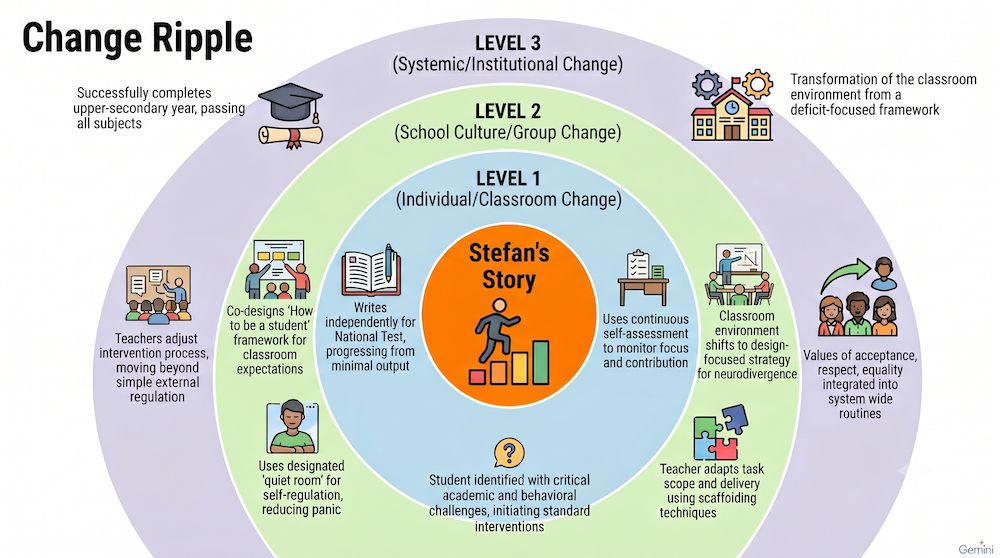
- Leo transitioned from completely refusing to write in lower secondary school to composing shorter, structured text segments and passing his high school Swedish class.
- Leo stopped wearing full white face makeup to school on regular days , reserving it only for occasional schedule-breaking activities involving unfamiliar peers.
- Leo booked a recurring, fixed weekly appointment with the school counsellor for the entire year during his very first meeting.
- Leo completed a highly successful bakery internship, earning the highest evaluation his vocational teacher had ever received from an internship host , alongside an offer for part-time employment.
3. Suggest Candidate MSCs
The fundamental shift from a state of protective isolation—symbolised by the literal painted makeup mask and total academic refusal —to a state of verified autonomy, where he confidently sheds the physical mask in a safe school environment and takes direct ownership of his literacy and vocational future.
4. Stakeholder Mapping
- Social Studies teacher, kitchen teacher, subject specialist, inclusion/support specialists, bakery teacher, bakery internship providers.
Change Ripple
Review the significant changes in this 'Change Ripple' infographic. Click image to enlarge
Reflection Prism
This narrative beautifully illustrates the power of explicit, structured instruction over programmatic avoidance. Leo’s previous educational environment committed a common pedagogical error: substituting task alteration (writing for him) for true scaffolding, which inadvertently reinforced his learned helplessness. In contrast, Maria applied Universal Design principles (UDL) by breaking down overwhelming texts into visual, colour-coded components. By combining explicit logic ('the why') with structural patterns ('the how'), the teaching team moved Leo from total resistance to successful, independent performance in national exams.
Leo’s white make-up served as a visual psychological boundary—a defensive coping strategy protecting an anxious, neurodivergent identity traumatised by previous school failures. The rapid drop of this defence mechanism demonstrates a profound shift from a state of hypervigilance to psychological safety. By establishing predictable routines, such as the self-initiated counsellor schedule, and experiencing validation from key adults, his anxiety decreased. His sense of belonging blossomed, allowing him to step out from behind the mask and embrace vulnerabilities inherent in learning new skills.
From a sociological perspective, the vocational school functions as a micro-community that successfully dismantles structural barriers through collective, systemic norms. The physical space itself—a low-traffic, shared environment where 'everyone knows each other'—minimises sensory and social stressors. Crucially, the school culture reframes differences not as individual deficits to be cured, but as a diverse baseline that drives pedagogical innovation for the entire student cohort. Leo's successful transition into a real-world bakery internship underlines the ultimate systemic goal of inclusion: creating accessible pathways into wider societal and economic participation.
From an organisational and school-leadership perspective, Leo’s story highlights how a school's culture, structural design, and leadership approach can either create or remove systemic barriers to inclusion. Rather than treating inclusion as an isolated special-education task, the school’s leadership built an environment where cross-disciplinary collaboration, relational trust, and student-centred adjustments could naturally happen.
Key Leadership Insights & Systemic Drivers
- Dismantling "Learned Helplessness" Caused by Systemic Over-Accommodation: In his lower secondary school, the system adapted to Leo's resistance by removing the challenge entirely, assigning a support person to read and write for him rather than teaching him the skills to do it himself. Leadership at the upper secondary level reversed this trend. By establishing clear, un-compromised standards paired with strong pedagogical support (such as Maria’s colour-coded text structures and Yasmin’s targeted literacy coaching), the organisation restored academic expectation while giving Leo the tools to meet it.
- Establishing "The Why" as an Organisational Standard: A key leadership finding in this case study is that neurodivergent learners often require transparent rationale to engage. Kitchen teacher Ben’s conversation about kitchen hygiene rules demonstrated effective leadership: explaining why a rule exists transformed potential confrontation into cooperative adaptability. The leadership insight here is that compliance should not be expected through authority alone; clear purpose drives meaningful engagement.
- Designing Physical and Social Environments for Safety: Organisational design extends to the physical and spatial environment. The school’s specialised vocational setup - a lower-density, secure facility where staff and students know each other - naturally lowered sensory and social overload. This spatial safety gave Leo the confidence to gradually shed his defensive "white face" mask, proving that organisational choices around space and group sizes directly influence student well-being.
- Enabling Multi-Disciplinary Wraparound Teams: Leo’s progress was made possible by the seamless coordination across different roles: social studies, vocational kitchen skills, language instruction, special education, and mental health counselling. School leadership created the operational space for these staff members to align their strategies. Crucially, the counsellor honoured Leo’s need for structural predictability by allowing him to secure a fixed weekly appointment for the entire year during his very first session.
- Bridging School Systems to Real-World Community Outcomes: A true measure of leadership in vocational education is how well the institution connects students to external environments. By matching Leo with a supportive bakery internship, leadership and staff provided a real-world setting where his skills were recognised. The glowing evaluation and job offer he received demonstrate how an inclusive school culture can successfully help a student transition into wider society.