
How to be a student
This story follows Stefan, a 16-year-old Swedish student with multiple neurodivergent diagnoses (including autism, ADHD, dyslexia, dyspraxia, and OCD) and a history of severe absenteeism, as he enters upper secondary school. Through empathetic collaboration, clear advance notice, tailored task scaffolding, and structured recovery time, his teachers and family create an inclusive environment where he can thrive.
Story
Summary: Teachers gather for handovers ahead of the new school year and learn about Stefan's complex diagnoses, historical absenteeism, and academic challenges.
August 2024. All the teachers gather after a long break and expectations for the coming school year are high. The teachers who will teach first grade gather to receive a handover regarding new students for the Restaurant and Food Programme. 24 expectant students, with different challenges and strengths, would take their first step into upper secondary school the following week. The special education teacher shared important information about students who were about to start. When the presentation of Stefan began, it became quiet around the table. The special education teacher explained that Stefan has a long history of school failure and school absenteeism, and that Stefan has been assessed and has many diagnoses to take into account. Stefan has dyslexia, dyspraxia, ADHD, Autism and OCD, and he has always had major challenges in the subjects of mathematics and Swedish. He has had his own support resource who has helped with reading and writing. Stefan does not write himself, neither on a computer nor with a pen. He is now 16 years old.
Oh, thought Patrik, who was Stefan's new mentor and would guide the student through the three coming years of upper secondary school. But, as the experienced mentor and teacher that Patrik is, he thought that handovers usually always describe the students' challenges and difficulties, rarely their strengths. At the same time, he knew that the mentorship would be of great importance, and therefore his approach was to quickly create a good relationship with Stefan and try to find his areas of interest, so they would have something to build their relationship around.
Opposite Patrik sat Maria, a Swedish teacher, thinking; "Oh, this is an impossible task. How am I going to sort this out?" Stefan does not write himself, and that is a large part of the nature of the subject and the ability to write must be graded in June." But she too is an experienced teacher who reflects that the handovers, for natural reasons, focus on difficulties, which does not always give a fair picture of the student. She decided to contact the student's previous school to find out how they worked with him. But that contact became a disappointment for Maria, as the school described a student who easily became both frustrated and angry when he could not manage the task; this handover also focused on what he was not able to do.
The mathematics teacher Lena, who was also present at the handover, panicked. "How will this work, what a huge challenge," she thought. Here I really need to rethink my teaching and see what I can change, how I can create accessible teaching for everyone, including Stefan. I'd better get help from the special education teacher to figure out how we should do this.
Summary: Stefan and his mother visit the school prior to day one to address anxiety, outline past challenges, and establish communication channels.
Two days before the start of school, Stefan and his mother were invited to the school for a meeting with the mentor and the special education teacher. The purpose of the meeting was for Stefan and the mentor to have a first contact and for Stefan to see the premises and where he would go on the first day. Stefan felt a great anxiety about upper secondary school; for him everything would be new. New classmates, new teachers, new subjects and lessons. New situations have always been difficult for Stefan to handle, and he has liked having good advance notice before new situations.
At the meeting, Stefan and his mother were asked, "What are the biggest challenges and how can we from the school provide the best support?" His mother felt that it was so difficult to explain, but tried as best she could so that the mentor and the special education teacher would understand what needs Stefan has. The most important message she conveyed was that she is always available by phone and can provide support in situations where challenges may arise that contribute to Stefan getting stuck. As a mother, she has had many school meetings during all the years Stefan has attended school. Especially during lower secondary school when Stefan increased his school absenteeism and was difficult to motivate to go to school. His school absenteeism was around 30% during the last three years of compulsory school.
Then came the first week of school. As always, nerve-wracking for the first-year students who did not know which classmates, teachers or what the schedule might look like. But 24 expectant students stood in the doorway and one of them was Stefan. Patrik and his co-mentor Bella stood smiling in front of them and warmly welcomed the new students. Schedules were handed out, and the students were told that the first week would look different from the regular schedule as there was a planned activity day on Wednesday. The students were told that they would play rounders and meet other classes from other programmes at the school and that they would meet in the park at 9:00 a.m. Stefan felt a certain confusion; no one had said anything about "other activities." What is that? Why? Where will it take place? Who will he hangout with? How long will it last? Vague questions that he could not directly formulate for himself swirled around in his head as he went home.
Summary: Unclear advance information leads to panic on an activity day, resulting in a crucial reflective meeting to establish clearer communication rules.
The third day of the term. An activity day with other classes and other upper secondary programmes was planned. The students were to play rounders and socialize with the aim of getting to know each other and their teachers through less demanding activities. Stefan arrived at the park with time to spare, but felt a gnawing anxiety as he did not know how the day would unfold. His gaze swept across the open field and searched for his mentor Patrik. He caught sight of him and slowly began to walk toward him while seeing several students flocking around Patrik. When Stefan reached him, the anxiety had grown in his stomach and he felt how the panic slowly escalated and a familiar feeling spread through his body. Before Patrik, who was standing next to him, had time to react, Stefan broke down, the tears came and he became completely inconsolable. Patrik took him aside and they called Stefan's mother to explain the situation. Together they decided that Stefan would be allowed to go home. Patrik, who felt that this had not been expected, immediately booked a meeting with Stefan and his mother for the following day and contacted the special education teacher so she could participate in the meeting.
The next day, Patrik and the special education teacher met Stefan and his mother. Patrik opened by saying; "I'm sorry. We handled this the wrong way. How can we do this so that it will be better next time?" A sense of relief spread in the room; the mother and Stefan felt that the question was genuine and that Patrik and the special education teacher truly wanted to meet Stefan in his challenges and find strategies that work for him. Stefan himself was able to express that he did not know what he was supposed to do and therefore became insecure. Then Patrik understood how important it was for Stefan to have as good and clear advance notice as possible before all activities. Patrik had of course, in front of the whole class, gone through the activity day- what would happen, where and when. But he now understood that this was not enough for Stefan; he needs more clarity than the general information. After the meeting, the special education teacher contacted all the teaching staff to clarify the importance of advance notice, that Stefan benefits from knowing: what will happen, when it will happen, how long it will last, who he will be with and what happens next. The teaching staff responded positively to the message, and many of the teachers contacted his mother to introduce themselves and establish contact before the school year.
Summary: The Swedish teacher implements color-coded writing templates, clear boundaries, and immediate micro-breaks to build Stefan's writing skills.
The first real week of school arrived. Swedish was on the schedule for Stefan and his classmates. Maria, the Swedish teacher, felt a certain concern but, in consultation with the special education teacher, had decided to take things slowly and allow Stefan to develop his abilities at the pace he himself needed. The lesson got underway and the class got started fairly well. Stefan kept up during the review, but when the students were to tackle the assignment Maria had created, Stefan became both sad and frustrated. He immediately showed resistance and did not want to do anything. Maria chose not to make a big deal out of the incident, but instead let him sit and draw. She smiled at Stefan and said, "Okay, you don't want to do more today. That's fine. Draw if you like. Tomorrow is a new day and then we can try again."
The strategy Maria chose was not to try to find a solution on the spot in the classroom. She realized that it was her job to adjust the assignment so that it would suit Stefan better. And to come up with a different solution right there would be contradictory, since then Maria would be changing what she had previously said. That would create chaos in the student's thoughts.
After the lesson, Maria sat down at her desk and began to think about how she could get Stefan started with his own writing. When she was alone in the language subject in the program, she turned to the special education teacher to bounce her ideas around. She knew that patience and a systematic approach with slow progression were required here in order for Stefan to believe in his own ability and dare to challenge himself. Maria designed writing templates that she color-coded, which could help Stefan see the differences between, for example, a subjective statement and a fact in a sentence. She also understood that she needed to start with small parts of a text and decided to work intensively and carefully on what an introduction can look like. It would be time-consuming but at the same time necessary if Stefan was to meet the course objectives before the school year ended. To meet Stefan in his autistic challenges, the assignment was made to focus on his area of interest, computer games.
At the next lesson, Maria presented the new assignment with its writing templates to Stefan. They agreed that he only needed to write three sentences for an introduction based on the templates; then he could play if he wanted to. Stefan agreed immediately, and after only about a third of the lesson time, he had completed his three full sentences in an introduction. Maria read them and saw that they were correct. Her first impulse was to ask him to do two more to make the introduction complete, but at the last second she stopped herself. They had agreed on three; if she broke that agreement, she would lose his trust. But now she knew that she could slowly challenge him and knew how she would get him to produce his own text. Therefore, she chose to let him play games for the rest of the lesson. Stefan felt satisfied, and the effort he had made to construct these sentences was considerable, so he appreciated that Maria let him play games and recover.
The lesson Maria took with her was the importance of structure and support templates, color-coding, not adapting tasks away but breaking them down into small parts, and allowing Stefan to work at his own pace together with his classmates. The goal for him was still the same as for the others in the class - to pass the National Test in Swedish at the end of the course. That required the ability to write an essay of at least 300 words. Maria used the same tactic in other components included in the Swedish subject, such as when the class practiced reading comprehension and she agreed on how many questions XX would do during that lesson. Then he could play games or draw to recover.
Summary: The math teacher shifts to short individual explanations, verbal problem-solving, and agreed-upon workload targets during lessons.
Lena, the math teacher, had her first lesson with the class. What she immediately observed was that Stefan did not have the endurance and energy to maintain focus during long presentations. She also observed that Stefan was in great need of sitting with a safe classmate in order for it to work for him. After the lesson, she decided to have short individual presentations with him after the joint presentation in the whole class. She, too, quickly understood that it was important to win Stefan's trust and not to rush. To let him learn at his own pace. Therefore, she decided that in each lesson she would make an agreement with Stefan about how many mathematical problems he would solve during the lesson. Since Stefan had challenges with writing, Linda thought that he could present problem-solving orally to her.
At the next lesson, Lena began with a short presentation for the whole class; after that, she went to Stefan and had a short, clear explanation of the problems she wanted him to solve. They agreed on how many problems he would do, and Lena was careful to affirm him after each calculation he had made. But it was important not to adapt away the level, only to think about the scope and how he could demonstrate his knowledge. They found a good collaboration, and Stefan got to see that his abilities were growing, while at the same time he did not have the pressure to complete as many math problems as the other classmates; there was time for recovery during the lesson for him.
Summary: Patrik adapts vocational serving assessments using family members and learns that clear purpose and structure motivate Stefan to complete tough tasks.
Patrik, who was not only a mentor but also a teacher in vocational subjects such as service and serving as well as certain cooking courses, thought a lot about how Stefan would be able to benefit from the education. Working in the restaurant industry with the challenges Stefan has will be tough, Patrik thought. There it is about meeting people and giving them a good experience during their restaurant visit. And the courses are assessed based on how the student treats guests in the school's restaurant. He called Stefan's mom to bounce ideas around with her. "Oh," mom said. "We probably didn't realize how much of the education is about meeting guests. Service is not his thing. People he knows work well, but strangers can be tough."
During the conversation, Patrik and mom decided that when Stefan was to be assessed in serving, he would serve his grandmother and grandfather. Stefan would be responsible for their table while the other students were responsible for other tables in the restaurant. In that way, Stefan could show that he mastered serving technique and interaction even in a more stressful environment.
A couple of months into the school year, it was time for student progress meetings. Patrik invited Stefan with both his parents to the meeting, as well as the special education teacher. During the meeting it emerged that Stefan wanted to focus on bakery, not kitchen and/or serving. As other teachers had expressed that they experienced difficulties motivating Stefan to do tasks that Stefan found boring, Patrik asked Stefan the question: "How can we at school get you to do these boring tasks?" Stefan answered quickly, "If I just know the purpose and understand its importance, then I'll do it." Patrik and the special education teacher looked at each other, and both quickly realized that they had found yet another key to learning for Stefan. Since Patrik had observed that Stefan quickly became tired in a noisy kitchen with many students and teachers, the school and home agreed with Stefan on how he would find time during the school day for recovery and to find balance in the challenges.
After the development meeting, Patrik informed the staff about two important aspects; Stefan has a sense of humor and it can be used. It is important to build a good relationship with Stefan, and that structure and dividing knowledge into small pieces are extremely important. He encouraged his colleagues to dare to limit the tasks Stefan would do. The slightest ambiguity creates frustration that is very energy-consuming for Stefan.
Summary: With tailored adaptations and structured expectations, Stefan finishes the autumn semester on track across all subjects.
he rest of the autumn term went on. There were situations that created frustration and were challenging, but increasingly things were resolved without Stefan ending up in inner chaos. He began to radiate self-confidence and trust in his own abilities. The Christmas break came and the students looked forward to a longer holiday. What the teachers could conclude was that Stefan was on track in all subjects. They saw that the approach and the adaptations had helped him this term and that it was a proud boy who left for Christmas break.
Summary: Stefan excels during a café internship due to structured supervisor guidance, overcoming speech challenges to serve unfamiliar customers.
The spring term began. For Year 1 it was time for the first APL period ($APL=$ workplace-based learning), out in the real world at an ordinary workplace. Many students were a little nervous and had no experience of working life or internships. Stefan was one of them. Patrik thought a lot about how APL would work for Stefan. He realized that it was important to find the right place, with a supervisor who had a good understanding that Stefan may need very structured guidance and to grow in small steps. In consultation with the teacher responsible for APL, a placement was found at a tiny café where baking and serving were done on a small scale. Not many people worked there and the supervisor was known for being able to meet students based on their needs.
APL worked well for Stefan. He received clear instructions on what he was to do and what was expected of him. The supervisor, who was experienced in supervising students who have had school difficulties, knew the importance of meeting in the morning with the day's instructions and ending the day by confirming successes as well as telling Stefan what was expected of him the next day. One day, his mother decided to go to the café and have coffee together with the rest of the family. She wanted to see how it was working for her son. With tears of joy in her eyes, she could see that Stefan had grown and took responsibility in a mature way. That Stefan, despite his dyspraxia with challenges in speech, could meet customers who were unknown to him and provide quality service. She saw a boy who was proud of his achievements. Stefan had high attendance throughout the entire period and developed his abilities according to the expectations set by both the workplace and the Swedish National Agency for Education's knowledge requirements. Yes, it went so well that Stefan was offered a few weeks of summer work at the café the following summer.
Summary: Teachers maintain structured support while Stefan finds his own recovery routine and actively engages with practical learning.
The rest of the spring term went on. Stefan developed good abilities in all subjects. He had also on his own found a place in the school, which he called "the quiet room," where he could go to recharge his own energy when the stress became too great for him. In Swedish, Maria continued to work with color coding and clear structure with reasonable expectations. She saw how he slowly but purposefully began to formulate his own texts to the extent that she knew was the requirement to pass the Swedish subject.
Lena, the math teacher, continued to build her trusting relationship with Stefan and also chose to have math lessons in the kitchen with the whole group in order to practically clarify the mathematics. It suited Stefan well, and in the kitchen Lena could have mathematical conversations with him so that she knew he had acquired the knowledge that was expected. The student felt safe and benefited from his curiosity. He asked many questions and did not give up until he had received answers to what he wondered about. Learning improved as the teacher always took time for his questions and encouraged and reinforced every small step toward clarification and understanding. Sometimes the student's frustration was very great, but Lena was careful never to end a lesson or a conversation in uncertainty for the student. She stayed until there was a good ending for Stefan and the conditions for the next lesson were good.
What also proved to be successful for the teachers was that they had a good collegial exchange throughout the entire school year. They shared the success factors, the methodology and pedagogy that produced the results they were striving for.
Summary: Stefan passes all National Tests, writes a 307-word story independently, and completes the year without requiring special action plans.
Spring was drawing to a close. The major national test period was approaching. All Year 1 students were to take National Tests in Swedish, Mathematics, and English. Stefan participated in all the tests and was a proud boy who independently wrote a short story of 307 words. A short story that contained all the expected parts, an engaging introduction and cohesive paragraphs that gave the text meaningful content. He also passed mathematics. After this first school year, we could conclude that Stefan had passed all his subjects, without the need for an action plan or a reduced schedule. He was now a student like any other. For the teachers, Stefan had contributed to very important and successful collegial learning. The teachers had developed their pedagogical abilities and teaching methodology. They benefit from this when they meet other students who encounter difficulties in school.
Significant Change
1. Identify Domains of Change
- Teacher Agency & Collegial Learning (primary)
- Social-Emotional Well-being & Belonging
- Academic Progression / Inclusive Practices
2. List Observable Changes
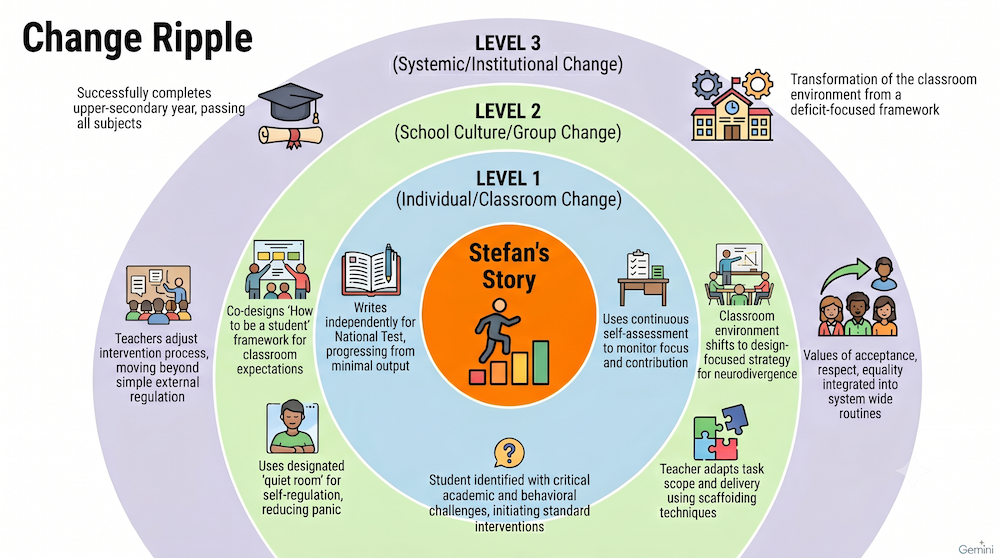
- Student Attendance: Stefan’s chronic absenteeism dropped from a historical 30% in lower secondary school to high, consistent attendance during both his academic term and his workplace-based learning (APL).
- Student Output: Moving from a historical state of not writing at all (neither by hand nor computer) to independently writing a 307-word cohesive short story for his National Test.
- Emotional Presentation: Shifting from early-term panic, breakdowns, and inconsolable crying in unstructured situations to radiating self- confidence, navigating unknown customer interactions proudly, and self-regulating via a designated "quiet room."
- Teacher Behaviour: Teachers actively rejected modifying or minimising curriculum content ; instead, they adapted task scope and delivery using scaffolding techniques (such as colour-coded templates for text structuring , oral mathematics testing in practical kitchen environments , and highly customised assessment scenarios involving grandparents).
- System Shift: The student successfully completed his first upper- secondary year passing all subjects without triggering standard bureaucratised intervention systems, such as a formal Action Plan or a reduced schedule.
- From Ambiguity to Transparency: The school transitioned away from assuming students naturally know how to behave or learn, replacing vague behavioural expectations with an explicit, co-designed framework titled "How to be a student."
- From Compliance to Strategy: Students shifted from simply trying to "be good" or compliant to actively identifying and deploying specific learning strategies (e.g., active listening, asking for clarification, organising physical materials).
- From External Regulation to Self-Assessment: The evaluation mechanism evolved from teachers policing behaviour to students using continuous meta-cognitive check-ins to monitor their own focus and contribution.
- From Segregated Skill Building to Universal Classroom Culture: The practices were not isolated to a special education room; instead, the strategy was institutionalised as a foundational classroom norm for all learners, leveling the playing field for those without hidden academic curriculum access at home.
3. Suggest Candidate Most Significant Change
- The systemic transformation of the classroom environment from a deficit-focused framework (where diagnoses dictate limitations) into a design-focused strategy (where structured, micro-progressive boundaries enable a neurodivergent student to achieve identical milestone standards alongside peers).
4. Stakeholder Mapping
Student, vocational mentors and educators, Swedish Language teacher, mathematics teacher, Special Education Teacher, student’s family, workplace supervisor
Change Ripple
Review the significant changes in this 'Change Ripple' infographic. Click image to enlarge
Reflection Prism
This narrative serves as an exemplary operational design model for Universal Design for Learning (UDL), showcasing the critical difference between watering down curriculum expectations and scaffolding access to them. Maria and Lena rejected the common pitfall of removing complexity; instead, they modified the format and magnitude of output. By deploying color-coded visual syntactical constraints and decoupling spatial constraints from mathematical assessment (oral kitchen validation) , they successfully built teacher capacity and systemic agility. The pedagogy triumphed precisely because the core cognitive target remained uncompromised , successfully preparing the student for standard standardised national examinations.
Stefan’s trajectory illustrates the profound impact of environmental predictability on a neurodivergent student’s emotional resilience. His early catastrophic affective collapse was not a behavioural failure, but an acute manifestation of high baseline anxiety met with unexpected, ambiguous structural shifts. When the teaching collective shifted their positioning—honouring relational agreements with exact precision and transparently validating micro-goals —they constructed an authentic psychological safety zone. This deliberate reduction of systemic cognitive friction minimized internal chaos , transitioning Stefan from an externalised state of survival defence to an internalised space of self-regulation and healthy academic vulnerability.
From a sociological perspective, Stefan's success challenges standard institutional structures that process disability through medicalised deficits and individual isolation. By integrating his specific special interests into mainstream environments and designing structural workplace roles that explicitly accommodated his neurotype , the school actively dismantled typical institutional barriers. Stefan was not integrated via special, separate programmatic concessions; he was accommodated directly within the communal structure of his peer group. Crucially, his presence acted as a catalyst for collective professional growth, converting individual specialised knowledge into a shared, school-wide community asset.
From an executive and school-leadership perspective, Stefan’s trajectory is less about individual teacher heroism and more about an organizational culture that operationalizes genuine inclusion. It illustrates what happens when leadership fosters psychological safety, empowers collaborative problem-solving, and chooses flexible human responsiveness over bureaucratic administrative compliance.
Key Leadership Insights & Systemic Drivers
Replacing Deficit Handovers with Constructive Leadership Mindsets: School handovers often suffer from a systemic "deficit bias"—framing complex learners purely through medicalized diagnoses and risk assessments. Leadership excellence in this context is demonstrated by how Patrik, Maria, and Lena reframed this incoming data. Rather than allowing diagnoses (dyslexia, dyspraxia, ADHD, Autism, OCD) to trigger lowered expectations or administrative isolation, leadership set a clear tone: maintain core educational standards while adapting the delivery architecture.
Fostering a Culture of Psychological Safety and Honest Error Recovery: A defining leadership moment occurs when Patrik meets Stefan and his mother after the initial breakdown in the park and explicitly states: "I’m sorry. We handled this the wrong way. How can we do this so that it will be better next time?" This vulnerability models a non-punitive culture. When school leaders and staff publicly own systemic missteps, it builds immediate trust with families and creates a safe operational space for teachers to innovate without the fear of failure.
Shifting from Bureaucratic Tracking to Agile, Solution-Focused Collaboration: Traditional school structures often rely on formal Action Plans or reduced timetables as default risk-management tools—mechanisms that can inadvertently marginalize learners. Here, leadership facilitated tight, informal, and continuous feedback loops between subject teachers, the special education specialist, and the family. By prioritizing real-time instructional agility over rigid paperwork, the organization solved problems at the classroom level before they escalated into formal failures.
Strategic Stakeholder Alignment and Authentic Partnerships: Organizational leadership extended beyond the school walls. By actively engaging Stefan’s family (e.g., inviting grandparents to act as familiar guests in the school restaurant) and carefully vetting external partners (selecting a small-scale café supervisor skilled in micro-step guidance for workplace-based learning), leadership ensured that the surrounding ecosystem actively reinforced the school's inclusive strategy.
Converting Individual Adaptations into Collective Organizational Learning: True leadership ensures that successful interventions do not remain trapped in classroom silos. The team regularly shared success factors, color-coding strategies, and scaffolding methods across disciplines. Stefan’s case ceased to be an isolated challenge; it became a catalyst for institutional professional development, permanently strengthening the staff's collective capability to serve all future neurodivergent learners.