
The Boy With The Green Cap
This story tells the journey of Leo, a student with autism and a history of school refusal and literacy avoidance, as he starts at a vocational upper secondary school. Initially concealing himself beneath the same green cap and worn hoodie, Leo slowly builds trust with his educators, who address his need to understand the "why" behind tasks and provide structured, visual scaffolding for reading and writing.
Story
It was my first week in a new job, in a type of school that was entirely new to me. Had I prepared well enough? What challenges would I face? Previously, I had worked in academically oriented upper secondary programmes with a strong theoretical focus. This was something different: vocational education with a strong emphasis on practical learning.
I imagined I would be teaching students who were interested in practical work and perhaps less interested, or not interested at all, in the theoretical subjects I taught. It would be a challenge, but one I looked forward to. As it turned out, some of my assumptions were correct and others were not. This was a different group of students from those I was used to teaching, though not necessarily in the ways I had expected.
I should emphasise that, both individually and collectively, students have far more similarities than differences. Still, some stand out a little, and that is often a good thing. They challenge us to think differently, refine our practice, and develop approaches that ultimately benefit everyone.
During my first days at the school, one student caught my attention. He was hard to miss. A tall boy who seemed to wear the same green cap wherever he went. Together with a worn favourite hoodie, it gave the impression of someone who preferred to keep the world at a distance.
The transition records from his previous school contained a great deal of information. He had attended an Introduction Programme, designed for students who require additional support before entering a national upper secondary programme. He had recently received an autism diagnosis. The records also described significant attendance difficulties throughout compulsory school and noted that he refused to write. Building relationships with trusted adults was considered crucial, and staff were advised to connect with him early. On the positive side, the documentation stated that there were no significant learning difficulties.
What a challenge, I thought. How should I approach this student? Would I understand how he functioned? Would we understand one another? These were the questions running through my mind before my first lesson with the class.
I had read that it was important to connect with him early, but only later did I fully understand just how important it was. If things went wrong with this student, progress could come to a complete standstill and become very difficult to repair. Establishing trust from the outset mattered enormously.
Summary: The specialized vocational facilities and tight-knit community create a safe environment where students who previously felt different find a sense of belonging.
Physical Barriers
Pedagogical Barriers
This suggests that Leo quickly found something many students seek: a sense of security and belonging. In that environment, the protective shell represented by the cap gradually became less necessary.
As mentioned earlier, Leo does not have significant learning difficulties. What he does have are barriers to learning, and one of the most important appears when he cannot see the purpose of a task.
Learning for its own sake means very little to him. Learning simply because a teacher says so is equally ineffective. But if you can explain why something matters in a way he understands, he is willing to invest effort and develop.
This requires clear leadership from teachers. We must explain not only how to do something, but also why it is important. That is not the only key to success, but it is certainly one of them.
Leo's autism has shaped many of his educational experiences. Throughout much of his previous schooling, support staff read and wrote on his behalf. As a result, he developed few independent strategies for literacy. More importantly, he never truly understood why reading and writing were important skills.
Understanding why, however, is only part of the solution. Students also need practical strategies for how to learn.
Fortunately, Leo was taught by Maria, a Swedish teacher with considerable experience supporting students with similar challenges. She had developed a structured approach to reading and writing based on visual organisation, colour-coding, and clear text structures.
The principle is simple. A long text can feel overwhelming, particularly for a student who lacks confidence in literacy. Breaking that text into smaller parts makes it more manageable. Colour-coded categories provide further structure and clarity.
These methods are not only beneficial for students like Leo. Many learners, particularly those struggling with literacy, benefit from a more structured approach.
Leo himself says he does not fully understand why the method helps him. Nevertheless, he recognises the results. Today, he reads with greater understanding and can write short texts independently, something he previously found extremely difficult.
The same principles can be seen in the practical subjects. Teachers make extensive use of demonstrations, visual support, and varied teaching methods.
The kitchen teachers often point out that if Leo is simply asked to sit and read, he can struggle to engage. Yet he listens attentively to explanations, follows presentations and videos closely, and remembers an impressive amount of information. He rarely takes notes, but he can often recall lessons in remarkable detail afterwards.
His challenge has never been a lack of ability. Rather, it has been finding strategies that allow him to succeed.
Leo's progress in literacy has been impressive and has required a tremendous amount of effort on his part.
Yet it is his personal growth that has impressed me most. The boy who arrived hidden behind a green cap and a permanently raised hoodie has become a young man who participates, contributes, and belongs.
The cap was never really the issue. It was a form of protection, a way of keeping the outside world at arm's length. As the need for that protection gradually faded, it became increasingly clear how much Leo had grown, not only as a student but as a person.
In retrospect, the cap has become a powerful example of the balance required when supporting students. The goal cannot always be to remove every challenge or every source of discomfort. Sometimes the goal is to provide enough trust, security, and support for students to face those challenges successfully.
For Leo, replacing the cap with a chef's hat was not the loss of a protective shield. It was a step towards greater independence.
Today, he stands out in both kitchen and customer-service settings. As one of only a few first-year students, he was selected to help serve at the school's Christmas banquet. He also completed his bakery placement with outstanding reviews. One of our baking teachers, Eddie, remarked that he had never received such positive feedback from a placement provider. The bakery was so impressed with Leo that they were even willing to offer him part-time work.
Significant Change
1. Domains of Change
- Academic Achievement and Literacy: Transitioning from work refusal to independent reading and passing grades.
- Personal and Social Development: Shifting from social isolation and reliance on a protective barrier (the green cap) to active participation and increased confidence.
- Independence and Student Agency: Moving from relying on adults to read/write for him to using independent learning strategies and thriving in workplace environments.
- Inclusive Pedagogical Practice: The shift from mere accommodation to providing structured, meaningful learning that builds student capacity.
2. List Observable Changes
1) Changes in Teacher Pedagogy/Approach:
- Culinary teacher) explained the professional rationale and purpose behind hygiene regulations rather than merely enforcing the rules.
- Teacher implemented a structured approach to literacy using visual organisation, colour-coding, and clear text structures to break down long texts.
- Special Education Teacher prioritised listening and building trust before challenging the student to write.
- Practical subject teachers extensively used demonstrations, visual support, and varied teaching methods instead of relying solely on reading.
- Teachers provided explicit explanations of not only what the student was expected to do, but why it mattered.
(2) Changes in Student Engagement:
- Student removed his green cap and wore the required professional workwear during practical kitchen lessons.
- Student began leaving his cap on his desk instead of wearing it on his head during general lessons.
- Student booked the same weekly appointment time with the school counsellor for the entire academic year to establish predictability.
- Student transitioned from refusing to write a single word to reading with greater understanding and writing short texts independently.
- Student actively chose to practise reading and literacy skills during his support sessions with the special education teacher.
- Student achieved a passing grade in Swedish.
- Student engaged successfully in vocational placements, receiving outstanding reviews and a part-time job offer from a bakery.
- Student completely stopped engaging with both practical and theoretical activities in Physical Education by the middle of the autumn term because he could not see the subject's relevance.
3. Candidate Most Significant Change (MSC)
The single most impactful pedagogical shift was the transition from passive accommodation (where previous schools read and wrote on his behalf) to purposeful, structured capacity-building. By combining clear explanations of relevance (the "why") with concrete tools like visual organisation and colour-coding, educators empowered Leo to develop his own independent learning strategies. This shift directly caused the most significant improvement in student engagement: Leo's transformation from hiding behind his green cap and refusing to write, to independently passing Swedish and excelling in an authentic bakery placement.
4. Stakeholder Mapping
- The student at the centre of the narrative.
- The student’s mentor and culinary teacher.
- The class teacher.
- The school's special education teacher.
- The Physical Education teacher.
- The baking teacher at the school.
- The School Counsellor.
- Bakery staff who supervised and evaluated Leo's practical placement.
The Boy with the Green Cap demonstrates that student success is rarely determined by individual characteristics alone. Rather, it emerges through the interaction between the student, teaching practices, relationships, and the support structures provided by the school. The case illustrates how a student with a history of educational challenges can make significant progress when the right conditions for learning, participation, and personal growth are established.
One of the clearest lessons from this study is the importance of trusting relationships. The positive relationships developed between Leo and the adults around him created the foundation for both academic progress and increased confidence. For some students, relationships are not simply supportive factors alongside learning; they are a prerequisite for learning itself.
The story also highlights the importance of meaningful learning. Leo's willingness to engage increased when teachers explained not only what he was expected to do, but also why it mattered. This suggests that motivation is closely linked to relevance and understanding. When students see the purpose behind learning activities, they are often better able to invest effort and persevere through challenges.
A third lesson concerns structure and accessibility. Progress was not achieved through lowered expectations, but through clear pedagogical strategies, predictable routines, visual supports, and explicit learning structures. Importantly, many of the approaches developed to support Leo also proved beneficial for other students, reinforcing the value of inclusive teaching practices.
The case further illustrates the distinction between accommodation and independence. The green cap serves as a useful symbol of this balance. While it initially provided comfort and security, the long-term goal was not merely to preserve existing coping strategies but to help Leo develop the confidence required to function independently within authentic educational and workplace environments. Effective support therefore involves creating sufficient security for students to meet challenges, rather than removing those challenges altogether.
Another important finding concerns the development of student agency. Rather than relying indefinitely on adults to compensate for difficulties, the school focused on helping Leo develop strategies of his own. Over time, this enabled him to take increasing responsibility for both his learning and his participation.
Finally, the story demonstrates the importance of collective responsibility. Leo's progress cannot be attributed to a single teacher or intervention. It emerged through sustained collaboration between mentors, subject teachers, special educational staff, student support services, and his wider support network. Inclusive education is most effective when responsibility for student success is shared across the organisation.
Key Principles Emerging from the Case
- Trusting and supportive relationships.
- Clear purpose and meaningful learning.
- Structured and accessible teaching.
- The development of independence through appropriate support.
- Collaborative responsibility across professional roles.
Perhaps the most important insight is that what initially appeared to be an individual student's difficulties can largely be understood as an interaction between the student and the educational environment. When teaching, support structures, expectations, and relationships were aligned, meaningful progress became possible. This lesson extends beyond a single student and highlights the importance of building schools that are both inclusive and ambitious, providing support while also preparing students for active participation in education, work, and society.
My main narrative highlights many positive aspects of Leo's development. The challenges are certainly present, but the focus is on how teachers have addressed them and developed approaches that have proved successful. However, this narrative does not present the full picture of Leo's schooling.
Although much has improved and Leo has made significant progress compared with his previous educational experiences, there were still situations and subjects during his first year in which things did not work. This complementary perspective aims to provide a more balanced and complete picture.
Physical Education was one of the subjects Leo did not pass during his first year. Even before the school year began, his PE teacher, Phyllis, expected it to be challenging. Based on the information received from his previous school, she knew there had been difficulties and was uncertain about how he would engage with the subject and ultimately meet the course requirements.
When she met him, some of her concerns proved unfounded, while others were greater than she had anticipated. From the records, she had expected a student who might be disruptive or restless. Instead, she met a student who was quiet and generally cooperative.
Initially, Leo participated to a reasonable extent. He was very clear that he did not enjoy physical activity, but he took part and made an effort. This aligns with Leo's own description of the subject. He openly states that he struggles to understand why schools require students to participate in this type of physical activity and sees little value in the subject.
His lack of interest was therefore obvious, but despite this, he participated during the early stages of the course.
The theoretical components of the subject presented a greater challenge. Phyllis felt that Leo's reluctance to read and write became a significant obstacle. In other situations, we have seen that his abilities are stronger than he sometimes acknowledges himself. However, motivation is crucial for Leo, and in this case he simply could not see the purpose of the subject. It is therefore not surprising that he claimed he could not complete certain tasks when, in reality, the issue often appeared to be that he did not want to engage with them because he could not see their relevance.
By the middle of the autumn term, things came to a standstill. Leo stopped engaging not only with the theoretical elements of the course but also with the practical activities.
Phyllis finds it difficult to identify exactly what caused this shift. It is clear that he disliked physical activity, but at some point he seemed to make up his mind that the subject was not for him. Once that decision was made, it became extremely difficult to change.
This pattern is familiar.
One of the characteristics frequently associated with Leo's autism is that when he reaches a firm conclusion, changing that belief can be exceptionally difficult. Once a barrier has been established, it tends to remain in place.
A similar pattern can be seen in English, although the breakdown occurred even sooner.
Leo himself has suggested that personal chemistry played a role. He has explained that his difficulties were not with the subject itself, but rather that he quickly decided he did not want to study the subject with the teacher he had been assigned. He struggles to explain exactly why or what was not working, making the situation difficult to analyse. What can be observed, however, is the same recurring pattern: once Leo has made up his mind about something, it becomes very difficult to persuade him to reconsider.
Another theme highlighted in The Boy with the Green Cap is the importance of building a relationship with Leo and doing so early. In these situations, something appears not to have connected. I do not suggest that the teachers involved did anything wrong. Rather, an idea became fixed in Leo's mind that the situation was not going to work.
And once that belief has taken hold, changing it can be extraordinarily difficult.
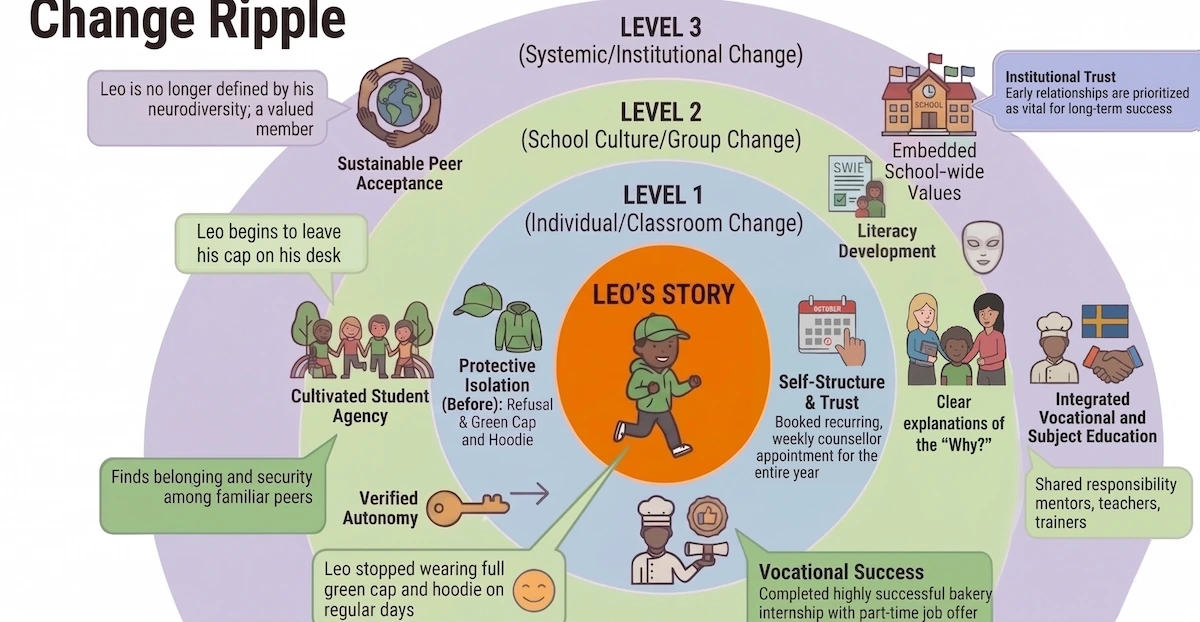
Change Ripple
Review the significant changes in this 'Change Ripple' infographic. Click image to enlarge
Reflection Prism
Pedagogically, this narrative demonstrates the effectiveness of explicit, structured instruction paired with relational teaching. Teachers shifted away from compensating for Leo’s difficulties, instead equipping him with independent strategies such as colour-coding and visual organisation to make literacy accessible. Furthermore, addressing workplace hygiene rules by explaining their professional rationale, rather than demanding blind compliance, aligns with constructivist theories of meaningful learning. This transition from mere accommodation to active capacity-building dramatically improved student agency. Conversely, the breakdown in his Physical Education and English classes underscores that without perceived relevance and strong teacher-student alignment, even standard pedagogical strategies can fail to engage learners on the autism spectrum.
Leo's journey illustrates a profound shift in emotional resilience and motivation. Initially, he used his green cap and hoodie as a physical barrier to manage anxiety and keep an overwhelming world at a distance. As educators established trusting relationships and provided predictable routines, his sense of security deepened, reducing his need for this protective shell. By understanding the clear purpose behind his tasks, Leo’s intrinsic motivation grew, replacing his initial isolation with a strong sense of belonging. However, when this relevance was absent, such as in Physical Education, his engagement collapsed entirely, highlighting how heavily his psychological investment depends on perceived purpose and early relational connections.
From a sociological perspective, Leo’s story highlights how systemic barriers to inclusion can be dismantled through community cohesion and shared expectations. Initially isolated, Leo found a supportive environment within the vocational school's small-scale, predictable setting, which naturally fostered peer and professional integration. The collective responsibility demonstrated by mentors, subject teachers, and special educational staff created a culture of inclusion that did not lower expectations but provided the necessary scaffolding for authentic participation. By guiding Leo to adapt to professional workplace norms, such as culinary hygiene standards, the school successfully bridged the gap between social marginalisation and active societal and workplace inclusion.
For institutional leaders, this case underscores that inclusive education requires coordinated, multidisciplinary collaboration rather than isolated interventions. The alignment between mentors, subject teachers, and student support services was the foundational architecture of Leo’s progress. Leaders must prioritise early relationship-building and ensure teaching staff are trained to communicate the explicit purpose behind learning activities. Next steps should involve universally embedding structured pedagogical supports, such as visual aids and predictable routines, across the wider curriculum, as these strategies benefit all learners. Furthermore, institutional systems must remain agile enough to intervene early when a student's engagement stalls, as evidenced by the unrecovered breakdown in Physical Education