
Enabling a New Future for Ardi and His Family
Ardi, a 6th‑grade pupil with autism who moved from Southern Europe to Finland has never attended school before. He communicates only with single words in his mother tongue, and is restless in unfamiliar environments. His behaviour during the first meeting required constant supervision.
In Finland, all children are subject to compulsory education, so Ardi was placed in a special education small class. The physical environment was designed for pupils with disabilities—accessible classrooms, calm spaces, and a fenced yard. His classroom was further adapted by removing distracting items.
Pedagogically, his learning began with very small steps. Communication relied on pictures, sign support, and strict routines. He learned Finnish words quickly and adopted signs. Gradually, school tasks increased, and his eating improved with positive reinforcement.
Socially, Ardi did not engage with peers, but slowly began participating in simple play. Integration lessons were not appropriate for him. The text highlights that immigrant pupils with disabilities often lack previous support, and teachers must guide families through available services.
Starting school transformed Ardi’s life. His skills emerged, his behaviour stabilised, and his family’s wellbeing improved as school enabled the parents’ integration into Finnish society.
Story
We sit tensely in a classroom, waiting to meet a new pupil and his guardians. Present are the city’s consulting special education teacher, our school’s instructor for pupils with intellectual disabilities, and myself in the role of assistant principal. We have received very little prior information about the pupil and the family. We know only that the pupil is of 6th‑grade age and that the family recently moved to Finland from Southern Europe. The common language for the meeting is English. Our aim is to gather more information about the pupil and to decide whether he will be enrolled in our school.
The pupil arrives with his guardians and enters the classroom. They close the door behind them and make sure it is locked. The pupil holds his mother’s hand and sits down beside her. We barely manage to introduce ourselves when a whirlwind named Ardi bursts into action. Ardi begins by walking and soon running around the classroom. He goes to the teacher’s desk and grabs whatever he can find. He discovers whiteboard markers and smells them. He begins drawing on the board and attempts to draw on the teacher’s desk as well. His mother intervenes.
She returns to her seat, and Ardi continues exploring the room. So far, no actual conversation has taken place because we have simply been observing Ardi’s whirlwind‑like activity. We urgently need more information about his background and history. As we try to ask the guardians some questions, we notice that Ardi is about to take the consulting special education teacher’s laptop from her bag. He comes very close to unfamiliar people, as the bag hangs on a chair and the teacher is sitting in it. She steps in to stop him.
Ardi continues exploring and is about to start running around again. This time I intervene. At this point, our instructor for pupils with intellectual disabilities decides to take Ardi with her for a walk around the rest of the school so that the rest of us can talk through the important questions we have prepared.
The guardians have a large pile of documents, but all of them are in their own language. As the conversation progresses, we learn more about Ardi’s background and history. He has been assessed in his home country, but no diagnoses were given. Autistic traits are clearly visible. We learn that he can say many individual words in his mother tongue, but cannot form sentences. He is restless, especially in unfamiliar environments—as we have just witnessed—and requires constant supervision. Even in the car, he does not stay seated: he unbuckles his seatbelt and tries to move around. Most importantly, we learn that he has never attended school. He has been in daycare, but never in actual school. We all agree that our school is the right place for him. We decide that Ardi will start as soon as possible with shortened school days, and we will arrange another meeting soon, with his future teacher present.
After Ardi and his guardians leave, we look at each other and realise we have quite a task ahead. It will be fascinating to see how Ardi manages starting school for the first time at this age, in a new country, and without a common language.
Our school is a comprehensive school, offering basic education from grades 1–9. In addition, we host the city’s classes for pupils requiring demanding special support, so‑called small classes, currently six separate groups. These classes are located in their own building in the same yard as the main school. Most of the pupils have intellectual disabilities of varying degrees. Many are also on the autism spectrum or have autistic traits. Numerous comorbid medical conditions are common. I myself served as assistant principal for the small classes for six years, which is why I chose to focus on education for pupils with intellectual disabilities and their integration.
In Finland, every child has a compulsory education obligation. Compulsory education begins the year a child turns seven and continues until they turn eighteen or complete an upper secondary qualification. By law, every pupil is obligated to study, and therefore even pupils with severe intellectual disabilities study in our small classes. Compulsory education does not include mandatory school attendance—only the obligation to learn. Thus, a pupil in a small class may not always be able to attend school, and teaching can be delivered at home if necessary.
In many countries, pupils with intellectual disabilities are still not included in compulsory education. For this reason, we occasionally receive pupils who have moved from abroad and have no school background at all, but who become subject to compulsory education upon arriving in Finland.
School transport for pupils in small classes is usually provided by taxi, and in addition, morning and afternoon activities as well as holiday‑time care are offered, since many of the pupils cannot safely stay at home even for short periods without adult supervision. Morning care is offered from 7:00–8:30, after which the school day begins. Afternoon care is available until 16:45, enabling guardians to work normal hours.
I chose Ardi as my case pupil. His family moved to Finland from Southern Europe, making him subject to compulsory education as a 6th‑grader. In this text, I examine integration from the perspective of how important it is for every pupil to become part of the school community and daily routines. Ardi started school late in the autumn term with shortened days. Gradually his school days became longer, and eventually he also took part in afternoon care, allowing his guardians to attend language courses and work. In Finland, special education is always confidential, so I describe Ardi in a way that makes him unidentifiable. The name Ardi is changed, as are some other details. I interviewed his first teacher, who played a major role in his integration into Finnish school life.
The small classes are located in their own building in the same schoolyard. The building was originally constructed specifically for pupils with intellectual disabilities, so many essential accessibility features were included from the start. The physical environment enables school attendance for all pupils. The main door is accessible for various vehicles, including wheelchair taxis. There are no thresholds in the building. The hallways are wide, and the cloakrooms spacious. Classrooms are large, each with a smaller adjoining room equipped with a door and window. The classrooms are well sound‑insulated. Regular toilets are located in hallways, with accessible toilets and a care room nearby. The building also includes a small gym, an art room, a therapy pool, a cafeteria, and a home economics room. There are smaller rooms used for therapy and IT activities. The small classes have their own fenced yard. The fences are an important safety factor, as many pupils would not be safe in the unfenced main school yard.
Ardi’s homeroom group consisted of other autistic pupils as well. Each pupil has their own workspace. Some have visual dividers made from shelves or panels so that they cannot see other pupils while working. The classroom was already low‑stimulus, but with Ardi’s arrival, items were reduced even further. For example, he was very interested in whiteboard markers—he hid them in his sleeve and sometimes scribbled on toys—so the markers were stored out of sight, as were toys and games, to minimise distractions. Reducing sensory stimuli also benefits many pupils in mainstream education. Ardi was not sensitive to noise, but many autistic pupils are, which makes integration into larger classes challenging. When planning integration, schedules for lunch and recess must be considered to keep noise levels manageable. The fenced yard made outdoor activities safe for Ardi, as he wandered everywhere and needed constant supervision. Although he recognised dangerous places, he did not avoid them or understand the concept of danger.
Once the physical environment supports every pupil’s learning, we can focus on pedagogical practices. Teaching autistic pupils with intellectual disabilities requires substantial expertise and experience. Adults must understand the challenges autism creates. Staff in the small classes have high professional competence, many having worked with autistic and intellectually disabled pupils for years. Sometimes adults find it difficult to understand how slowly progress may occur and how long repetition is needed before a skill becomes automatic. Adults may grow tired of repetitive routines, but for autistic pupils, consistent routines provide safety, and they may repeat them year after year.
Over decades, the small classes have amassed a huge variety of materials. These are used widely, as few pupils work with traditional textbooks. Most pupils with intellectual disabilities never learn to read. Fortunately, advances in technology have brought new tools, especially for communication. Still, sign‑supported communication remains important. Pupils who cannot communicate through speech often receive their own iPad as an assistive device. With communication software, pupils can communicate with adults, and photos and notes from the school day can be recorded for guardians.
Collegial support is always available, since many classes operate in the same building. No one needs to work alone. Support is available for everyday questions and challenging situations. Clear rules and consistent procedures are essential. The Basic Education Act guides all operations.
Great emphasis is placed on maintaining consistent teaching practices even when adults change. This is particularly important for autistic pupils. The same principle applies to pupils with aggressive behaviour—stability is crucial even if staff turnover is unavoidable due to workload.
Ardi’s teacher had extensive experience with autistic pupils and knew how to start. The classroom assistants were also knowledgeable. One adult worked with Ardi at a time. The teacher worked most with him at first, and later the adults rotated. His schooling began with very small steps. A major challenge was the lack of a shared language, including sign language. Communication began with pictures: the day’s schedule was displayed with small visual cards. Each picture and activity was paired with a Finnish word and a sign. The teacher reported that already in the second week Ardi learned individual Finnish words such as “outside”, “eat”, and “taxi”, and soon began using signs as well. After that, he learned about one new word per day.
Ardi had the same daily schedule for the first two weeks. Every morning, the schedule was arranged together using a ruler and picture cards. Each school task lasted 5–10 minutes, followed by a self‑chosen activity such as puzzles, building blocks, kinetic sand, or spinning on a balance board. Ardi usually chose spinning in the hallway. After two weeks, the teacher added songs to the school tasks, paired with picture cards. The songs covered topics such as body parts, clothes, school supplies, and foods.
Soon Ardi began asserting his own will. If a school task was not to his liking, he would lie down on the floor. Systematically, the teacher crossed out the picture of the self‑chosen activity: if schoolwork wasn’t completed, the reward was removed. After a few days, the tasks went well again.
Ardi was an extremely picky eater when he started school, eating only a few foods at home. In Finland, school meals are free and vary daily. Ardi fell in love with crispbread, and using it as a reward, he gradually tasted new foods. Eventually he ate regular school meals with no problems.
Ardi’s development was wonderful to observe. He enjoyed school, taxi rides went well, and he thrived with clear structure. The routine provided safety in the absence of a shared language. Afternoon care is less structured than school, which Ardi liked less. He fell in love with swimming and wanted to swim every day in the therapy pool, placing the swimming picture on the schedule daily. However, swimming took place on Fridays only.
By spring, Ardi could work for about 20 minutes on tasks such as copying exercises. In six months, remarkable progress had been made. Improvements were also seen at home, where he became calmer thanks to structured, meaningful school days.
When discussing integration and inclusion, the focus is often on each pupil’s right to attend their local school or be among peers. Alongside the physical and pedagogical environment, the social environment must also be appropriate for integration to succeed. Integration cannot be done for its own sake. Peer presence and genuine willingness to interact are important. Pupils with intellectual disabilities need peers around them so that integration does not consist solely of interacting with their personal assistant. Autistic pupils may not initiate contact with peers or adults, which is normal for them.
Integration must always occur on the pupil’s terms and be beneficial for them. Some pupils attend integration lessons in the main school. Each case is evaluated individually to determine whether a lesson is suitable and what goals it may serve. For lower‑grade pupils, integration may include mother tongue lessons to experience the language environment and social interaction. Optional subjects may also be integrated. In upper grades, some pupils attend English integration lessons. Home economics is the most common subject for integrated 7th‑graders, often with very positive outcomes. Integration can theoretically occur in any subject if it benefits the pupil. Integration may also occur during recess, and some pupils spend time outdoors with the main school pupils—those who do not require fenced areas.
Integration must feel comfortable for everyone involved. Some teachers feel they lack the skills to work with pupils with intellectual disabilities in their classes, even with an assistant present. Often, once teachers participate, they are pleasantly surprised by how well things work out. It helps that integration involves pupils who enjoy it. However, sometimes pupils dislike large groups and feel anxious, and integration must then be paused or stopped entirely. Integration also requires sufficient adult resources.
For Ardi, simply coming to school changed his entire social environment. The teacher proceeded with very small steps. As an autistic pupil, Ardi did not interact much with peers. His interactions mainly involved grabbing toys from others or breaking their constructions. He did, however, interact with the adults in the class. Over time, some progress occurred and eventually, for example, a game of tag in the schoolyard with a classmate was possible—though the teacher remarked that both mostly ran away from one another, with no one catching anyone. Ardi observed crowds in the main school during shared events.
In Finland, pupils with intellectual disabilities are provided the same opportunities as all other pupils. For example, work‑experience periods in lower secondary school are arranged for them, and all pupils apply for further education. Some may even enter the workforce with support. Various supported‑employment models and work centres also exist.
Guardians often say that if a child is born with an intellectual disability, they are overwhelmed with information—advice, services, support systems, and contacts. But if the diagnosis comes later, guardians feel largely alone. No one explains what services exist or what aids the child is entitled to. Immigrant families with intellectually disabled children face similar challenges. They often have no knowledge of available services or supports. Assistive equipment is missing, and the child may never have received therapy. Teachers play a major role in guiding families through application processes.
Pupils in small classes often have many assistive tools obtained via healthcare services, sometimes already in early childhood. Their development has been supported through speech therapy, motor skills training, and communication interventions. Many already have a communication method when entering school.
The situation for immigrant pupils is very different. Obtaining assistive devices can be slow, and therapy decisions require extensive expert statements.
In Ardi’s case, integrating into school life clearly brought many positive outcomes. He had skills that had simply never had a chance to be expressed. The pupil’s wellbeing directly improved the wellbeing of his family. The ability to attend school and receive afternoon care enabled his parents to integrate into their new home country through studies and employment.
The narrator is the assistant principal of classes requiring intensive special support, who has administrative and pedagogical responsibility for the functioning of the classes. The assistant principal’s long experience in teaching students with intellectual disabilities is evident in the story, as is the assistant principal’s own work experience as a guide, teacher, and in administrative tasks. The story also includes the voices of the special class teacher and school assistants.
Themes in the story include moving to a new country, arriving at a new school, and starting school at a relatively old age. The student who is the subject of the story is among the first to come to school without prior school background. Among students in classes requiring intensive support, immigrant background is increasingly emphasised, which also complicates communication with guardians as they lack Finnish language skills. On the other hand, the use of alternative communication methods, assistive devices, and structures with students is at a good level in classes requiring intensive support because there are other students with communication difficulties as well.
Parties related to the story include, for example, the consulting special education teacher, therapists, guardians, social and health services, and school assistants.
The student who is the subject of the story has autism spectrum disorder, intellectual disability, and immigrant background. There are other students with similar profiles at the school, but this combination makes this case unique.
Often, the understanding of school among guardians coming from backgrounds similar to the student appearing in the story is different; school is thought of, often due to cultural background, only as a care facility, whereas in Finland, even for students with intellectual disabilities, it is schooling with student-specific content and objectives. In Finland, educational equity is at a high level, as all children have compulsory education and schools’ task is to enable this for all children.
However, inclusion must not mean that all students are integrated into general education. For some students, a better place is a separate group or special school, often without integration into general education. Inclusion must not be implemented for the sake of inclusion, but considered case by case. Inclusion must be understood from the student’s benefit perspective; in Ardi’s case, inclusion is already realised in that he participates in school. This improves the quality of life especially for the student, but also for guardians and other parties. In the case of classes requiring intensive support, inclusion is already the fact that special classes are part of a large general education school, whose events they participate in.
Significant Change
1. Identify Domains of Change
- Individual Learner Development and Wellbeing
- Pedagogical and Classroom Practice
- Social Inclusion and Peer Interaction
- Family Wellbeing and Integration
2. List Observable Changes
- Ardi moved from only speaking individual words in his mother tongue to learning about one new Finnish word per day alongside corresponding signs.
- Attention span and working time on tasks like copying exercises increased from 5–10 minutes to roughly 20 minutes within six months.
- Restless behaviour and running around transitioned into feeling safe, calm, and settled within predictable daily routines.
- Floor-lying refusals when tasks were not to his liking stopped once the teacher systematically crossed out the picture of his chosen reward activity.
- Being an extremely picky eater who ate only a few foods shifted to eating regular school meals without problems after using crispbread as a reward.
- Moving around and unbuckling his seatbelt in the car shifted to smooth, successful taxi rides to and from school.
- Peer interactions moved from grabbing toys or breaking other children’s constructions to playing games like tag in the schoolyard.
- Home life changed noticeably, with Ardi becoming calmer as a direct result of structured school days.
- Guardians moved from having no school placement for their child to having morning and afternoon care, allowing them to attend language courses and go to work.
3. Candidate Most Significant Change
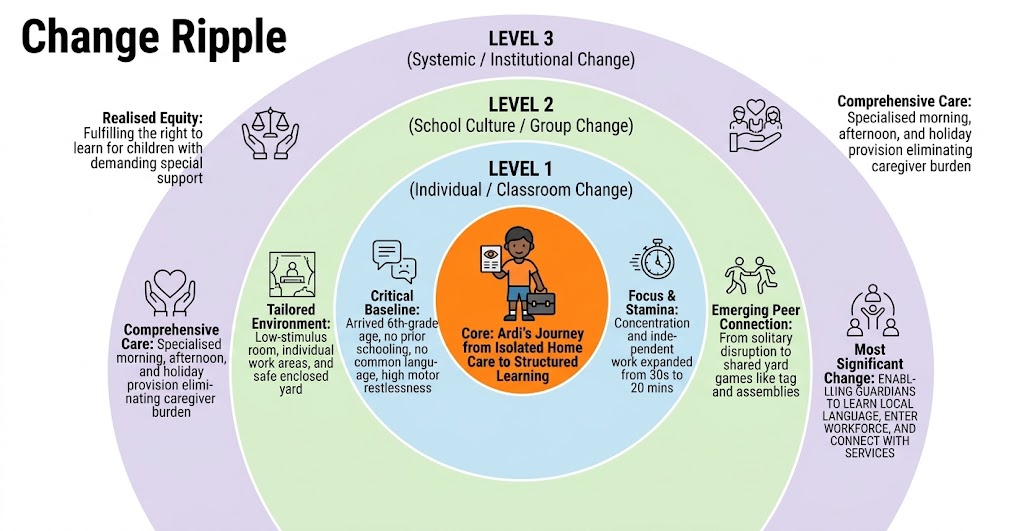
- The most significant change is one that has affected the entire family, because the student’s arrival at school also enables the family’s integration into Finnish society.
4. Stakeholder Mapping
- The pupil
- The family including Ardi's mother, father and carers
- School Leadership
- Teacher(s)
- Special Education Teacher
- Classmates
- External support services (including healthcare professionals, social services, taxi driver)
This was the considered the Most Significant Change because it shows, with the right kind of support, new aspects, daily life skills, and social relationships and skills were found in the child, for example, the change in concentration ability from 30 seconds to 20 minutes, diverse eating of school meals, and smooth taxi trips; all this became possible through school attendance when structures and operating methods were created by professionals in the field instead of guardians.
Change Ripple
Review the significant changes in this 'Change Ripple' infographic. Click image to enlarge
Reflection Prism
The teaching approach succeeded because it started with very small steps rather than complex school demands. The teacher adapted the physical room by removing items like whiteboard markers to eliminate distractions, kept initial work periods short, and paired each activity with a picture, a spoken Finnish word, and a sign. Consistent follow-through—such as crossing out reward pictures when work was not done, and using preferred foods like crispbread to encourage tasting new meals—helped Ardi learn clear boundaries and expectations. As a result, his ability to focus grew from short intervals to 20 minutes of continuous work.
At the start, Ardi’s running around, touching unfamiliar belongings, and inability to sit still reflect the acute stress of an unfamiliar environment without a shared language. The teacher’s clear schedule and picture cards provided certainty, replacing confusion with safety and predictability. Over six months, having a steady routine and ways to make himself understood helped Ardi build confidence and calm his restless behaviour. This emotional stability carried directly over into his home, reducing daily strain on the family and helping everyone feel more settled.
This case highlights the barriers faced by families who move to a new country with a child who has an intellectual disability and no prior school history. In many countries, such children are excluded from education, leading families to view schools merely as care facilities rather than places of learning. In Finland, compulsory education guarantees the right to learn for every child through adapted small classes and specialized facilities. By welcoming Ardi, offering transport, and providing morning and afternoon care, the school not only included the child, but also enabled his guardians to learn the language, enter employment, and integrate into society.
From a leadership and systems perspective, Ardi’s successful transition demonstrates the impact of proactive institutional design, resource management, and distributed professional expertise. Rather than treating inclusion as an isolated classroom issue, the leadership team coordinated internal and municipal stakeholders—including consulting special education teachers, dedicated instructors, and transport services—under the framework of the Basic Education Act. The school’s purpose-built, accessible infrastructure and co-located small classes enabled collegial support and consistent operating procedures across rotating staff. By establishing wraparound morning, afternoon, and holiday-time care, school leadership addressed structural barriers, creating the institutional stability required for whole-family integration.