
Crossing Barriers
A remarkable journey of development – four years’ teaching experience in supporting a pupil from abroad.
A brief description of the story:
In 2022, we met a young boy who spoke very little Hungarian, was withdrawn, found it difficult to understand social situations, and often tried to solve his conflicts through the use of force. Language barriers made it considerably more difficult for him to settle into school and form social relationships.
Four years later, we see a young man who has found his place in the community, formed friendships, is able to cooperate with his peers, takes part in community and sports programmes, and is now able to resolve conflicts independently in many situations.
Perhaps the greatest change is that he no longer merely adapts to the community but actively influences it himself. His classmates accept him and pay attention to his opinions and ideas. This represents significant social development for a child who, just a few years earlier, was still struggling with serious communication and integration difficulties.
This significant change cannot, therefore, be captured by a single metric or a single assessment. The change is evident across the child’s entire functioning: in verbal communication, social relationships, emotional regulation, conflict resolution, independence, community involvement and his attitude towards experiences of success.
The most important lesson we have learnt from this story is that the child’s development required time, patience and consistent support. It was a combination of several interventions, applied together, that brought about the result: daily personalised attention, language development, special educational support, community programmes, sport, music, peer support, maintaining contact with the family, and the persistent work of the teachers.
The added value lay precisely in this: in the fact that the school did not simply set expectations for the child but also created the conditions that enabled him to meet those expectations.
These four years have shown us that one of the most important tasks of an inclusive school is not to expect every child to follow the same path, but to find the path along which the child can truly thrive.
In this case, that path led through personal relationships, language support, community experiences, sport, music and a consistent pedagogical presence. The result was the development of a child whose school career changed dramatically over the course of four years: from insecurity to independence, from conflict to increasing self-regulation, and from communication barriers to an increasingly confident presence within the community.
Story
We first met this young boy in September 2022, and over the past four years we have been able to continuously monitor not only his academic progress but also the development of his personality, social relationships, communication skills and self-regulation. His story clearly illustrates that a child’s success at school is not determined solely by their own abilities and diligence. Conscious pedagogical support, personalised development, the strength of the community, sport, artistic activities, and a safe and accepting environment in which the child can experience their own successes can all play a particularly important role.
The little boy joined our school in September 2022 as a Year 1 pupil. He is the child of Nigerian parents and lives with his mother and younger sibling. The family communicates primarily in English at home. His mother’s knowledge of Hungarian is limited, so communication between the school and the family encountered difficulties right from the start. An interpreter has been assisting with communication ever since.
The child’s knowledge of Hungarian was very poor when he first started school. This not only made the learning process more difficult but also had a significant impact on his social relationships and behaviour. He had spent his earlier nursery years in several institutions, where he frequently came into conflict with both his peers and the teaching staff. Due to instructions being misunderstood or not understood at all, as well as his limited ability to express his own thoughts and feelings in Hungarian, he found it difficult to make sense of many situations. He often tried to resolve conflicts through physical force.
For all these reasons, he had already been assessed as having SLBD by the time he started school, and it became clear that the child would require long-term, consistent support across multiple areas simultaneously.
At the start of Year 1, one of the most important tasks was to create a predictable and safe school environment for the little boy. The teachers had to focus not only on imparting knowledge, but also on ensuring that the child understood how the school works, its rules and the behaviour expected of him in social situations.
The school’s support teacher provided two support lessons per week. In addition, the class teachers gave him regular extra tuition, and arrangements were made for a secondary school pupil undertaking community service to work with him once a week, primarily to help him learn Hungarian.
This personalised attention proved to be particularly important. In this child’s case, language difficulties and behavioural problems were closely interlinked. The less he understood what was happening around him, the greater his uncertainty became, and the more easily conflicts arose.
In the first year, therefore, every small step forward was significant. The aim was not for the difficulties to disappear overnight, but for the child to gradually learn to interpret situations, ask for help, express their feelings, and realise that conflicts do not necessarily have to be solved through force.
The community-building sessions organised by the Menedék Association were also a great help in this regard. The weekly programmes held for the class provided shared experiences in which the child could naturally bond with his classmates. The ice-skating sessions organised in Years 1 and 2, which were combined with educational activities, as well as the multi-day forest school programmes, also provided him with important community experiences.
We were already able to report noticeable changes in the first-term assessment. Although he was initially reserved and shy, he gradually settled into school life. He became increasingly independent in familiar situations and found common ground with more and more of his classmates. His language difficulties slowly diminished.
The first significant improvements also became apparent in his behaviour: he adhered more and more strictly to the common rules, and was respectful, polite and kind towards adults.
By the end of the year, the child had settled into the class community. He had become a kind, inquisitive little boy who found it increasingly easy to get on with his peers and was slowly beginning to build friendships. This was a significant change from where he had started.
In the second school year, the focus shifted increasingly towards developing community relationships and self-regulation. By this stage, the child was no longer simply present in the class but had become an increasingly active participant in it.
From the second term of the second year, he became a member of the school’s Nagyműhely, the school choir. Initially, he attended rehearsals once a week; later, twice a week.
The choir provided a particularly valuable developmental environment. Singing together required cooperation, the ability to focus attention, following rules, and the child’s ability to adapt to the rhythm of the group. Whilst taking part in an activity he enjoyed, he developed skills that proved useful both in lessons and in social interactions.
The assessment for the second half of the year showed clear progress. The previously intense emotional reactions had almost completely disappeared, and he had become more composed. This change was also evident in his social relationships: his classmates invited him to play together more and more often, and his friendships grew closer.
A particularly significant outcome was that misunderstandings arising from language difficulties also became less frequent. He rarely needed to seek an adult’s help to solve conflicts.
This progress therefore took place in two closely interrelated areas: his communication in Hungarian improved, and, in parallel with this, his ability to handle social situations also improved.
He generally followed the flow of lessons closely; he was active in his favourite subjects, put his hand up frequently, and completed his tasks at a good pace with few mistakes.
During this period, it became increasingly clear that the child performs at his best when he experiences a sense of achievement, his interest is piqued, and he receives appropriate personal support.
By the third year, the little boy had become one of the key figures in the class community. This marked another significant milestone in his development. The child who, upon starting school, had been withdrawn and introverted, and who had faced many conflicts due to his linguistic insecurity, was, a few years later, able to influence his classmates.
By the end of the year, he had become one of the class’s central figures; his classmates accepted and liked him. At the same time, however, this change created new pedagogical challenges. The child’s influence did not always have a positive effect. His mood swings, sulking and emotional reactions to minor misunderstandings still caused difficulties from time to time.
At this stage, therefore, development was no longer primarily about whether he could fit into the community, but about how he could use the position he had gained within the community responsibly.
This was a very important step. The aim of the educational work at this stage was to develop a higher level of self-regulation: to learn that a conflict, a minor grievance or a misunderstanding does not necessarily require a prolonged emotional reaction.
In the third year, his academic work also became more consistent. He generally worked diligently and independently, completing his tasks with very few errors; his pace of work was good, and his self-assessment became increasingly accurate and reliable.
He could be particularly proud of having been a key member of the team that came third in the ‘Kosárpalánta’ programme competitions. His success in sport meant more to him than just physical activity. Team sport taught him cooperation, following the rules, concentration and the need to regulate his own behaviour in pursuit of a common goal.
The same was true of his participation in the Nagyműhely programme. He took an enthusiastic part in the performances and was able to concentrate even in situations where he would previously have found it easier to lose focus.
By the fourth year, the child’s personality and role within the community had become even more defined. He had become a lively, energetic and increasingly thoughtful boy. He remained one of the key figures in the class, and his classmates accepted his suggestions and ideas.
However, he still needed support in terms of behaviour. He was already able to follow the rules of the school and the class, particularly when he was motivated. At the same time, he still occasionally found it difficult to take others’ interests into account, and this led to conflicts.
The most significant change, however, was that he was increasingly successful in resolving these conflicts. This is a fundamental difference compared to previous years: he no longer relied solely on adult intervention but was able to handle more and more situations on his own.
In the fourth year, he also received more conscious and regular one-to-one support. Every morning, we spent about thirty minutes with him before the morning sessions began. These sessions consisted of informal conversations, games and language activities. These did not function as traditional lessons, but rather as a safe personal space where the child received attention, encouragement and help.
Based on our experience, these personalised sessions – whether in small groups or oneto-one – proved to be one of the most effective tools for development. The direct connection allowed the child to work at their own pace, ask questions, make mistakes and then try again. The playful language activities developed both using the Hungarian language and his self-confidence.
Sport has also been a constant feature of his life. We provided him with free swimming lessons; he went swimming twice a week and also continued to take part in the Kosárpalánta programme. He really enjoyed these activities, and his successes in sport strengthened his motivation and his social connections.
He has been taking part in the Digi Tanoda programme for two years, which provides him with further opportunities to learn and develop his digital skills. The support from the Menedék Association and ongoing special educational support have also remained part of the comprehensive support system surrounding him.
Based on four years’ experience, it is clear that the acquisition of the Hungarian language and behavioural development were mutually reinforcing processes.
When the child first started school, his ability to communicate was significantly limited. If he did not understand an instruction or were unable to express his thoughts properly, misunderstandings could easily arise. These misunderstandings caused uncertainty, and this uncertainty often led to conflict.
Four years later, he is now able to communicate in a much more nuanced way. The number of misunderstandings arising from language deficiencies has decreased significantly. He is able to express his thoughts with increasing precision and finds it easier to interpret social situations.
This development was directly linked to a change in behaviour. The previously intense emotional reactions have gradually subsided; the number and intensity of conflicts have decreased, and he is increasingly able to find solutions without assistance.
The change was not linear. After the summer holidays, we regularly observed setbacks, which demonstrated that ongoing support is needed to maintain the progress made.
Nevertheless, looking at the four years as a whole, the change is clear and significant.
The child’s development was not the result of any single programme or method. On the contrary: it was a system of complementary forms of support that made this development possible.
The personal attention of the teachers, special educational support, regular tuition, support from secondary school pupils on community service, the programmes run by the Menedék Association, the Nagyműhely, sport, the Kosárpalánta programme, swimming, Digi Tanoda, and maintaining contact with the family – with the help of an interpreter where necessary – all combined to create the supportive environment in which the child was able to thrive.
It was particularly important that we did not focus exclusively on his weaknesses. We identified the areas in which he could succeed. We were later able to draw on the positive experiences gained through sport, singing and community activities in learning situations as well.
The personal connection was also crucial. The daily thirty-minute morning sessions conveyed to him that he is important to us, that he can count on us, and that there are adults at school who would listen to him and help him.
By the end of the fourth year, the child had become a pupil who had found his place within the class community, is accepted by his peers, and is capable of outstanding performance in several areas. He is sporty, energetic, talented at singing, and, with the right motivation, can summon great willpower and concentration.
At the same time, there are still areas where development needs to continue. Further improvement in Hungarian is particularly important, as adequate language competence is one of the fundamental prerequisites for successful learning in general subjects. Strengthening motivation to learn, managing resources and the learning environment more independently, and taking others’ perspectives into account more consciously are also further objectives.
In the fourth year, a decline in diligence was observed compared with the previous year. It was more difficult to arouse his interest in learning, and his motivation decreased in certain subjects. At the same time, he continued to show enthusiasm for his favourite subjects – such as physical education, singing, digital culture and technology.
This is an important pedagogical insight: motivation is not a fixed trait but can be developed and sustained in the right environment. This child’s story shows that if we can identify entry points linked to their interests, they can mobilise the energy needed to achieve success.
Significant Change
1. Identify Domains of Change
- Social-Emotional Learning (SEL) and Self-Regulation: Transitioning from physical conflict resolution to independent emotional regulation.
- Language Acquisition and Communication: Moving from severe language barriers to nuanced, precise expression in the host language.
- Inclusive Pedagogy and Institutional Adaptation: The shift from standard instruction to highly personalised, multi-layered support systems.
- Community and Peer Integration: Evolving from an isolated, withdrawn student to a socially integrated community leader.
2. List Observable Changes
Teaching
- Instituted two dedicated support lessons per week with a special education teacher.
- Provided regular extra tuition from the primary class teachers.
- Partnered the student with a secondary school volunteer for weekly Hungarian language support.
- Implemented daily 30-minute, 1-on-1 morning sessions (informal conversations, games) before formal classes began.
- Integrated external NGO programmes (Menedék Association community-building, Digi Tanoda).
- Leveraged the student's personal interests (choir, basketball, swimming) as primary vehicles for pedagogical development and executive functioning.
- Utilised an interpreter for continuous parent-teacher communication.
Student
- Ceased using physical force to resolve peer conflicts, transitioning to verbal conflict resolution without adult intervention.
- Transitioned from being shy and withdrawn in Year 1 to actively raising his hand and participating in favoured subjects.
- Joined and regularly attended the school choir (Nagyműhely) 1–2 times per week.
- Participated in and helped lead his team to third place in the ‘Kosárpalánta’ sports competition.
- Decreased intense emotional reactions and sulking over minor misunderstandings.
- Shifted from following peers to generating ideas and actively influencing classmates.
- Showed a measurable decrease in academic diligence in Year 4 for general subjects, while maintaining high enthusiasm for physical education, singing, digital culture, and technology.
3. Suggest Candidate Most Significant Change
The greatest change is that the student no longer merely adapts to the community but actively influences it himself.
He is increasingly successful in resolving conflicts and no longer relies solely on adult intervention but is able to handle more situations on his own.
4. Stakeholder Mapping
Primary: The Year 1 student.
Family: Nigerian parents (specifically the mother) and younger sibling.
Educators: Class teachers, school support (special education) teacher.
Peers: Classmates, choir members, sports teammates.
External/Community Support: Secondary school volunteer, Menedék Association staff, Digi Tanoda programme staff, family interpreter.
Change Ripple
Review the significant changes in this 'Change Ripple' infographic. Click image to enlarge
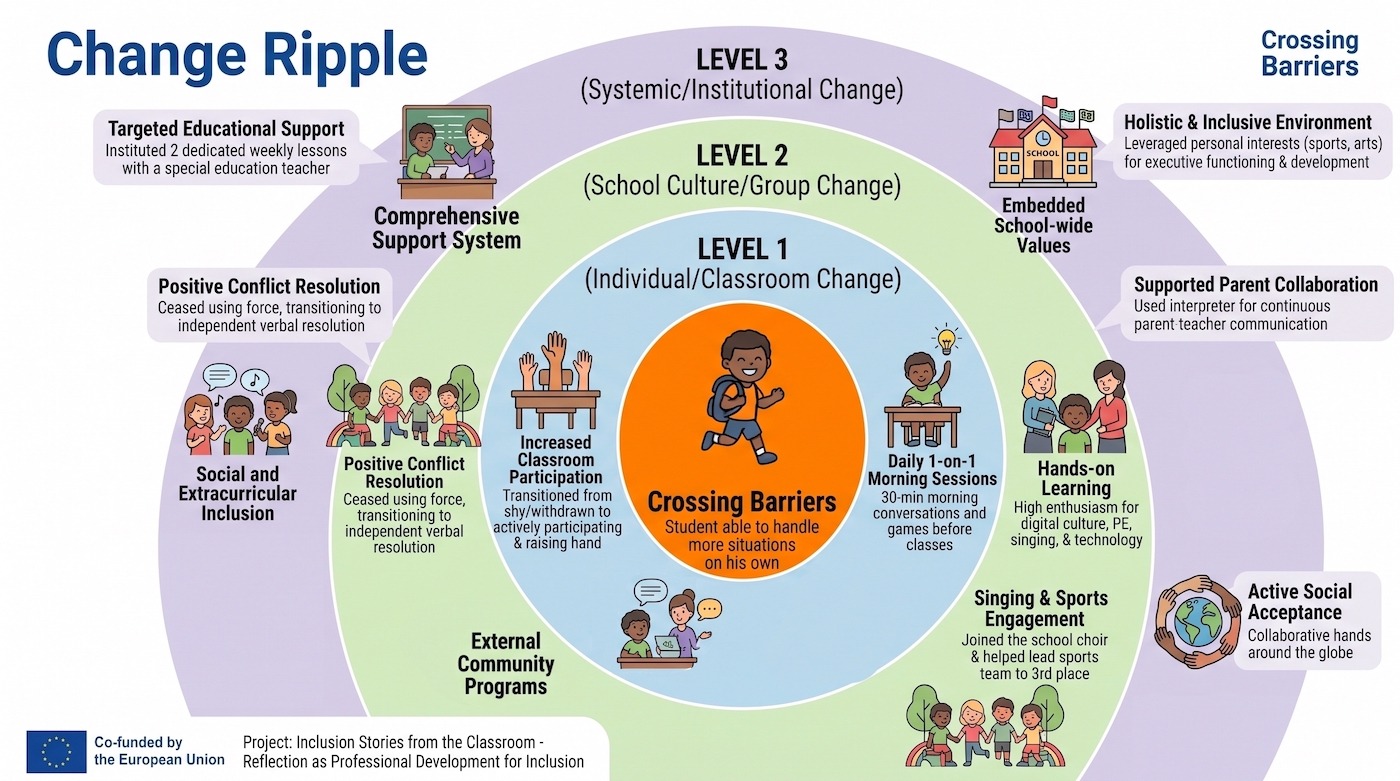
Reflection Prism
The teaching team demonstrated a vital shift from a deficit-based model of compliance to a strengths-based, holistic pedagogical approach. By leveraging the student's inherent interests, incorporating choir and team sports into his educational journey, the teachers effectively scaffolded his executive functioning and concentration. The educators expanded their classroom management capacity by realising that behavioural modification could not be achieved through discipline alone, but required structured, low-stakes environments (like morning play and peer-mentorship) to build vocabulary and behavioural norms concurrently. This responsive pedagogy directly engineered his academic and social success.
This narrative highlights the profound link between linguistic isolation and emotional distress. Initially, the student’s inability to decode his environment generated severe uncertainty, which manifested as anxiety and physical aggression. As language acquisition progressed, his emotional resilience grew in tandem. The implementation of daily 30-minute personalised morning sessions acted as a psychological anchor, providing a secure attachment figure within the institution. By shifting his self-concept from a misunderstood outsider to a competent, central community figure through successes in sports and choir, the school successfully lowered his affective filter, enabling both emotional self-regulation and deeper social trust.
This story illustrates the dismantling of systemic barriers to migrant inclusion through intentional community cohesion. Rather than placing the burden of assimilation entirely on the child, the institution adapted its ecosystem to support him. By partnering with the Menedék Association to facilitate shared cultural experiences (such as forest schools and ice skating), the school actively prevented the boy's social marginalisation. The group dynamics transformed dramatically: his differences were normalised, and he was empowered to become a culturally integrated, highly respected leader among his peers, proving that inclusive communities are built through structured, shared social participation rather than proximity alone.