
Allegra's Journey
Allegra experienced the condition of "not knowing how to read" with deep distress, and frustration became unbearable when she could not perform the same activities as her classmates. This experience often translated into oppositional behaviors and the refusal of schoolwork.
The journey began in the 2020-2021 school year, during a period when the outside world was deeply marked by pandemic restrictions. The school also bore evident traces: masks and social distancing compromised the natural sociality of children, making the school experience more tiring and complex. Allegra's class was part of this context—a particularly complex reality. The group consisted of 21 students with very heterogeneous characteristics: four children with ADHD, one with autism spectrum disorder, and two with significant behavioral dysregulation. This initial complexity made the application of traditional teaching models difficult and slow.
The Italian school system promotes the inclusion of students with disabilities within regular classes of all levels and grades, providing a support teacher. This right is enshrined in Law 104/1992. The student's functioning level is defined by specific medical commissions through a functional diagnosis, from which the Functional Dynamic Profile (PDF) and the Individualized Education Plan (IEP) are derived.
The analyzed educational path is fully situated within the Italian model of school inclusion, consistent with Law 104/92 and Legislative Decree 66/2017, which orient planning toward a "life project" based on the criteria of the ICF (International Classification of Functioning).
At the municipal level, the contribution of specialized assistance (OEPAC) represented a key element in managing the most complex relational dynamics. At the healthcare level, collaboration with the ASL (Local Health Authority) allowed for the definition of an accurate clinical profile during the second year of primary school, offering an interpretive reading of the student's behavior that moved beyond mere descriptive observation. This systemic approach is consistent with the goals of the European Strategy 2021-2030, aimed at the full and meaningful participation of students in educational and social contexts.
The school offers a free educational path to students aged 3 to 14, following the National Curriculum Guidelines. Within its autonomy, the institute identifies areas for improvement in relation to the specific needs of its users. Educational priorities include the inclusion of students with special educational needs, the valorization of multiculturalism, and the development of European citizenship skills, as detailed in the PTOF (Triennial Plan of the Educational Offer), the internationalization plan, and the RAV (Self-Evaluation Report).
First grade, primary school. We are in the canteen; Allegra plays with everything: the tablecloth, the cutlery, the glass, the bread, but she doesn't eat. The teacher, observing the girl's plate, asks her — "Allegra, excuse me, aren't you eating the cheese?" — "Of course I'm not eating it, teacher," she replies with extreme naturalness — "mice eat cheese!".
Allegra is a primary school student who, at the age of six, presented with a complex functioning profile, characterized by the coexistence of significant personal resources and fragilities on cognitive, emotional-relational, and self-regulatory levels.
● Socio-Affective Level: She is an affectionate child, endowed with marked expressive vivacity and a natural propensity for verbal relationships. Her communicative style is rich and articulate, with an appropriate use of vocabulary and good narrative ability, elements that represent a major strength of her functional profile.
● Emotional Level: Allegra manifests marked sensitivity and empathy but presents significant difficulties in emotional regulation. She frequently tends to retreat into an imaginative world, used as a compensation strategy when facing situations perceived as frustrating or excessively complex. Her self-perception appears immature and characterized by a rigid representation of emotions, with a tendency to recognize only the expression of happiness as socially acceptable. This defense mechanism generates a misalignment between internal emotional experience and manifest behavior, resulting in difficulties managing frustration and failure.
● Relational Level: Allegra shows selective interaction patterns: she prefers playing in small groups and establishes limited friendships. In relationships with peers, she may be perceived as "younger" than her chronological age, also due to a marked emotional vulnerability that leads her to take offense easily in situations interpreted as being directed personally at her. Her cognitive-emotional style is characterized by a dichotomous view of reality, which leads her to categorize people and situations in absolute terms ("good/bad"), making the management of conflicts and relational ambiguities complex.
● Behavioral Level: In situations of high emotional tension, Allegra may manifest dysfunctional conduct, such as crying fits, refusal of the proposed activity, and, in moments of greater dysregulation, oppositional behaviors that can lead to physical contact with classmates (biting, kicking, pushing, pulling). These behaviors are not intentionally aggressive but appear linked to a difficulty in decoding the context and recognizing her own causal role in events, highlighting a predominantly external locus of control.
● Cognitive and Attentional Level: Allegra has very short attention spans and marked psychomotor agitation. She struggles to remain seated and tends to intervene verbally in ways that are not pertinent to the ongoing activity. Logical-spatial difficulties constitute a significant obstacle in the processes of acquiring literacy, calculation, and problem-solving skills. Even structured motor activities are challenging, due to both coordination difficulties and the rapid onset of fatigue and boredom.
● Organization and Physiology: Additional critical issues concern personal organization and the management of school materials: Allegra struggles to take care of them, tending to damage, lose, or put them in her mouth, and her workspace is frequently messy. Furthermore, physiological factors such as fatigue and hunger—aggravated by a poor acceptance of the food offered at school—significantly affect her emotional balance, increasing the likelihood of behavioral outbursts.
Despite the difficulties described, Allegra's profile is enriched by important resources. These include a marked visual memory, good imitation skills, and strong interests in specific areas such as languages (particularly English), nature, and animals. Furthermore, the student manifests a natural talent for drawing, expressed in detailed and emotionally significant graphic productions, and a good sense of rhythm, accompanied by a strong attraction to songs and nursery rhymes. These elements represent fundamental motivational levers on which to build a personalized and inclusive educational path.
Despite the difficulties described, Allegra's profile is enriched by important resources. These include a marked visual memory, good imitation skills, and strong interests in specific areas such as languages (particularly English), nature, and animals. Furthermore, the student manifests a natural talent for drawing, expressed in detailed and emotionally significant graphic productions, and a good sense of rhythm, accompanied by a strong attraction to songs and nursery rhymes. These elements represent fundamental motivational levers on which to build a personalized and inclusive educational path.
The journey began in the 2020-2021 school year, during a period when the outside world was deeply marked by pandemic restrictions. The school also bore evident traces: masks and social distancing compromised the natural sociality of children, making the school experience more tiring and complex. Allegra's class was part of this context—a particularly complex reality. The group consisted of 21 students with very heterogeneous characteristics: four children with ADHD, one with autism spectrum disorder, and two with significant behavioral dysregulation. This initial complexity made the application of traditional teaching models difficult and slow.
In second grade, thanks to a reorganization of school resources, Allegra was able to benefit from some hours with a support teacher. Despite this, difficulties in learning to read and write remained very marked and persistent. The girl experienced the condition of "not knowing how to read" with deep distress, and frustration became unbearable when she could not perform the same activities as her classmates. This experience often translated into oppositional behaviors and the refusal of schoolwork.
The teachers also went through a phase of crisis and self-questioning. It was necessary to start a long and demanding process of professional reflection, aimed at reviewing the educational approach toward the class and, specifically, toward Allegra. The turning point came in third grade, when the girl could finally count on a full-time support teacher and the presence of the OEPAC. The educational team stabilized and decided to explore new paths and strategies, with the goal of tapping into Allegra's interests and strengthening the affective-relational dimension, recognized as the essential foundation for planning her learning path.
The teaching team chose to adopt a creative and flexible design, based on a careful analysis of each student's educational needs. Teachers began to share skills, materials, and best practices, training each other and participating in professional development courses on Universal Design for Learning (UDL), Artificial Intelligence, and Storytelling. This collaborative work allowed for the development of effective teaching strategies not only for Allegra but for the entire class group.
With the lifting of COVID-related restrictions in third grade, students no longer wore masks, and it was finally possible to reorganize teaching through group work. The teaching team thus implemented a significant change in perspective: they moved away from an approach centered on Allegra's difficulties, particularly those related to literacy, to orient themselves toward planning based on her potential and intrinsic motivations, valorizing resources and strengths as levers for learning.
Visual Mediation of Emotions
To facilitate the recognition and verbalization of emotional states, a permanent visual mediator was introduced: an outline depicting a girl with different emotional expressions (anger, sadness, fear, disgust, joy). The tool, placed near the desk, allowed the student to name her experiences and place them in context, reducing impulsive reactions and promoting emotional awareness.
Use of Social Stories
Digital Social Stories were designed and created using tools such as Canva and Book Creator, structured according to the Carol Gray method, with descriptive and directive sentences. These stories supported the understanding of social dynamics and expected behaviors, leveraging the student's natural capacity for identification and her interest in narratives.
Role-Playing and Empathic Perspective
Through role-playing games based on the use of paper dolls and drawing, conflict situations or daily experiences were simulated. In some cases, the student was asked to play the role of the other, favoring the development of empathy and cognitive flexibility.
Normalization and Verbalization of Emotions
Constant work was dedicated to emotional normalization and the deconstruction of absolutist thinking. Emotions were presented as legitimate experiences, neither "good" nor "bad," including complex emotions such as fear of the future. This contributed to reducing anxiety and increasing the capacity for metacognitive reflection.
Universal Design for Learning and Collaborative Learning
The entire path was based on the principles of Universal Design for Learning (UDL). Activities were designed with multiple modes of:
- Presentation: (diagrams, images, pictograms, videos, audio).
- Engagement: (narrative and creative activities).
- Expression: (digital, manipulative, and graphic productions).
The educational proposals, conveyed through the student's passion for stories, were offered to the entire class, transforming teaching in a flexible and accessible sense and reducing the risk of exclusion.
Peer Tutoring
Peer tutoring was promoted, favoring work in pairs or small groups. In particular, the student took on the role of tutor in the English subject, an experience that contributed significantly to strengthening her self-esteem and sense of competence.
Laboratory and Play-Based Teaching
The curriculum was reworked in a laboratory-based, experiential, and playful key. Practical projects were carried out, such as creating perfumes, podcasts, eBooks, and digital activities via Wordwall. This approach valorized the student's creativity and her active protagonism in learning processes.
Subject-Specific Educational Adaptations
- Mathematics: Use of visual problems, concrete situations, and manipulative tools to make calculation and problem-solving accessible.
- Italian: Use of pictograms for grammatical analysis and the use of Augmentative and Alternative Communication (AAC) for the production and comprehension of complex texts.
- Oral Subjects: Support through advance organizers, images, and audio files with the teachers' voices to facilitate memorization and independent study.
- Gamification: Presentation of content, tests, and homework in the form of educational games, increasing motivation and engagement.
Management of Physiological Routines
Targeted work was carried out on recognizing signals of hunger and fatigue, in collaboration with the family and health services. The regulation of meals helped prevent emotional outbursts and improve behavioral stability.
Space Organization and Self-Regulation
The classroom was organized with a cluster desks setting to facilitate interaction and participation. Visual checklists were introduced to support the organization of work and school materials, promoting autonomy.
Valorization of Talents
The "sketchbook" and free drawing were recognized as tools for emotional self-regulation and expressive channels. The student's graphic talent was integrated into educational projects, such as the Giotto workshop, becoming a resource for processing concepts and experiences.
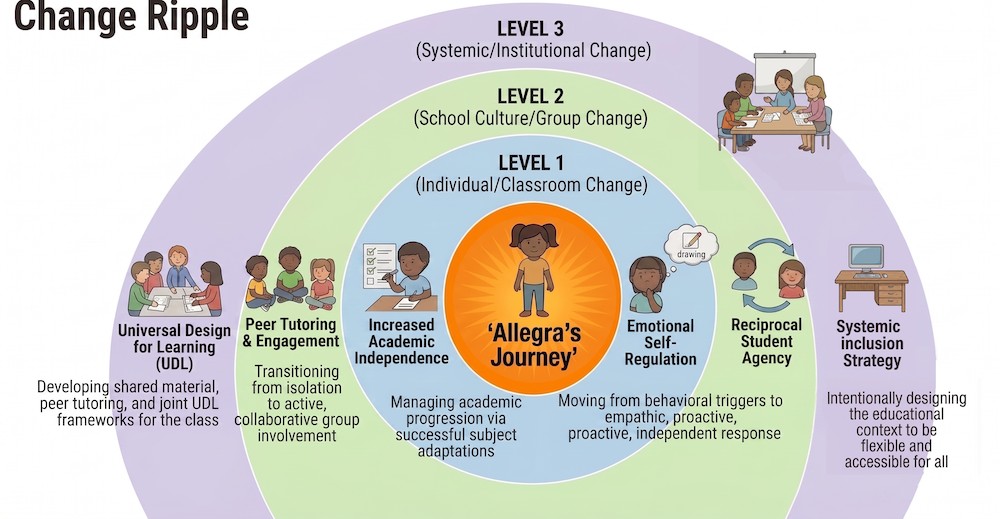
The adoption of the UDL (Universal Design for Learning) approach, starting from third grade, represented the turning point in Allegra's journey. Thanks to this approach, Allegra moved from a condition of isolation and behavioral crises to a profile of an empathic, proactive, and independent girl. The normalization of her "diversity" within a universal teaching framework allowed her to develop awareness of her own abilities, preparing her with confidence for secondary school.
Systemic Barriers
- Starting primary school during restrictions related to the COVID emergency, which lasted until second grade.
- Slowness of public apparatus: the diagnosis arrived only at the end of second grade, with the assignment of the support teacher and OEPAC at the beginning of third grade.
- Prevalent use of traditional teaching methodologies.
- Lack of adequate multimedia supports.
Facilitators
- Conclusion of COVID emergency restrictions.
- Constant, positive, and constructive collaboration with the family.
- Organization of the class into cooperative work groups.
- Introduction of the Digital Board in daily teaching and regular access to the computer lab starting from third grade.
- Presence of a stable and collaborative teaching team, with shared planning.
- Curricular flexibility and careful organization of school resources.
- Use of open spaces and participation in educational projects and field trips.
The combination of these facilitators, consistent with the principles of Universal Design for Learning, contributed to the creation of an inclusive, flexible, and motivating learning environment, favoring Allegra's well-being, active participation, and educational success.
The Network of Local Actors
The success of Allegra's path was not the result of isolated interventions, but the outcome of a real synergy between different local actors. This collaboration transformed educational action into a coordinated network model, capable of supporting the inclusion process in a coherent and continuous way.
Constant consultation with ASL neuropsychiatrists allowed for the translation of clinical data into daily teaching actions. Through periodic meetings, the teaching team could calibrate the cognitive load of activities based on the student's actual possibilities, preventing overload situations that could have triggered new emotional crises. This dialogue ensured that school expectations were always aligned with the girl's functional profile.
In this framework, the figure of specialized assistance (OEPAC) assumed a central and proactive role. The assistant was fully involved in the teaching design phase, contributing significantly to the construction of an accessible learning environment. Her presence proved to be an essential facilitator, particularly in group work, where she acted as a relational mediator, allowing Allegra to interact with classmates in a constructive and safe way.
Finally, the collaboration extended to the network of private specialists, including speech therapists and psychomotor therapists who followed the student outside of school hours. The constant exchange of information allowed for the creation of a stable bridge between the therapeutic and school settings, preventing rehabilitative and educational goals from proceeding on parallel tracks. Instead, these goals merged into a single growth project, in which the school took on the role of the central hub of a broad and coherent support ecosystem.
The analysis of this journey highlights how school inclusion is not the result of generic individual willingness, but the result of rigorous pedagogical planning based on the principles of inclusive design. In this perspective, the educational context is intentionally designed to be flexible, accessible, and capable of responding to the needs of all students.
The approach adopted allowed for the consolidation of a fundamental principle: so-called "problem behavior" must not be interpreted as an oppositional act, but rather as a form of dysfunctional communication that requires appropriate mediators and intentional educational responses.
This path did not produce significant effects only on the student; it also generated a relevant impact on a professional level. The experience fostered the development of specific technical skills, particularly in the use of assistive technologies and conflict management strategies. These tools are now permanently integrated into daily teaching practice for the benefit of the entire class group.
At the same time, systematic cooperation within the teaching team proved to be an indispensable requirement both for the effectiveness of educational action and for the prevention of professional stress and burnout. The sharing of strategies and the plurality of methodological perspectives made it possible to achieve significant goals. At the end of the five-year cycle, Allegra reached an increasingly conscious narration of her own emotional experiences, expressed through poetic and graphic language.
Lessons Learned: Best Practices for the Community
From this experience, several best practices emerge that are transferable to other educational contexts:
- Choral Planning: The IEP is not the exclusive property of the support teacher but represents the shared commitment of the entire class council.
- Visual Methodology: Images constitute powerful cognitive "anchors" for all students, not just for those who present difficulties.
- Curricular Flexibility: Valorizing individual talents, such as English and art in Allegra's case, proves to be an effective strategy for repairing wounded self-esteem.
- Normalization of Emotions: Emotions considered "negative" should not be repressed but welcomed and recognized. When Allegra accepted that she could be "angry" without ceasing to be "good," she achieved a new inner freedom.
Today, Allegra is ready for secondary school. She is independent, aware of her own limits, and at the same time proud of her strengths. She has clear ideas about her future: she wants to be a fashion designer. This experience confirms how authentic inclusion does not only transform the path of students but contributes profoundly to the professional growth of those who educate, inviting teachers to accept the challenge of looking at the world through new eyes.
This analysis follows the Most Significant Change (MSC) methodology, a participatory form of monitoring and evaluation focused on identifying impactful shifts within social and educational programs.
1. Predefined Domains of Change
- Primary Domain: Social-Emotional Well-being.
- Secondary Domains: Teacher Agency (Collaborative Professional Practice) , Student Agency & Autonomy , and Academic Integration via Universal Design.
2. Observable Changes
- Behavioral Regulation: Shift from dysregulated, oppositional acts (crying fits, activity refusal, biting, kicking, pushing, pulling) to an empathetic, proactive, and independent daily profile.
- Emotional Articulation: Shift from an immature, rigid mask of hiding frustrations to utilizing a permanent desk-side visual mediator to actively name complex emotional experiences.
- Academic Progression: Transition from severe literacy frustration ("not knowing how to read") causing task refusal to successfully managing subject adaptations and acting as a peer tutor in English class.
- Peer Dynamics: Transition from isolation and selective, immature interaction patterns to active, collaborative engagement within a cluster-desk classroom layout.
- Pedagogical Infrastructure: Teachers moved away from individual traditional models to implement shared material creation, peer tutoring, and joint Universal Design for Learning (UDL) frameworks.
3. Candidate Most Significant Change (MSC)
The Shift: Allegra's transition from an isolated student enduring severe literacy distress and behavioral crises to a proud peer tutor who owns her learning via customized tools , signaling a profound reconstruction of her self-esteem and sense of classroom competence.
4. Stakeholder Mapping
Student: Allegra.
School Educators: Class curricular teachers , specialized Support Teacher , and the Educational Assistant (OEPAC).
External Collaborators: Local Health Authority (ASL) neuropsychiatrists , family members , private speech therapists, and psychomotor therapists.