
A Student From Ukraine
Lara is a 10 year-old student from Ukraine, escaping the war with her adopted mother.
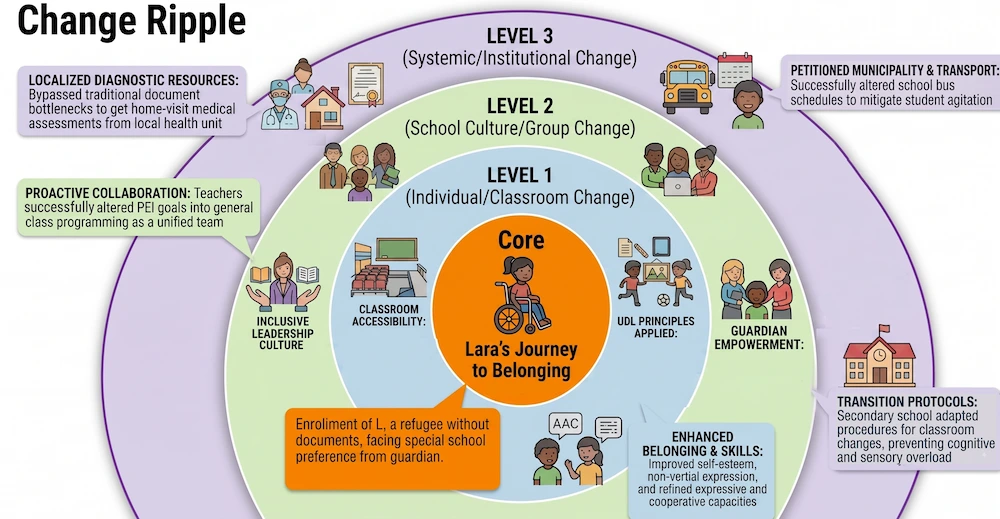
Review the significant changes in Lara's story in this 'Change Ripple' infographic. Click image to enlarge.
Lara is a 10 year-old student from Ukraine, escaping the war with her adopted mother. The student was registered in the final year of the primary school (grade 5) but the mother did not want the child to attend the school. When the head teacher found out that the student was not coming to school she contacted the step-mother and asked her the reasons why Lara was not at school.
The step-mother argued that the child, as a result of her severe impairment, would have been better educated in a special school. Lara’s diagnosis reports a severe cognitive disability, a physical disability (she is a wheelchair user) and the lack of any verbal communication.
The step-mother’s position was very clear. There was no point for a child with such severe impairment to go to a regular class with other students. She only wanted Lara to be registered in the school to obtain the residence permit and her migration status. Both documents are required if you want to live and work in Italy. She had no intention of sending her to school as she would not have been able to take part in the school activities. She reclaimed her right to a special school/class and complained with the school principal about the Italian education system which lacked a differentiated and alternative pathway for students with severe disabilities.
Despite the Ministry of Instruction and Merit in 2022 had passed a series of legislative measures to safeguard the registration and participation of Ukrainian refugees in the Italian school system, in terms of didactical (tools, materials and technological supports) as well as administrative shortcuts, there was no mentioning of specific support for Ukrainian children with disabilities.
Children with disabilities need to present a certificate/diagnosis of disability, issued by a medical commission in order to be provided with the support that they may need. To put it simply, inclusion process is conditional upon the issue of a medical diagnosis which guarantees that students with disabilities can be provided with all the additional support that they need according to the severity of their impairment.
The support consists of three different types of provision:
Support teacher. This staff is assigned to the classroom where the student with disabilities is placed. The support is provided for some hours of the school time depending on the type of diagnosis
Teaching assistant/learning assistant is assigned specifically to the individual child as a one-to-one ratio also depending on the type of diagnosis
Communication assistant is assigned to individual children with sensory impairments or with non verbal communication (Augmentative Alternative Communication)
Technological devices
When Lara came to Italy, she did not have any documentation with her. Although Lara was clearly a child who required extra support, the lack of official papers prevented the school from obtaining the additional support staff and resources required.
The inclusion working group from the school had to face a series of challenges:
A culture change of the way in which the mother saw education and need to have Lara at school
Provide Lara with extra support as a result of the issue of the medical certificate required by the system to obtain extra resources
Engage the local health unit to take charge of the student’s assessment procedure
Design an individualized educational plan that could outline Lara’s strengths and weaknesses
Engage the teachers as a team to promote her participation in learning by developing projects that could benefit Lara (Augmentative Alternative Communication; technological devices)
The school principal and the inclusion leaders had to work hard to ensure that the process of inclusion could be started:
From a cultural perspective to ensure that the step-mother supported the process of mainstreaming Lara in a regular class. To ensure that Lara’s rights to attend the local school with her same age classmates in the shortest time possible
To get in touch with the local health authority in order to trigger the process of inclusion by ensuring the child could be diagnose and seen by medical staff at her house
Make sure that a medical diagnosis could be issued in order to require additional resources
- Send the medical diagnosis and the request of support (certificate of school integration) to the regional educational authority in order to obtain the support teaching staff
- Send the medical diagnosis to the municipality to obtain the teaching staff
The Ministry of Education passed a series of measures to speed up the process of providing support to students from Ukraine.
Thanks to the networking system that the school had already put in place and the collaboration with different local stakeholders such as the local health unit office and the teachers and the association providing teaching assistants, the student managed to obtain the medical diagnosis and all the other supports required.
The educational context is the IC "Octavia". The regulatory framework supporting participation includes:
L.104/92 art. 3 comma 3: Applied for the two students with severe disabilities present in the class.
L. 170/2010: For the 5 students with Specific Learning Disorders (DSA).
Ministerial Directive 27/12/2012 and C.M. 8/2013: For the student with linguistic
disadvantage.
Right to education: Guaranteed not only in name but substantially, allowing participation in field trips and workshops even in the presence of structural limitations.
The school operates with a culture favorably oriented towards inclusion, viewing diversity as a daily way of living school life rather than just a goal to be reached. The key documents are:
PEI (Individualized Education Plan): Reference document for differentiated programming (autonomy, communication, socialization).
PDP (Personalized Learning Plan): Drafted for the 6 students with BES (5 DSA and 1 linguistic disadvantage).
- PTOF/PAI: Programming reflects accessible, meaningful, and transformative teaching for everyone.
The lights dim in the school theater. On stage, the students of Class V E are not just performing the Odyssey; they are redefining it. The scenery has been specially adapted to ensure "scenic accessibility," allowing Lara, a student who uses a wheelchair, to move freely alongside her classmates. This is not simply a play; it is the culmination of a daily reality where physical and cultural barriers are systematically broken down.
In another corner of the classroom, a Kamishibai (paper theater) is ready. Here, the story of The Little Prince is told not only through words but through Augmentative and Alternative Communication (AAC), ensuring every child, regardless of verbal ability, is a narrator.
The student repeated the fifth grade of primary school because, due to numerous absences following a long post-operative hospital stay in the previous school year, the school, in agreement with the family, decided she should remain for an additional year. This allowed her to mature the educational and didactic skills necessary to foster inclusion and prepare her for the subsequent school career. Her presence has enriched the class context, contributing to a climate of acceptance and collaboration.
The educational-didactic path was designed and implemented taking into account her specific needs, with the aim of fostering the maximum possible development of her potential, inclusion in the new class group, and the acquisition of skills. The Individualized Education Plan (PEI) was the reference document for activity planning, providing for differentiated objectives in all dimensions, with particular attention to personal autonomy, communication, socialization, and essential cognitive skills.
Diagnosis: Prematurity and perinatal hypoxia, agenesis of the corpus callosum, optic atrophy, spastic diplegia, and mixed specific developmental disorder.
Weaknesses: Lack of independent walking (use of a wheelchair) following orthopedic surgeries (osteotomy and techtoplasty); severe delays in developmental milestones.
Strengths: Ability to establish positive relationships with adults and peers; enthusiastic participation in creative and theatrical activities.
Family: Constant, open, and constructive collaboration with the school, with a strong sharing of educational goals and global well-being.
Systemic Barriers
Structural Limits: Historical contexts (such as Florence or Ostia Antica) with physical obstacles and partial accessibility.
Organizational Challenges: Complexity in managing mobility (wheelchair) during educational trips and transfers.
Cultural Barriers: Potential exclusion resulting from the rigidity of standard paths, overcome through the adaptation of institutional routes.
Systemic Facilitators
UDL (Universal Design for Learning): Applied in the Kamishibai project through multiple means of representation (text, audio, images, AAC), expression (drawing, acting), and engagement.
Aids and Materials: Use of AAC, simple musical instruments (triangle, maracas), and alternative routes (elevators at the Quirinale).
Methodologies: Peer tutoring (peer modeling), cooperative learning, experiential workshops, and authentic tasks.
Human Support: Inclusive leadership from the teaching team and constant emotional support.
Educational Outings
- They strengthen school learning through direct experiences.
- They stimulate curiosity, observation, and active participation.
- They promote socialization among peers and the development of autonomy.
- They allow students to engage with Italy's cultural and historical heritage.
Inclusive and Educational Value
Inclusion in all phases of the trip (travel, visits, breaks) was a fundamental educational message for the whole class.
It made active and inclusive citizenship concrete.
It offered the student with a disability in a wheelchair an experience of equal dignity and value.
It promoted awareness and solidarity among classmates.
It made the concept of "no one excluded" tangible.
It strengthened transversal skills: collaboration, respect, autonomy, and responsibility.
Specific Outings
Quirinale Palace: The class visited the Quirinale, participating in activities designed to learn about Italian institutions. The fact that all students traversed the same places (though via adapted paths) normalized disability and full participation in social and cultural life. Students saw concretely how institutions work to break down barriers (elevators, alternative routes). This teaches the value of respect and welcome more than any theoretical lesson. The student's presence stimulated mutual help within the group, strengthening empathy and class cohesion.
Florence (by train): Visit to the Medici Chapels, the Duomo, and the Uffizi Gallery. This was highly educational but also a major organizational challenge. The class learned that even in historical contexts with structural limits, solutions can be found through the active commitment of the community. The train journey was an excellent choice for logistics and mobility.
Ostia Antica: An immersive and multisensorial experience where children moved through ancient streets and touched materials to reconstruct the past from sources. Even with partially accessible paths, it was possible to build a personalized and significant educational experience, fully realizing the right to study.
Music Workshop (Classes III and V)
- Students participated with great enthusiasm
- The use of simple instruments (flute, triangle, woodblocks, tambourine, maracas) allowed active participation for everyone, including those with motor, cognitive, or relational difficulties.
- It valued every student according to their abilities and fostered peer cooperation.
- It offered a non-verbal expressive space for those with communication difficulties
- It strengthened group identity and self-esteem, making school performances a celebration of diversity.
"Odyssey" Theatrical Performance
The fifth-grade class staged an adaptation of the Odyssey with the goal of valuing all students and making the experience inclusive.
- Active Participation: Demonstrated that every student can participate regardless of physical abilities.
- Breaking Barriers: The environment was adapted for scenic accessibility, and classmates provided active logistical and relational support.
- Skills Enhanced: Students improved expressive capacities, autonomy, responsibility, problem-solving, and empathy.
- The experience proved that inclusion is a daily way of living school, not just a distant goal.
Kamishibai Project: "Traveling with the Little Prince"
Kamishibai is a Japanese visual and narrative tool that fosters concentration and logical sequencing.
Multimodal Approach: Valued different intelligences (verbal, visual, spatial, interpersonal).
Authentic Task: Students produced an original story to present to a real audience.
AAC Integration: The use of Augmentative and Alternative Communication allowed maximum accessibility for the student with a disability and others with complex communication needs.
UDL Principles
- Representation: Information offered in multiple formats (audio, text, images, AAC).
- Action and Expression: Students expressed ideas through writing, drawing, painting, and drama.
- Engagement: Working toward a public presentation strengthened responsibility and motivation.
Thematic Projects
Bullying and Cyberbullying: Class visit to the cinema to see the film "Il ragazzo
con i pantaloni rosa".
Violence Against Women: Watching a play performed by middle school
students.
Book Festival: Exhibition of the original Kamishibai story.
Role of School Actors and Changing Roles
Support Teacher and OEPAC: Key figures whose roles evolved from "assistance"
to "facilitation" of global interaction.
Teaching Team: Designed personalized paths integrating PEI goals into class programming.
Class Group: Students became active tutors and models of behavior, transforming into active and solidary citizens.
Family: Active partners in school placement decisions and monitoring well- being.
Institutions: Provided concrete examples of breaking architectural barriers.
Best Practices and Professional Development
Data-Driven Approach: Using concrete evidence to guide decision-making.
Proactive Communication: Transparent information flow to prevent operational bottlenecks.
Methodological Agility: Adapting strategies in real-time.
Professional Growth: Continuous update on technologies, critical thinking, and
emotional intelligence for managing diverse teams.
The transition to secondary school presented new challenges:
Initial Perceptions:
Some teachers initially focused only on motor aspects and physical barriers rather than the student's complexity.
Architectural Barriers
- The main entrance ramp is steep and requires significant physical strength to manage safely. A school collaborator now assists with this.
- The "SCUOLAB" experiment involves frequent moves between classrooms, which are difficult due to narrow corridors and overcrowding. Support teachers now anticipate these moves to avoid cognitive overload and noise.
- The lack of a ramp between the gym and the outdoor space prevents the student from participating in outdoor activities (like signaling the start of a race).
- The stairlift only reaches the first floor; there is no disabled-accessible bathroom on the first floor (only on the ground floor), and the second floor is entirely inaccessible.
Communication Challenges
The student's guardian is a native Ukrainian speaker and sometimes struggles to understand teacher requests. A daily diary and the electronic register are now used for rapid communication.
Logistics:
Issues with the school bus schedule caused the student agitation; this was resolved through a formal request from the Principal to change the bus times.
Nutrition:
A critical issue arose regarding lunch administration, as the student requires significant assistance to eat safely (to prevent choking/insufficient chewing). Support teachers initially handled this until OEPAC hours were modified to cover the mealtime.
Currently, the support teacher is organizing two educational outings designed to ensure the participation of all students in the class.
Based on the provided Most Significant Change (MSC) methodology guide and the structured curation support framework , here is the multi-stage analysis of Lara's narrative.
This analysis follows the Most Significant Change (MSC) methodology, a participatory form of monitoring and evaluation focused on identifying impactful shifts within social and educational programs.
1. Predefined Domains of Change
Systemic & Administrative Adaptation: Overcoming rigid structural guidelines to secure localized funding and diagnostic resources for refugee students without documentation.
Refugee Inclusion & Cultural Realignment: Shifting the family's paradigm from total self-exclusion/special schooling toward active participation in a mainstream classroom.
Teacher Agency & Collaborative Practice: Moving the school staff from a reactive mindset regarding architectural/logistical barriers to a proactive, Universal Design for Learning (UDL) approach.
2. Observable Changes
The headteacher actively initiated contact with the stepmother to investigate non-attendance, rather than letting the student slip out of the system.
The stepmother shifted from insisting on total exclusion ("no point for a child with such severe impairment to go to a regular class") to accepting a mainstream registration.
The school activated a localized networking system, bypassing traditional document bottlenecks to get home-visit medical assessments from the local health unit.
The teaching staff transitioned their approach from providing basic physical "assistance" to implementing active "facilitation" of global interaction.
The physical theater stage and scenery were structurally modified to ensure "scenic accessibility" for a wheelchair user.
- Classroom delivery incorporated Augmentative and Alternative Communication (AAC) alongside a Kamishibai paper theater to accommodate a non-verbal student.
- Classmates evolved into active peer tutors and behavior models rather than passive observers.
- The secondary school revised its physical transition protocols, having support teachers anticipate classroom changes early to bypass corridor overcrowding and prevent student cognitive overload.
- The Principal successfully petitioned the municipality to structurally alter the school bus schedule to mitigate student agitation.
- The school formally altered the operating hours of the OEPAC assistant to guarantee targeted physical safety during mealtimes.
3. Candidate Most Significant Change (MSC)
The single most impactful shift in this narrative is the complete paradigm reversal of the student's family regarding the value of mainstream education. The stepmother moved from utilizing the school purely as a bureaucratic vehicle for legal residency permits to engaging as an active partner in goal-setting and educational co-design. This dismantled the primary barrier to entry before the school's pedagogical strategies could even begin.
4. Stakeholder Mapping
- Direct Beneficiary: Lara (10-year-old Ukrainian refugee student).
- Family/Guardians: Stepmother (native Ukrainian speaker).
- School Leadership: Headteacher/School Principal, Inclusion leaders.
- Instructional Team: Support teachers, Classroom teachers, OEPAC assistants, Communication assistants.
- Peers: Class V E students (acting as peer models and theater collaborators).
- External System Actors: Local health unit medical staff, Regional educational authorities, Municipality transport managers, Association providing teaching assistants.
Start writing here...