
Find out more about Istituto Comprensivo "Octavia"
Mark's Story: A Story of Inclusion
(African proverb)
The story concerns Mark, a 9-year-old student of Ethiopian nationality attending the fourth grade of primary school.
This account of inclusion focuses on a third-grade primary school class that includes Mark, a nine-year-old pupil. The teaching team consists of four mainstream teachers covering different subject areas, two special education teachers, and two educational assistants who support autonomy and communication (OEPAC).
I am a primary school teacher, and I have decided to share my reflections on the inclusion processes implemented in my classroom.
I still remember my first impressions when I began teaching at my current school. I had recently moved from another nearby comprehensive school, but one with a markedly different student population. Here, I found a strong culture of initiatives designed to promote inclusion, teachers with both theoretical training and many years of practical experience, highly motivated staff, and a leadership team committed to raising awareness of the importance of genuine inclusion. Central to this story was the work of my colleague Maria, who holds the Instrumental Function (Funzione Strumentale) for “Student and Family Support” and the “Third Sector.” She acts as a bridge between the school and the many educational organisations in the local community.
Italian primary schools operate within a national educational framework that has supported inclusion since Law 517 of 1977 abolished special classes and schools. The school described here places each child—their needs, culture, and individuality—at the centre of its work, creating a welcoming and supportive environment for pupils with disabilities, many of whom also come from migrant backgrounds, as in this case study.
Our school’s 2024–2025 Annual Inclusion Plan (PAI) reiterates that difference is an inherent part of the human condition. Every individual has a unique way of learning and therefore has the right to be welcomed and supported. From this perspective, it is essential to value each pupil’s diversity by removing barriers to learning and participation and by introducing appropriate supports and inclusive practices, particularly when disability, a migrant background, or socio-economic and cultural disadvantage may affect access to education (PTOF 2024–2025 School Development Plan).
The 2025–2028 Self-Evaluation Report (RAV) identifies the creation of innovative and flexible physical and virtual learning environments as one of our school’s objectives. These environments are intended to support personalised, inclusive teaching methods, including through the improvement and modernisation of technological resources.
Academic Year 2022–2023: In first grade, on our way back from a class trip to the theatre, we stopped at a park where the children had lunch and played on the playground equipment. When it was time to take public transport back to school, Mark did not want to leave the swing. He told us that he had never been on one before and had never visited a playground.
Mark is an Ethiopian child who attends a class with 22 students in total. The class is heterogeneous in terms of origin but was very welcoming right from the start.
Mark is the third of six children; two older teenage brothers still live in Ethiopia with their maternal grandmother. The family in Italy consists of the mother, father, and younger siblings.
Mark had attended a municipal preschool, but the educational program there had not been adapted to his needs. When he entered first grade, he had little experience of structured learning, limited proficiency in Italian, clear difficulties with social interaction, and little independence in managing his school materials. He would also suddenly burst into tears for no apparent reason, even during recess in the school’s large outdoor playground.
His parents told us that Mark’s preschool years had been difficult. Communication between the preschool teachers and the family had been very limited; at the end of preschool, the teachers simply advised the family that Mark would probably need a clinical assessment before starting primary school.
Mark lived in a family context of severe socio-economic disadvantage: his father had just started working, and his mother was unemployed, caring for three young children at home.
At the beginning of first grade, the team faced two major critical issues:
- How to respond to the educational needs of a pupil with limited Italian language literacy and a history of schooling marked by poor socialisation.
- How to design appropriate instruction for a student coming from a migrant background and an extremely economically disadvantaged family environment.
The objectives identified by the teachers were:
- To welcome and support Mark throughout his learning journey, personal autonomy, and schoolwork.
- To support the family in their integration process into the local community, which could translate into an improvement in their socio-economic conditions.
Consequently, the teaching team undertook the following actions
1. Supporting the Student
To address the first issue, the teaching team decided that Mark needed a Personalised Educational Plan for Special Educational Needs (PDP for SEN/BES) from the beginning of first grade, so that he could approach school in a calm and reassuring environment. We drew on every resource available within the team, including the class’s special education teachers and the autonomy and communication support assistants present during school hours. (In Italy, a special education teacher is assigned to a class when a pupil with a certified disability is enrolled; at that time, Mark had not yet been formally recognised as having a disability or special educational needs.)
We nevertheless requested a clinical assessment through the local health authority (ASL) to identify any needs that could not be met without additional support. Following the assessment, the ASL issued a clinical certification recognising a mild disability.
By third grade, we were still working closely together to make the best possible use of the limited resources available to support Mark’s learning. In keeping with his Personalised Educational Plan—which emphasises compensatory tools rather than relying solely on exemptions, and builds on strengths rather than focusing on difficulties—we designed classroom activities around Mark’s tenderness, warmth, eagerness to learn, joy, and empathy.
From third grade onward, we developed an Individualised Education Plan (IEP/PEI), prioritising educational, instructional, and methodological interventions that fostered inclusion while building on his strengths:
- Group work: To support socialisation for both Mark and his classmates.
- Peer tutoring: To reinforce concepts not yet fully acquired.
- Experiential learning: To guide the student's understanding from a linguistic standpoint and reduce cognitive load.
- Positive reinforcement: Sharing achieved progress with teachers and peers.
- Use of technology/IT tools: Digital displays, PCs in the computer lab.
- Prompting and Fading techniques: To promote personal independence.
- Gym space: Utilising appropriate materials to develop psychomotor skills and participate in group games.
- Outdoor garden space during recess: This served as a key resource for Mark, allowing him to enhance communication, manage emotions, and "learn" to relate to his peer group.
- Classroom seating layout: Mark’s desk was consistently placed in the central island of desks, ensuring a clear view of the board and full access to the audio-visual tools on the digital board.
We engaged Mark in daily routines that structured the school day through established rhythms:
- "Morning Greeting": Performed collectively. In first grade, the teacher on duty demonstrated alphabet letters using body movements and wished students a productive day; in subsequent years, students took turns individually or in small groups leading their classmates in this activity. Often, a simple song opened the day's educational activities.
- Lunchtime tasks: Clearing tables, bringing snacks to the classroom, and distributing them to classmates.
- Personal organisation: Managing materials under the desk, in his backpack, and in his locker located in the hallway outside the classroom.
- From first grade onward, Mark took an active part in music workshops. An alternative notation system made music accessible through simple symbols, such as dots and crosses, rather than traditional notation, alongside body percussion and easy-to-play instruments including tambourines, maracas, triangles, and rhythm sticks.
- We also encouraged hands-on, creative, and visual-art activities using a variety of techniques and recycled materials. These activities helped Mark develop his fine motor skills and represent his experiences visually with greater awareness and confidence.
- The class itself played a major role in Mark’s inclusion. Several pupils had one or both parents from EU and non-EU countries, including India, Bangladesh, Venezuela, El Salvador, Afghanistan, Poland, and Romania. From first grade onward, the teaching team encouraged pupils to see cultural diversity as a personal asset and a source of enrichment throughout their development.
2. Supporting the Family
Alongside Mark’s educational journey, we began addressing the family’s socio-economic circumstances. Through cooperation between the school and a cleaning cooperative serving a hospital, Mark’s mother found temporary work. A year later, she secured a permanent five-hour-a-day contract paying approximately €1,100 per month, supplemented by the universal child allowance and attendance allowances for Mark and his younger brother.
Our school also works with local parishes to provide supported study programs, in which volunteers—often retired teachers—help pupils with homework after school in coordination with their class teachers.
Linguistic-Expressive Area Teacher:
The inclusion of Mark in the classroom was not only an educational act but also represented true professional growth for me. From a strictly instructional perspective, I developed specific skills aimed at making teaching accessible, personalised, and inclusive through the use of iconic mediators (images and concept maps) and non-verbal tools (music, art, acting, gestures). From a relational perspective, Mark and his family certainly enriched my intercultural background. I did not view Mark's diversity as an "obstacle," but rather as a resource for the entire class. In line with this approach, my team colleagues and I carried out activities, workshops, and theatre projects where Mark's culture of origin—as well as that of other students in the class from various migrant backgrounds—became an opportunity for mutual discussion and discovery, fostering empathy and a sense of belonging to "global citisenship" in every student. Therefore, Mark's inclusion strengthened my ability to co-design lessons alongside my team colleagues. Finally, I can affirm that I learned "in the field" how Mark's achievements are deeply connected to the vital network built between the school and various public and private educational agencies in the area, largely thanks to the work done by my colleague Maria.
Logical-Mathematical Area Teacher:
Having Mark in class was a very enriching experience on a personal level. For many years I have served as the Lead Teacher (Funzione Strumentale) for "Student Support," and more recently for the "Third Sector" as well. However, the story of Mark and his family symbolically represents the success of a support network—the result of years of effort by the school’s lead roles—that continues to function effectively between the school, the local health authority (ASL RM1), and various public and private agencies operating in the community. The cultural mediation work with the family was also essential: right from first grade, the family trusted us and completely "entrusted" themselves to me, the teaching team, and the Educational Support and Communication Assistants (OEPAC). Today, I am more aware that Mark's educational and relational success stems from the teachers' ability to establish a genuine partnership of co-responsibility with the family, which is now fully integrated into the neighbourhood. A prime example of this was the celebration of Mark’s ninth birthday. Because Mark had never celebrated a birthday before, the celebration was organised by the parent representative in the parish hall near the school—where he also receives homework assistance—despite the family being Muslim, and almost all of his classmates attended.
Current Special Education Teacher:
Meeting Mark at the beginning of third grade marked a turning point in my professional journey. I had previously worked at a private school, where I was both a mainstream and a special education teacher. After joining this school, I strengthened my interpersonal and lesson-planning skills by working closely with the teaching team, exchanging ideas, and sharing strategies. Mark taught me the importance of slowing down and finding alternative forms of expression. Above all, he needed to feel welcome—even through physical affection, such as hugs—and to receive encouragement and praise for efforts that still require consistent adult guidance. Mark’s progress has left an indelible mark on me and has made me a far more empathetic, flexible teacher, attentive to each pupil’s individual needs. His academic and social achievements have shown me that genuine inclusion is possible only when the entire teaching team shares responsibility for inclusive practices. Today, I feel I am a more mature and thoughtful educator, largely because of the journey we have shared.
Former Special Education Teacher:
In first grade, Mark would hide under the desks, wouldn't speak, and wouldn't make eye contact. Getting him to sit still for five minutes was our daily morning task; he cried a lot, and we had to constantly reassure him... Step by step, he began to trust us and discover that his classroom wasn't a hostile environment, but a welcoming and fun one. His laugh was contagious, showing those bright white little teeth, his cheerful black eyes, and his curled eyelashes. What did my time with him at school teach me? That you cannot teach children without being involved in their whole life; that you cannot separate instruction from the human and emotional aspects, as that would result in incomplete education on our part as teachers, especially for special education teachers. Mark learned to read and write, to express his thoughts without fear of making mistakes, and to play peacefully with his classmates without crying at every setback. Mark’s transformation speaks to a school system that includes, reassures, and encourages. As an educator, I feel fortunate to have met Mark because it was he who helped me grow both as a teacher and as a person.
OEPAC (Educational Support and Communication Assistant):
Thinking back to my first meeting with Mark, I remember him standing pensively, almost as if imagining and trying to figure out what our relationship would be like, but immediately afterward, his smile burst through. Mark always has a smile ready, along with a continuous expression of great affection and respect. Today, he is a serene child, willing to listen and allow himself to be guided. Mark holds no grudges: if he gets into an argument with a classmate, if he gets upset while playing, or if he gets corrected for slightly exaggerated behaviour, he manages to go back to smiling within moments. In the early days during lunch in the cafeteria, I used to remind him of some "table manners": "don't talk with your mouth full," "wipe your mouth with your napkin before drinking," "cutlery stays in your mouth or on the plate, never up in the air," "never gesture with cutlery in your hands." Today, I watch him eat and I see "my prince"—a little gentleman who knows perfectly well what to do and what not to do.
- Building an essential "network" between the school, the local health authority (ASL), and various public/private community educational agencies, through which not only Mark but his entire family is now integrated into their local community and country.
- Teamwork among educators executing inclusive teaching strategies.
- Institute-specific educational policies.
- National policy frameworks ensuring all pupils in Italian schools receive personalised learning paths, treating inclusion as a right rather than a favour.
Today, the family is fully integrated into the school, the local community, and the class parent network. Mark’s classmates’ parents support his social inclusion by inviting him to birthday parties and extracurricular activities. The school’s teachers continue to assist the family with residence permit renewals, applications for school transport exemptions and meal support, and arrangements for medical appointments.
In particular, the school—working closely with the local health unit—arranged an in-school dental screening. Mark’s teachers are actively working to secure free dental care for him and to help the family find a larger apartment, as the parents wish to bring their two older sons from Ethiopia to Italy. The family continues to receive support from municipal Social Services, which provides financial aid that, combined with their income, enables them to pay rent and meet their children's needs.
Mark is now in fourth grade. He is well integrated into the class, follows rules, manages his materials more independently, eats appropriately, sustains his attention for longer periods, and is cheerful and sociable with his peers during physical education, classroom breaks, and outdoor recess. Last year, he enthusiastically joined the school’s overnight trip and spent a night away with his classmates.
Every day, I watch Mark run and play freely in the garden with his classmates, listen to him share personal stories—even if his syntax is not yet perfect—and see him strive to improve by raising his hand and contributing to class discussions. These moments lead me to conclude that Mark’s inclusion has been a genuine success for our school.
For him, the saying “IT TAKES A WHOLE VILLAGE TO RAISE A CHILD” has truly become a reality.
It is essential to identify the barriers hindering inclusion, but it is even more vital to focus on removing those barriers. As teachers, we become the protagonists and facilitators of a cultural shift that views "diversity" not as a "problem," but as a "resource"—promoting participation for all pupils, encouraging peer learning, and building a welcoming, equitable, and motivating environment where no one is left behind.
As Don Milani wrote in his book from the 1960s, Letter to a Teacher, schools must always remember that "there is nothing more unfair than treating unequals equally." Therefore, our team strove to differentiate instruction to meet the diverse needs of all pupils, particularly Mark.
In Mark’s case, we also recognised the need to intervene on both educational and socio-familial levels. Building a local support network that could foster the family’s social integration proved essential and, in turn, strengthened Mark’s learning at school.
As this story shows, inclusion results from coordinated action at many levels: shared responsibility among school staff, collaborative planning, active and cooperative teaching methods, personalised learning plans connected to the core curriculum, close cooperation with educational support staff, and, above all, a local network linking the school, the family, the health authority, and third-sector organisations. The third sector played a particularly important role in helping the family gain access to employment.
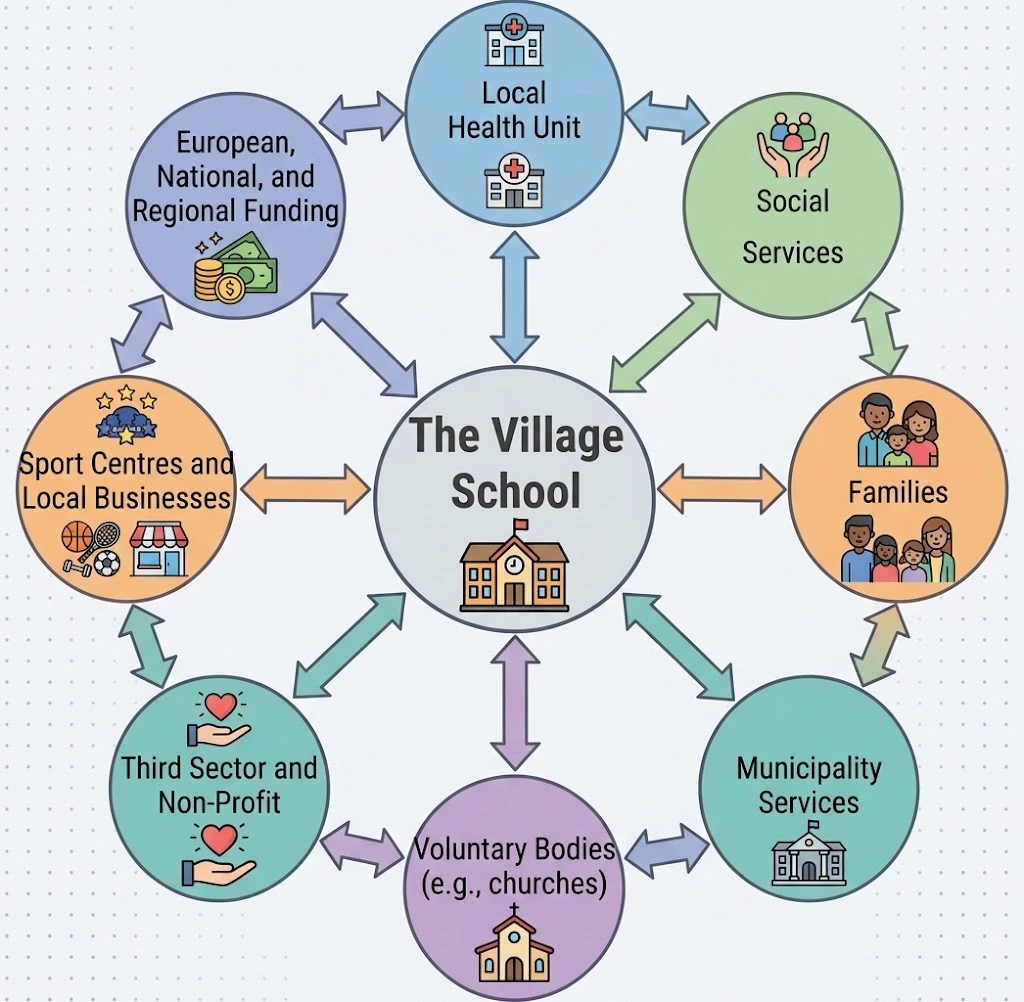
Below is a representation of the various services that contributed to building the support network for Mark's school inclusion:
● The Village School
● Local Health Unit
● Social Services
● Families
● Municipality Services
● Voluntary Bodies (e.g., churches)
● Third Sector and Non-Profit
● Sport Centres and Local Businesse
● European, National, and Regional Funding
Change Ripple
Review the significant changes in this 'Change Ripple' infographic. Click image to enlarge
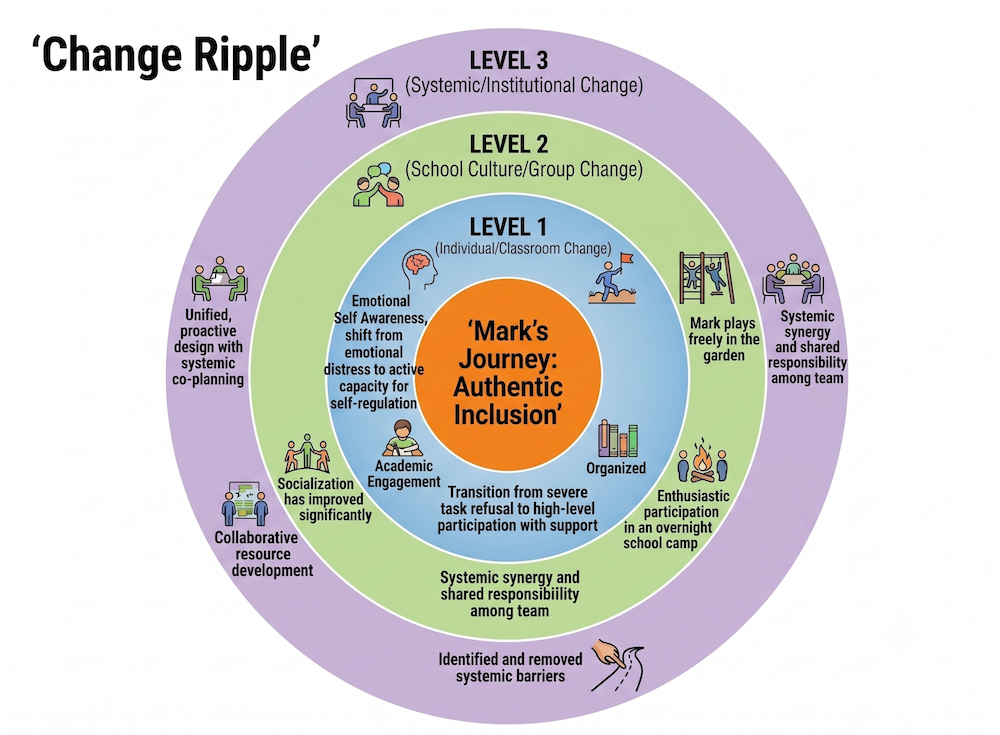
This analysis follows the Most Significant Change (MSC) methodology, a participatory form of monitoring and evaluation focused on identifying impactful shifts within social and educational programs.
1. Predefined Domains of Change
Pupil Social and Emotional Wellbeing
- Pedagogical Practice and Teacher Collaboration
Socio-Economic and Community Integration of Families
2. Observable Changes
(1) Teacher pedagogy / approach: Teachers shifted from standard instruction to using iconic mediators, concept maps, and non-verbal tools (music, art, acting). Teachers implemented alternative music notation (symbols instead of traditional notes). Teachers stopped relying on exemptions and instead provided compensatory tools and strengths-based activities. The seating layout was changed to place the pupil in a central island. Teachers integrated daily routines (e.g., "Morning Greeting," lunchtime tasks) to structure the day. Teachers engaged in multi-agency co-operation to secure employment for the mother and dental care for the pupil.
- (2) Student engagement: Mark stopped hiding under desks, making zero eye contact, and crying uncontrollably. He began trusting educators and laughing. He learned to read and write and began expressing his thoughts without fear of making mistakes. He adopted proper cafeteria etiquette (using cutlery correctly, not speaking with his mouth full). He sustained his attention for longer periods. He actively raised his hand to contribute to class discussions. He successfully participated in an overnight school trip with classmates.
3. Candidate Most Significant Change
The single most impactful organisational and pedagogical shift was the transition from an isolated classroom intervention to a holistic, community-wide support network (involving the school, local health authority, social services, and the third sector). By addressing the family’s socio-economic barriers alongside the implementation of a highly individualised, strengths-based pedagogy, the teaching team removed the external stressors inhibiting Mark's engagement, directly enabling his profound academic and social transformation.
4. Stakeholder Mapping
Student: Mark
- Family: Mark’s mother, father, and siblings
- School Staff: Mainstream Teachers (Linguistic-Expressive and Logical-Mathematical), Current and Former Special Education Teachers, Educational Support and Communication Assistants (OEPAC), Maria (Lead Teacher/Instrumental Function for Student and Family Support).
- Peers & Community: Classmates, Classmates' parents (Parent Representative), Retired teacher volunteers.
External Agencies: Local Health Authority (ASL RM1), Social Services, Cleaning co-operative serving a local hospital, Local parishes, Third Sector/Non-profit organisations.