
7th-Grade Visual Arts Classes
In this text, I present the general guidelines of the City of Porvoo regarding preparatory education for immigrants in basic education. I briefly define the foundations of language-aware teaching and examine the practical implementation of preparatory education in 7th-grade visual arts classes. I evaluate the activities on a general level and reflect on observed challenges, successes, and areas for development.
Story
The 2025 curriculum for preparatory education for basic education in Porvoo describes the immigrant student's path toward integration.
Immigrant students participate in preparatory education if their language skills are insufficient to follow instruction in a mainstream group. Simultaneously, the aim is to ensure the student's readiness to receive and understand new instructional situations, the environment, culture, and customs.The idea is to enable an understanding of both the student's original culture and the new culture in ways that serve the best interests of the child, supporting their growth and development.
In Porvoo, this means, for example, introducing the bilingual culture to families so that a free choice between the Swedish and Finnish languages is possible.
The placement of a child in basic education is determined by their initial learning level.
Ages 6–10: Offered a minimum of 900 hours of preparatory education.
Older students: Offered a maximum of 1,000 hours.
In practice, students entering grades 1–2 are placed directly into teaching groups with sufficient support. For older students, group-based preparatory education is organized, usually for about one year.
The goal is to join a mainstream group as soon as the student’s skill level allows them to follow the instruction.
Integrated Preparatory Education (Grades 1–2)
When a child enters school at the primary age (approx. 6–8 years), they study with a mainstream group from the beginning. In these cases, the student studies with the mainstream group for the first year (approx. 900 hours) but with the support of a preparatory education teacher. In Porvoo, some hours can be—and often are—differentiated into group-based study.An individual learning plan is drawn up for the students to build a learning entity suited to the child's development.
Group-Based Preparatory Education
Preparatory education for students in grades 3–9 can be either entirely group-based or partially integrated into mainstream groups.Arts and crafts subjects are also included in the timetable.The instruction aims to be entirely language-aware while supporting and opening up opportunities for the child's development and future.
Language-Aware Teaching
Language-aware teaching refers to operational models created through teacher collaboration, where the central importance of language is recognized in learning, instruction, assessment, and all school activities. In language-aware teaching, learning is seen as highly interactive—both between people and between the written text and the reader.
From the perspective of preparatory education, the goal of language-aware teaching relates to the amount and timeliness of support.The objective is to foster students' independent action and their ability to make autonomous decisions without adult support. Language-aware teaching provides tools for this, such as the scaffolding model. In this approach, work is phased from teacher-regulated collaborative activity with the group toward eventually becoming student-regulated activity.
Supported Instruction in Mainstream Groups
Students in preparatory education are entitled to the same special education services as students in general basic education. Similarly, a study counselor is involved in setting realistic goals for further studies.
Forms of support vary according to the students' needs. For example, long texts can be shortened, the amount of homework reduced, and oral exams can be facilitated. Additionally, special education teachers may help create differentiated learning modules. Plain language texts, audio materials, and adapted assignments are also utilized.
Here are some examples of the work of preparatory education students in 7th-grade visual arts classes. During the first lesson, the preparatory class teacher is present alongside the 7th-grade students.The teacher supports the students with art-related vocabulary, encourages them to use the Finnish language, and aims to help them integrate into the group's regular activities whenever possible.
Cleaning up, group work, and distributing materials are excellent opportunities for students to interact with the mainstream group in everyday situations. In visual arts classes, numbered written instructions are available to all students and remain visible throughout the lesson.These provide structure for everyone, en- suring that students do not have to rely solely on remembering everything from the teacher’s introductory talk.
Instructions are also demonstrated through examples, and specialized techniques are introduced by doing. Some topics are supplemented with images and/or videos. Basic artistic vocabulary is written into notebooks with all students. Furthermore, immigrant students are provided with "support vocabulary" in addition to these basics.This support vocabulary is left visible on post-it notes during lessons to make experimenting with and using the language easier.
During lessons, the teacher circulates among all students and, if necessary, helps by providing examples or "hand-over-hand" guided lines. In practice, during these rotations, preparatory students are met in the same way as mainstream students; the only difference is the language.The teacher demonstrates in practice where new words and phrases are used and supports learning through their own example of language use.
The most significant challenges relate to the excessive use of translation software, limited time for group integration, and the identification of learning disabilities.
Integration lessons for preparatory students are specifically intended for practicing the everyday use of the language. However, students often want to focus primarily on the subject matter and learn the same content as their peers. Using Finnish slows down their progress during lessons, which is a frequent source of frustration for immigrant students. Consequently, there is a strong temptation to use quick translation apps or revert to English.
Another issue involves group integration (ryhmäytyminen).
There isn’t always enough time during lessons for the level of integration that immigrant students would require. Teachers face a challenge in balancing the delivery of curriculum content while simultaneously facilitating learning for children coming from diverse linguistic backgrounds.
For subject teachers, it is sometimes difficult to determine how much to focus on the actual subject matter with preparatory students versus prioritizing language acquisition. Fundamentally, the teacher uses Finnish with all students, assists with examples when necessary, and encourages independent experimentation.
Each student is also an individual learner. Sometimes, underlying learning difficulties may be overshadowed by the language learning process. It can be difficult to discern whether a student's struggles stem from challenges in perceiving a new language or if there is an underlying learning disability that might require a different type of support.
Successes are those moments when immigrant students dare to use Finnish as a spoken language,are successfully included in group work, or spontaneously join in conversations with other students while working. Other successes include shared cleanup moments, distributing notebooks, and experimenting with new tools—situations where everyone is trying something new together.
Success is visible in moments when a student gains the confidence to use Finnish, participates spontaneously in discussion, or integrates into group work. Successful collaborative tool trials and cleanup sessions also build a sense of inclusion.The teacher's role in creating an immediate and equal atmosphere is crucial.
At their best, misunderstandings are transformed into shared understanding.
The most critical area for development is group integration. Because students in preparatory education participate only in some lessons, authentic friendships and intercultural exchange often remain superficial. Group integration should be a shared strategic goal for the entire school, rather than just the effort of individual teachers.
Language-aware teaching is still taking shape in Porvoo. It requires a shift from individual experiments toward structural changes, such as themed months and pedagogical planning starting from the leadership level. Language acquisition and group spirit should support each other seamlessly.
In visual arts classes, development needs relate to the lack of co-planning time. The preparatory education teacher is a top professional who does everything possible for the students. However, the work should be more systematic and proactive. In the current situation, immigrant children arrive on short notice, and many changes can occur within a single week. Operating models should be built in advance to handle this fast-paced environment, allowing subject teachers to function without stressful surprises.
There is also much work to be done in engaging students in mainstream groups to facilitate integration. Group integration is school-wide work that is constantly evolving and changing. Plays, collaborative artworks, events, and other shared activities enable groups to participate in the integration process.
Significant Change
1. Identify Domains of Change
Based on the provided narrative, the story fits into the following predefined domains of inclusive education:
- Social Inclusion and Intergroup Dynamics: Shifts from superficial interaction to shared collaboration during cleanup, material distribution, and group work.
- Student Agency and Communication Confidence: Transitions from reluctance, reliance on translation software, or frustration to daring to use spoken Finnish and participating spontaneously in conversations.
- Pedagogical Practice and Teacher Capacity: Development toward language-aware teaching, utilizing scaffolding models, visual instructions, support vocabulary on post-it notes, and co-teaching strategies.
2. List Observable Changes
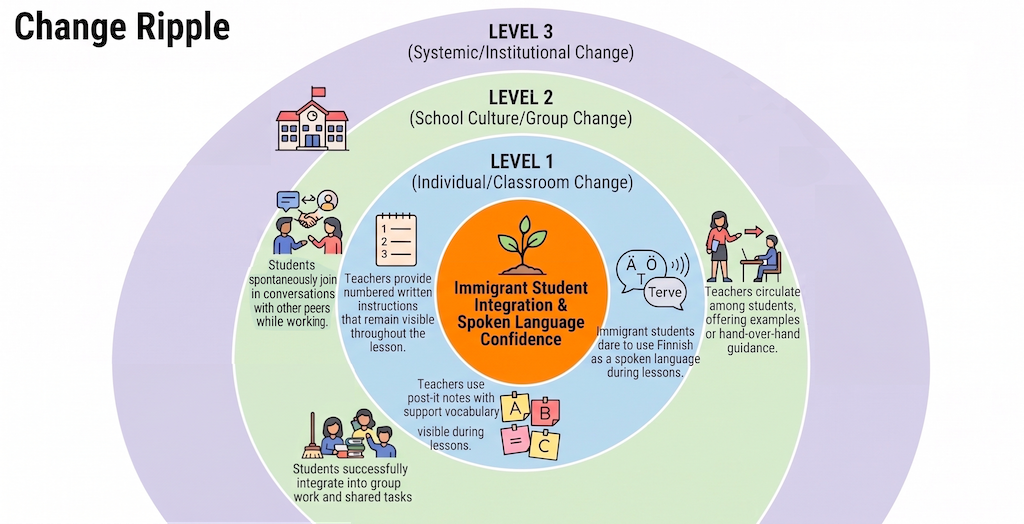
- Immigrant students dare to use Finnish as a spoken language during lessons.
- Students spontaneously join in conversations with other peers while working.
- Students successfully integrate into group work and shared tasks such as cleanups and distributing notebooks.
- Teachers provide numbered written instructions that remain visible throughout the lesson.
- Teachers use post-it notes with "support vocabulary" left visible during lessons.
- Teachers circulate among students, offering examples or hand-over-hand guidance.
3. Suggest Candidate Most Significant Change
- Candidate MSC: Immigrant students transitioning from relying on quick translation apps, engaging in peer conversations, and collaborating naturally during shared tasks like cleanup or art projects.
4. Stakeholder Mapping
- Immigrant Students: Newly arrived students in preparatory education (ages 6–10 and older students in grades 3–9).
- Mainstream Students: 7th-grade peers in regular classes.
- Teachers: Preparatory education teachers, mainstream subject teachers (specifically visual arts teachers), and special education teachers.
- Support Personnel / Experts: Study counsellors.
- Families: Immigrant families introduced to bilingual culture.
Change Ripple
Review the significant changes in this 'Change Ripple' infographic. Click image to enlarge
Reflection Prism
From a pedagogical standpoint, the narrative exemplifies the transition toward language-aware teaching and the scaffolding model. By moving from teacher-regulated instruction toward student independence using visual instructions, demonstration, and "support vocabulary" on post-it notes, the teacher bridges the gap between content delivery and language acquisition. However, the text underscores a critical tension in teacher capacity: the lack of systematic co-planning time and structural support can turn fast-paced, unpredictable integrations into stressors for subject teachers. Sustainable inclusion requires shifting from individual teacher experiments to structured, school-wide pedagogical planning.
This narrative highlights the delicate psychological balance between the anxiety of linguistic isolation and the intrinsic motivation to belong. For immigrant students, the classroom can be an overwhelming space where fear of falling behind or the frustration of slow progress sparks a heavy reliance on translation apps. Emotional resilience is forged in micro-moments, such as when a student gathers the courage to drop the translation tool and experiment with spoken Finnish. Cultivating safety through equal atmospheres and visible support transforms anxiety into belonging, enabling students to move from passive isolation to active emotional investment in the classroom community.
Sociologically, the narrative exposes the friction between superficial multicultural integration and true community cohesion. While shared tasks like cleanup and art projects foster immediate, equal interactions, systemic barriers, such as limited time for group integration and a lack of school-wide strategic goals, often keep intercultural exchange superficial. Addressing these structural hurdles requires moving beyond isolated classroom efforts to integrate language acquisition and group spirit across the entire school ecosystem through collaborative artworks, events, and shared community-building practices.
While individual teacher commitment is high in this example, the primary area for improvement is moving group integration from a classroom-level activity to a shared, school-wide strategic goal, supported by leadership-level planning rather than relying on isolated experiments. Organisationally, this demands addressing critical systemic bottlenecks, specifically the lack of dedicated co-planning time for preparatory and subject teachers. Increase focus on more whole-school community-building events and activities including themed months, cultural events and collaborative artworks.