
Social Mediation, Mentoring and Inclusion:
Building a Sense of Belonging.
The fifth-grade class presented a diverse educational context, including migrant students, learners benefiting from additional support measures and pupils with different learning profiles and needs.
Fifth Grade Story
The fifth-grade class presented a diverse educational context, including migrant students, learners benefiting from additional support measures and pupils with different learning profiles and needs. At the beginning of the school year, several challenges were identified, including difficulties in peer relationships, limited participation by some students, fear of making mistakes, low self-confidence and barriers affecting the inclusion of migrant learners.
In response, the school developed a collaborative intervention involving the Student Social Integration Support Office (GAISAE), the Intercultural Club, teachers, the school leadership, and a mentor from the ”Teach For Portugal” programme. Together, they aimed to create a learning environment where every student felt safe, valued and able to participate fully in school life.
The intervention combined social mediation, emotional support, intercultural inclusion and learner-centred pedagogical practices. Activities included conflict mediation, citizenship education, social and emotional learning, individual support, collaborative learning methodologies and projects designed to strengthen participation and belonging. Particular attention was given to building positive relationships, encouraging students to seek help when needed and helping them understand that mistakes are a natural part of learning.
Reflecting on the purpose of the intervention, J., the ”Teach For Portugal” mentor, explained:
"We wanted every student to feel that they belonged. Academic success was important, but so was developing the confidence, social skills and emotional competences that would allow students to participate fully in school and in their communities."
The impact of this work can be illustrated through the experiences of three students.
M., a student of Angolan origin, benefited from selective support measures due to learning difficulties. Initially, she appeared insecure, participated little in class and experienced difficulties in her interactions with peers. Through her participation in the Intercultural Club and the support provided by GAISAE, she found a space where her cultural identity was valued and where she could develop positive relationships. Over time, M. became more confident, participated more actively in classroom activities and demonstrated greater motivation towards learning.
Her Special Education teacher reflected:
"M. gained confidence and began participating much more actively in classroom activities. Today, she seeks out her classmates and genuinely feels that she belongs."
P. faced different challenges. He frequently experienced conflicts with peers and often struggled to regulate his emotions. Through individual emotional support, peer mediation sessions and the reinforcement of classroom agreements based on respect and collaboration, he gradually developed more constructive ways of interacting with others. As the school year progressed, conflicts became less frequent, his emotional self-regulation improved and his relationships with classmates and teachers became more positive.
One of his class teachers noted:
"P. progressively learned to resolve conflicts through dialogue. He became more willing to listen to his classmates and his relationship with the group improved significantly."
I. joined the class during the school year after arriving from Brazil. Adapting to a new educational environment, she presented some challenges related to social integration and belonging. Through the support of GAISAE and her participation in the Intercultural Club, she was welcomed into a space that celebrated diversity and encouraged participation. Gradually, she built friendships, became actively involved in school activities and developed a strong sense of belonging to her new school community.
Reflecting on her experience, I. stated:
"In the Intercultural Club, I felt that I could talk about my culture and learn about other cultures too. That helped me make friends and feel that this school is also mine."
While these individual journeys were significant, the most important changes occurred at the level of the whole class.
At the beginning of the year, many students were reluctant to participate, feared making mistakes, and were hesitant to ask for help. Some migrant students remained isolated from their peers and collaboration among students was limited. To address these challenges, teachers and the ”Teach For Portugal” mentor worked intentionally to build a positive classroom culture. Students co-created classroom agreements focused on respect, collaboration and mutual support. Reflective activities encouraged them to learn from mistakes and recognise their progress, while collaborative learning strategies strengthened relationships and peer support.
One particularly meaningful initiative was the creation of a Class Diary project. Developed collaboratively by students, teachers and the mentor, the project encouraged reflection, teamwork and shared ownership of the class experience. At the end of the school year, students proudly presented their work to other classes, demonstrating a strong sense of belonging and pride in their achievements.
Reflecting on the evolution of the class, J., the ”Teach for Portugal” mentor, highlighted:
"The most significant change was the growth in students’ sense of belonging. At the beginning, many students were withdrawn, afraid of making mistakes and unsure of their place within the group. By the end of the year, they participated more confidently, supported one another and felt that the classroom was a safe place where they could learn, contribute and be themselves."
Evidence of this transformation became visible throughout daily school life. Students increasingly helped one another during learning activities. Learners who experienced difficulties began studying alongside classmates who could support them. Migrant students became more integrated into peer groups, participated more actively and developed stronger friendships. Participation in classroom discussions increased and students became more comfortable expressing their ideas and asking for help when needed.
The success of this process was also supported by the commitment of the school leadership. By promoting collaboration between professionals and encouraging a shared vision of inclusion, the school created the necessary conditions for meaningful and sustainable change.
Reflecting on the experience, the school principal stated:
"What makes me most proud is not only the progress achieved by individual students, but the way the whole class learned to grow together. Inclusion happens when every student feels that they belong and that their voice matters. This experience showed the importance of bringing together different professionals, perspectives and forms of support to ensure that no student is left behind."
From a Most Significant Change perspective, the most important transformation was not simply improved behaviour, greater participation or stronger academic engagement. The most significant change was the development of a genuine sense of belonging and inclusion within the school community.
Through the combined efforts of GAISAE, the Intercultural Club, teachers, the ”Teach For Portugal” mentoring programme and school leadership, students moved from a position of uncertainty and hesitation to one of greater confidence, participation and connection. They learned that their voices mattered, that differences could be valued and that asking for help was a sign of growth rather than weakness.
This experience demonstrates that inclusion is built through relationships. When students feel safe, respected, heard and valued, they become more willing to engage with learning, support others and participate actively in school life.
The story of this class highlights a broader lesson for schools: meaningful inclusion is achieved through collective commitment. When leadership, teachers, support services, mentoring programmes, students and families work together, schools can create environments where every learner feels connected, empowered and capable of succeeding. The most significant change observed in this class was therefore the strengthening of students’ sense of belonging, a transformation that was reflected in stronger relationships, increased confidence, greater participation and a more inclusive school community.
Significant Change
Domains of Change
Inclusive Education; Social Inclusion; School Belonging; Emotional Well-Being; StudentParticipation; InterculturalIntegration; ClassroomEnvironment; Social and Emotional Competencies; Collaborative Learning; Educational Leadership.
Observable Changes
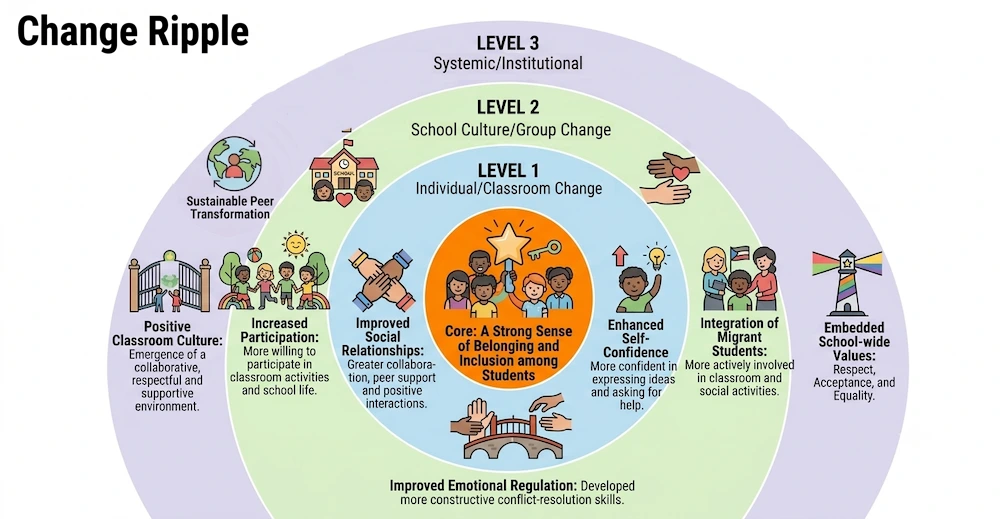
- Increased Participation: Students became more willing to participate in classroom activities and school life.
- Strengthened Sense of Belonging: Students developed stronger connections with peers, teachers and the wider school community.
- Improved Social Relationships: Greater collaboration, peer support and positive interactions among students were observed.
- Enhanced Self-Confidence: Students became more confident in
- expressing their ideas, asking for help and engaging in learning.
- Integration of Migrant Students: Migrant students became more actively involved in classroom and social activities, forming stronger peer relationships.
- Improved Emotional Regulation: Students experiencing difficulties with peer relationships developed more constructive conflict-resolution skills.
- Positive Classroom Culture: A more collaborative, respectful and supportive learning environment emerged.
Candidate Most Significant Change
The most significant change was the development of a strong sense of belonging and inclusion among students, reflected in greater confidence, participation, peer support and engagement in school life. Through a collaborative and multidisciplinary approach, students moved from feelings of hesitation and isolation to becoming active, valued and connected members of their learning community.
Stakeholder Mapping
Students (including M., P., I. and their classmates); Families; Class Teachers; Special Education Teacher; GAISAE Team; Intercultural Club; Teach For Portugal Mentor; School Leadership; Educational Support Staff; Wider School Community.
This change was considered the most significant because it transformed how students perceived themselves, how they related to others and how they engaged with school life.
At the beginning of the school year, many students demonstrated insecurity, reluctance to participate, fear of making mistakes and limited confidence in their ability to contribute. Some migrant students remained socially isolated, while others struggled with peer relationships and emotional regulation. Although these challenges manifested differently across students, they shared a common consequence: a reduced sense of belonging within the school community.
The intervention created opportunities for students to experience acceptance, support and success. Through social mediation, intercultural initiatives, emotional support, collaborative learning and positive classroom practices, students gradually developed stronger relationships and greater confidence in themselves and others.
The significance of this transformation lies not only in the observable improvements in behaviour, participation or social integration but also in the deeper shift in students' identities as members of the school community. Students increasingly saw themselves as valued contributors whose voices mattered and whose differences were respected.
This change also had a wider impact on the classroom and school environment. As students became more connected and collaborative, the learning environment became safer, more inclusive and more supportive for everyone.
From an inclusion perspective, the most significant aspect of this story is that students moved from simply being recipients of support to becoming active participants in a community where they felt recognised, respected and valued. The development of belonging became the foundation upon which confidence, participation, well-being and learning could flourish.
This story demonstrates that belonging is a powerful driver of inclusion. Students are more likely to participate, learn and develop positive relationships when they feel safe, valued, and connected to their school community.
The experience also highlights the importance of addressing social, emotional and relational dimensions of inclusion alongside academic support. Building positive relationships, valuing diversity and creating opportunities for meaningful participation can significantly enhance students' well-being and engagement.
Reflection Prism
From a pedagogical perspective, this story highlights the importance of creating learning environments that address both academic and socioemotional development. The intervention extended beyond traditional teaching approaches and intentionally fostered collaboration, reflection, participation and student’s voice.
The Teach For Portugal mentor played a significant role in supporting teachers to build a classroom culture based on respect, shared responsibility and positive reinforcement. Co-constructed classroom agreements, reflective activities, collaborative learning methodologies and the Class Diary project enabled students to become active participants in their own learning processes.
Importantly, the intervention recognised that educational success depends not only on content acquisition but also on students' confidence, relationships and willingness to engage. By integrating social and emotional competencies into daily classroom practices, the school created conditions that supported learning for all students.
The story demonstrates that inclusive pedagogy is most effective when students are empowered to participate, collaborate and contribute meaningfully to their educational experiences.
From a psychological perspective, the story illustrates the importance of belonging, emotional safety and positive relationships in supporting student development. At the beginning of the school year, several students displayed low confidence, reluctance to participate and fear of making mistakes. Some migrant students also experienced uncertainty regarding their place within the peer group and the wider school community.
The intervention created opportunities for students to develop self-confidence through positive experiences, supportive relationships and meaningful participation. Students learned that mistakes were acceptable and could be viewed as opportunities for growth rather than evidence of failure. This shift reduced anxiety around participation and encouraged greater engagement in learning.
For M., increased confidence emerged through the recognition of her identity and strengths. For P., emotional support and mediation contributed to improved self-regulation and interpersonal relationships. For I,, feeling welcomed and valued strengthened her sense of security and belonging.
The most significant psychological change was the transition from insecurity and hesitation to confidence, participation and a stronger sense of personal value.
From a sociological perspective, the most significant aspect of this story is the strengthening of social inclusion through participation and relationship-building.
At the beginning of the year, social interactions within the class were often limited by cultural differences, insecurity and difficulties in peer relationships. Some students remained on the margins of classroom life, while others struggled to build positive relationships with their peers.
The combined work of GAISAE, the Intercultural Club, teachers, and the Teach For Portugal mentor created opportunities for students to interact, collaborate and learn from one another. Shared activities encouraged mutual understanding, respect for diversity and stronger peer connections.
As relationships improved, students increasingly supported one another, both socially and academically. Migrant students became more integrated into friendship groups, while collaborative learning practices strengthened social cohesion.
This experience demonstrates that inclusion is fundamentally a social process. When schools intentionally create opportunities for interaction, participation and recognition, they strengthen students' sense of belonging and contribute to more inclusive educational communities.
From an organisational perspective, this story demonstrates the importance of leadership in creating the necessary conditions for inclusive practices to flourish.
The positive changes observed were not the result of a single intervention but emerged from a coordinated effort involving school leadership, teachers, support services and external partners. The school's commitment to collaboration enabled different professionals to work together around shared goals and respond to the diverse needs of students.
The involvement of the school leadership helped establish a culture where inclusion was understood as a collective responsibility rather than the responsibility of individual professionals. This facilitated multidisciplinary collaboration, strengthened communication between stakeholders and supported the implementation of sustainable practices.
The experience illustrates how leadership can play a crucial role in fostering inclusive school cultures by promoting shared vision, collaboration and responsiveness to student needs.